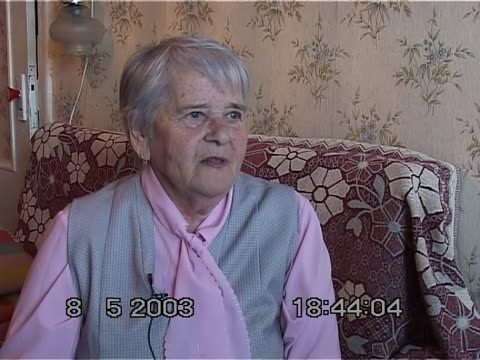
Talks with Kerler about prewar cultural life in her shtetl. She comments on differences of speech between streets and on a proverb, and on the term for an older grandmother. She names Warsaw Yiddish periodicals (Moment, Der Shtern) that were read, and recalls klezmer and singers coming from Luts'k to perform. She also remembers the first car in the street, a Jewish teacher who taught singing, a strongman, and touring actors, though she was a small child then.
Includes dialect remarks on street speech and kinship words, the periodicals read, and memories of the first car and a Jewish singing teacher.
Answers Kerler's questions about prewar religious life: whether there were Hasidim, and yeshivas (young men studied in Rivne rather than locally). She is asked what rov, rebbe, rabiner and a 'good Jew' mean, and the term 'gut ort' for a cemetery. Her answers are brief and in places uncertain.
Dialectological questions with Kerler: plural forms of rov and rebbe, and what Jews from Belarus, Lithuania, Galicia and Volhynia were called (litvak, galitsyaner, volynyaner). She is also asked the meaning of tsadik and misnaged. She says her community had no Lithuanian Jews and does not know the word misnaged.
Answers Kerler's questions on Jewish weddings before the war: the khupe and rabbi, the matchmaker who brought the couple together, and the written engagement terms (tnoim). She is asked about the mitsve-tants, the broyges-tants, in which the two mothers mime a quarrel and make peace, and the badkhn. She knew these customs by name but did not see them herself.
Food and drink terminology with Kerler: how her mother made gefilte fish and whether it was called chopped fish, with the seasoning and the onions and a little sugar. She names fruits that grew locally, and is asked the Yiddish for vodka, tomatoes, grapes and raisins. Kerler explains that he is looking for speakers from near Kovel. She gives him the whereabouts of a Luts'k-born friend living in Lviv, whose wife is from her shtetl.
Adds a sidetrack in which she names a friend in Lviv as a possible further informant for Kerler's dialect survey.
Talks about folk and other remedies: blessings for health, the question of children's games with several local names for an item, and her grandmother's cures. She recalls a Jewish doctor from Luts'k who treated her family, and a brother's facial growths treated on his advice, which included eating raw calf's lung. Kerler also asks about spoken charms against evil, and she mentions wiping off with the tongue and wiping the forehead.
Terminology and beliefs around death: the dybbuk and the golem, the angel of death, Jewish funerals (the bier carried by several men, and crying), and Yiddish words for a cemetery. They discuss this world and the next, and the word for hospital (balnitse versus the older, Polish-derived shpitol). She is also asked formulas used when mentioning the dead, such as a wish that the dead person plead for the living and a wish for a bright paradise.
Adds the dybbuk, golem and angel-of-death questions and the hospital-word discussion to the funerals.
Shvardovskaia, asked by Kerler to speak of the war, describes first the Polish period, then two years of Soviet rule with closed shops, and the arrival of the Germans in 1941. Jews were confined as in a ghetto, forced to hand over valuables, and the first skilled Jewish worker was killed at once. She describes Jews thrown into pits and shot, her escape and flight into the woods, and a Ukrainian acquaintance who hid her in an attic, where her father and a sister joined her for three months. Later they hid for a year in the forest, fed at night by Ukrainians, escaped a second shooting, moved between villages, and finally joined Russian partisans. She mentions that her father and brother were killed; the details are unclear in the transcript.
Adds the Polish and Soviet periods before the Germans, and an uncle and aunt hiding in another village.
Briefly recounts what happened after the war. After the partisans she went with her unit to the Carpathians and worked in a hospital for wounded soldiers, and the military commissariat then assigned her to a military hospital. Kerler remarks that his mother also became a nurse. She reflects on how the survivors felt, wild and unlike normal people, and on her age.
Continues with her army service in hospitals in Poland, Czechoslovakia and Hungary. She did not know that her sister had been evacuated to Kharkiv, and she found her there. She returned to Luts'k, married, and worked as a nurse for 55 years. She has a son in Luts'k with three children, and a granddaughter in Israel; her husband has died. She moved to Israel to be near family, in Bat Yam, but pined for Luts'k and came back, and she is now unsure whether to help the granddaughter who wants to return. Kerler ends by saying he has language questions to ask in Russian.
Adds that she found her sister in Kharkiv without knowing she was there, her husband's death, her son's family in Luts'k, and that Kerler turns to Russian-language questions at the end.