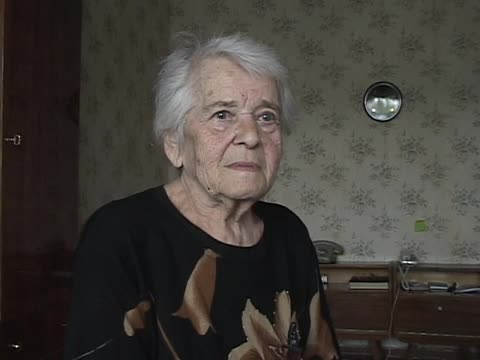
Arrival chatter and small talk before the interview: Kerler and Lemster talk with the interviewee about their travels in Romania and her health. She mentions a book about Trokhinbrod that her grandson bought in Kyiv. Kerler explains that this is an interview in which she will tell what she remembers.
Shvardovskaia gives her personal data: her Yiddish name, her Russian name and patronymic, her parents' names and her father's birth year. Both parents came from Trokhinbrod. Her maternal grandfather was a potter who dug clay pits and made pots and Passover vessels. She says there were four synagogues in town and that she was born in 1923.
adds the dialect form of the town name and the naming details (Yiddish and Russian names)
Asked about her early years, she describes Trokhinbrod as a Jewish town of tailors, shoemakers and other craftsmen. She compares Polish Jews with Bessarabian Jews and their Yiddish. She says she was taught Yiddish reading and writing by a private teacher at home, not in cheder, and read Sholem Aleichem. Youth organizations (halutzim, Communists, Betar) had a library, and Betar members spoke Hebrew. She later visited Israel and met people from Trokhinbrod.
She says she studied in a Polish school and that her father wanted her to go to gymnasium, but the Soviets arrived and she learned some Russian. Lemster asks about friends, and she names a surviving friend in Israel. She says she has no one to speak Yiddish with, her husband was Russian and her children became Russian speakers, while her son and grandchildren are in Israel.
adds her friends and the loss of spoken Yiddish in her family
Lemster asks about her family: she has one son, born in Kharkiv, three grandchildren and some great-grandchildren, one of whom will soon serve in the Israeli army. The conversation turns to the word for a grandmother who was also a midwife; her father's mother attended births and circumcisions. She says she has forgotten much Yiddish.
adds the terminology of the midwife grandmother and her loss of Yiddish
She briefly recalls Jabotinsky and dancing, then describes quiet prewar family life, poor but close. Her grandmother had two daughters and a son in America who sent money and clothes for holidays. Her grandmother prepared Sabbath dishes such as calves' feet jelly and kugel. She also discusses a second grandmother's family and the practice of having two Jewish names, her own and Kerler's included.
She speaks about Jewish names and a visiting rabbi, and says the whole town spoke Yiddish, while the youth spoke Polish and, in Betar, Hebrew learned from lectures. Meetings on Sabbath and outings to the forest are mentioned. Kerler asks about the distance of the town from Luts'k and the Yiddish word for 'other people'. She then recites Polish verse (Mickiewicz) with another voice and says she has forgotten much.
adds the Betar Hebrew, the distance question and the Polish poem recitation
She describes how she escaped from the execution pit where the Jews of the town were shot and fled while being shot at. Her father had told her to go to a Ukrainian acquaintance, who took her into the forest, where she spent about two years in cold and hardship. He brought food and, when Germans were near, left it in a canal. A younger sister also came. Kerler asks about the shooting and the Ukrainian nationalists.
adds the pit escape, the sister and the Polish-Ukrainian conflict
She explains that Jews called the town Trokhinbrod while Poles and Ukrainians called it Sofiyivka, and gives a story from her grandmother about its name: a man drove into the river, fell in and died, and the local landowner's wife was named Sofia. The town no longer exists. She also mentions a grandson who studies Torah and keeps kosher.
adds her grandson's religious observance and the name story
Kerler asks about her Hebrew teacher and joining Betar at ten or twelve; she recalls a shopkeeper teacher named Fishl (?). She mentions that girls learned sewing, and that young people put on their own theatre. Kerler then asks for Yiddish terms for ice cream and for breathing, and she answers.
She says she came to Luts'k in 1946 after the war. Partisans found them in the forest and she worked in a field hospital as a nurse, and afterwards in a hospital. Lemster and Kerler ask about postwar Luts'k, and she says its Jews were nearly all newcomers from Russia and she was the only local Jew from Volhynia.
She describes prewar Jewish weddings in Trokhinbrod with the chuppah, the custom of binding groom and bride and klezmer with bass and fiddle. Lemster asks about romance. She speaks of youth in Betar, dances and a young man named Eynshl Shpilman and a friend named Meir Drezner, later killed. She meets some in Israel.
Kerler asks about political organizations in the town before the war. She names Communists and Zionists, says there was no Bund, and mentions a Yiddish newspaper whose origin she does not know.
She describes Purim before the war, with baked goods and children dressing up, and says Jewish life was full and no one expected to be shot. Lemster asks about rich Jews, who were tanners or leather workers. She also tells of meeting by chance on a bus a man from Trokhinbrod, apparently Meir Shvarts (Schwartz) (?), with his non-Jewish wife who had adopted Judaism.
adds rich leather-working families and the meeting with a former townsman
Lemster asks about Jewish life in Luts'k after the war. She says Jews gathered in a private apartment on Sabbath and holidays, there was no synagogue, a man was imprisoned, and she fasted on Yom Kippur. Few knew when holidays fell; matzo came from Israel. Questions about minyans and schools follow, and Lemster asks for a Jewish story or anecdote, which she cannot recall.
adds the Sabbath gatherings, Yom Kippur and matzo from Israel
Kerler asks about mass graves; she says there are four memorials where thousands of Jews from Trokhinbrod and nearby villages were killed, and a mass grave of Luts'k Jews. She says relatives and people come to visit twice a year. She describes Luts'k as a largely Jewish city before the war.
Asked about Jewish trades in Luts'k, she lists doctors, shoemakers and shopkeepers, and says the best products came from Jews. Lemster and Kerler discuss the Luts'k memorial book, which has nothing on Trokhinbrod, and she mentions a Dr. Abramski (?) who treated them. She says she can still read Hebrew.
She says all non-Jews in Trokhinbrod understood Yiddish, since Jews outnumbered others, and tells of a Polish man's son who learned Hebrew. She lists Jewish occupations: shoemaker, tailor, miller, tanner, teacher, bakers (the Bas family), butchers. She describes the bathhouse and mikveh as separate buildings, going on Friday before Sabbath, the shoykhet, a Polish policeman and the post office as the only non-Jewish offices, and also mentions balagulas.
adds the bathhouse, mikveh, shoykhet and policeman