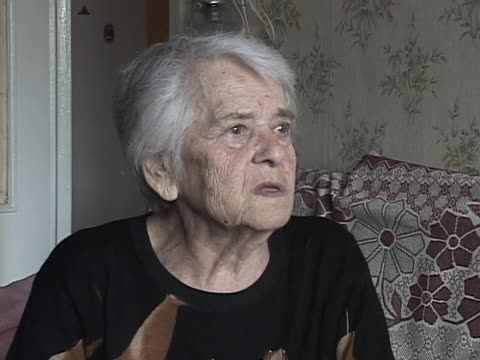
Shvardovskaia discusses who among her acquaintances spoke Yiddish, including a friend in Lviv, and says the family did not always speak Yiddish with visitors. She says she married in 1944 (?) after the war, with a matchmaker mentioned, and answers Kerler's question about the best time of her life. She names her army service as that time and recalls the end of the fighting and the question of where to go afterwards. A woman invited her to travel home to Kharkiv, and she mentions her husband.
The transcript shows talk about who spoke Yiddish, her army service as her best time, and the matchmaker.
Shvardovskaia says her husband was an engineer who trained at a factory, and that she was happy with him. She says no one survived from her mother's family. On her father's side a sister and her family went to America before the war. She mentions the longevity of an aunt and uncle and says she was one of seven children, five daughters and three sons (as heard).
The transcript shows her husband's occupation as an engineer, relatives who emigrated to America before the war, and the seven siblings.
Shvardovskaia says she has nothing more to add and longs for her youth. She says the Jewish character of her town no longer exists, the gravestones were taken, and only a few memorial stones remain. She describes a large commemoration with Jews from Israel and America and local Poles, Ukrainians and neighbours from the villages, and mentions a former partisan in Israel.
The transcript shows the destroyed cemetery, the few gravestones and the commemoration attended by neighbours.
Kerler and Lemster show a book about the town, with an English edition, and talk about the author and a film made there. Shvardovskaia compares the book and the film, mentions her grandchild, and talks in Russian about someone in Lviv and about relatives in Israel (Jerusalem) and America whose grandparents came from the town.
The transcript shows a book and film about the town being compared, and relatives in Israel and America.
Dialectological questionnaire, with Kerler asking most items and Lemster adding some. It covers greetings, kinship terms, words for house and rooms, and food and household words, and also the Yiddish for 'Christian', 'gentile' and Ukrainian-language terms. Further items are religious and folk terms such as dybbuk, golem, cantor, synagogue, dreidel and the evil eye, and sentences testing grammar and word choice. Shvardovskaia sometimes mentions her native town and its Jewish street.