0:00
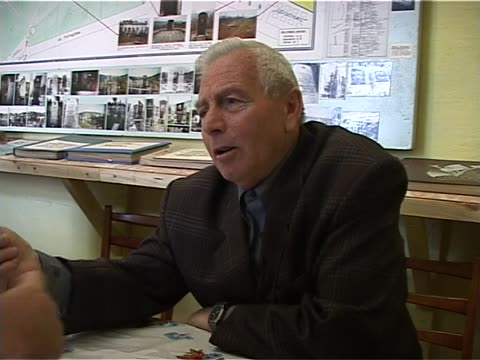
Kaplan expresses the view that Ukrainian Jews should care about their own history and laments how all the religious and scholarly Jewish leaders in today’s Ukraine are foreigners from USA and Israel rather than local Jews. Expanding on this point, Kaplan explains that organizations such as the Joint (American Jewish Joint Distribution Committee) and the Sochnut (The Jewish Agency for Israel) have unfairly encouraged post-Soviet Jews to leave the countries of their birth. He presents a series of reasons why he believes Jews in the former Soviet Union should not emigrate from their native lands: "I see it like this: one must not drive anyone away. In Ukraine, Russia, Georgia, indeed everywhere... Jews should still be living there because they have been living there for thousands of years already... so that Jewishness should be present throughout the world". Instead of making Jews leave their homes, states Kaplan, the Joint and other organizations should help them stay and maintain a good standard of living there. Kaplan further states his belief that if the leaders of these international Jewish organizations want to know the truth about Jewish life, they should come to the shtetlekh and smaller communities to see what happens there. Kaplan then details the activities of the town’s contemporary Jewish Sunday School, which is run by an educator from Vinnytsya who teaches Hebrew among other subjects. While Kaplan was born in 1933 in Mohyliv-Podil’s’kyy, his parents where born in smaller villages nearby. His mother Minikhe Velvls (who worked as a teacher of Russian language and literature) and her family came to Mohyliv-Podil’s’kyy from Ozaryntsi, a village 10km away. His father Duvid b”r Avrum (who worked as a soap maker) and his family came from Slydy. His paternal grandfather was “like a Rov” and was a bal-tfile (prayer leader) in his town’s synagogue. When the family moved to Mohyliv-Podil’s’kyy in 1924, this grandfather worked as a cantor. Kaplan takes great pride in his 30 years service in the army (starting in 1951) and is proud of the fact that his twin brother Lev/Leyb and grandchildren have also served. Kaplan grew up in a traditionally religious Jewish home, but did not learn in the local kheyder (religious school for boys), but with a melamed (private teacher) named Tseburskii for four years. From these lessons he learned numerous stories, how to pray, and how to read and write in Yiddish. While in the army, Kaplan says that he forgot how to read, write, and speak in Yiddish, only re-learning how to speak the language since returning to Mohyliv-Podil’s’kyy and working in the local Jewish community. His formal education was exclusively in Russian-language institutions.
Kaplan argues that Jews should not be pushed to emigrate from Ukraine, Russia or Georgia, and criticizes the Joint and the Sochnut. He asks why Jewish research is left to Americans, and says that visiting leaders and Jewish organizations should come to the small towns to see the truth. He recounts conversations with Kerler about politics, communism and the Zionist aim of bringing Jews to Israel. He also complains about leaders in Kyiv and Vinnytsya who give little help, about unfair distribution of trips abroad, and about corruption in the Jewish movement. He describes the Sunday school run by a teacher from Vinnytsya who teaches Hebrew, history and tradition. He gives his parents' origins in Ozaryntsi and Slydy and says his paternal grandfather served as prayer leader and later as cantor. He mentions the burning of Jews at Ozaryntsi in the war, his twin brother, his army service from 1951 and the army service of his son and grandchildren. He recalls studying with the melamed Tseburskii for four years, and says he later forgot Yiddish in the army and relearned speaking it in the community.
adds the Madlen Kann (?) / Kora Shvarts (?) gifts and contacts and the visit of a woman from Paris; Kerler's discussion of politics; and the Ozaryntsi burning.