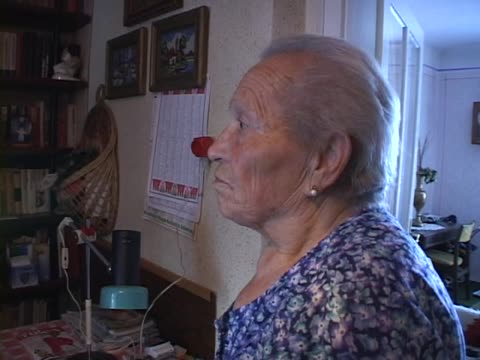
The first part of the tape includes a continuation of a formal interview, recorded in Solotvyno with Dora Abramovna Fiksler, born in 1924 in Solotvyno. Fiksler makes a number of phone calls, before they go inside to talk about Fiksler’s library, which includes prayer books. Fiksler then shows photographs of her family. Fiksler briefly talks about religious life before the war.
Fiksler makes a phone call or two, then shows her bookshelf. Kerler and Katz look at old Yiddish and Hebrew books, including a Yiddish Tsenerene-type book, a Humash with Yiddish translation, Haggadahs and a Soviet-era prayer book. She shows family photographs: her late husband, a grandchild and great-grandchild who speak Yiddish, and her brothers, one of whom died in Israel. Another brother's wife and daughter did not return from the camps. She says women went to synagogue only on holidays, and her son Yakov arrives at the end.
Also covers the phone calls and the Hungarian-language books she bought.
Fiksler’s son Iakob arrives. He provides biographical information and talks about his family. Iakob was born in Uzhhorod. He then talks about life today.
Fiksler's son Yakov arrives and speaks Yiddish with Kerler and Katz, who say they want to learn the proper local Yiddish. He mentions his birthplace (garbled in the transcript), his mother's teaching of Yiddish to the children, and his young daughter who speaks Yiddish well. He recalls a trip to Crimea. He compares credit and investment conditions in America and Ukraine and says life is hard for business. They discuss a roadside Jewish memorial seen on the way and plan a further visit, with Munkács as a destination.
Also covers Yakov's views on the economy, a memorial seen on the road, and plans to visit Munkács.
Fiksler tries to recite the morning prayer Modeh ani but says she has forgotten much of it. Yakov remarks on how hard it is to get prayer books and religious services nearby. She says that after the war the kosher meat came from a shoykhet in Khust once the Solotvyno one had left. Poultry was slaughtered locally. Kerler then asks her about the start of the war.
Adds Yakov's remarks on the lack of prayer books and that Munkács and Uzhhorod are too far.
Fiksler discusses life at the beginning of World War II during Hungarian occupation, including the social and political discrimination of Jews. Fiksler remembers non-Jews speaking Yiddish, and even a Romanian boy, who attended religious school (cheder).
Fiksler tells how Hungarian forces advanced into Subcarpathia in 1938–39, and how Jewish children were then barred from school and Jewish shops were closed. She remembers life being harder for Jews than for others, a Jewish doctor and dentists, and good non-Jewish friends who returned her belongings. She recalls a Romanian (Vlach) man who knew Yiddish and attended cheder with the Jewish boys, and says Solotvyno's mixed population spoke little Yiddish among non-Jews. Kerler leads her to the events of March 1944.
Adds the dates of the Hungarian advance, the closing of shops and the Romanian boy in cheder.
Fiksler discusses the last two years of World War II. She explains that she was forced to live in a ghetto in 1944, before she was taken to Birkenau. She was then deported to Austria and worked in a factory. She was liberated by the Americans in Austria. Fiksler then talks about her life after the war, and her search for surviving family members.
Fiksler says she was taken into a ghetto in April 1944 and deported in May to Auschwitz-Birkenau, where she was in a camp block and had no number. Her parents were killed there. She was then sent to Austria, worked at machines in a factory near Linz, and was liberated by the Americans. She decided to go home to look for relatives.
Adds that her parents were killed in Auschwitz and that she worked in a factory in Austria.
Fiksler talks about her return home. She explains that they knew nothing about the deportations before 1944. She then recalls the first days of Hungarian occupation in 1939.
Fiksler speaks of her return, when neighbors gave back what she had left with them but the fields were later taken into the kolkhoz. She says they knew nothing of the deportations before 1944 and recalls an older brother's worried remark when Hungarians first arrived. She also describes the mixed Hungarian and Romanian population of Solotvyno and the Jews living there. She mentions that her family kept Passover.
Adds the kolkhoz and fields, the older brother's remark and the town's mixed population.
Fiksler talks about Purim in the prewar period and about Purim shpiels, during which she would dress up in costumes. Fiksler talks about Yiddish-speakers today.
Fiksler recalls prewar Purim, when people dressed up and performed a Purim play, and she recites a short rhymed Purim verse. Her granddaughter is mentioned as one who could recall more. The group then arranges follow-up contact by phone and discusses where the family is travelling. Katz and Kerler ask about Yiddish speakers today, and the family says few remain in Solotvyno or Munkács and that her eight-year-old granddaughter may be the only child in the Carpathians who speaks Yiddish. They also touch on Polish Jews' Yiddish and on visa rules for travelling to Sighet.
Adds the recited verse, phone-number exchange, Yiddish-speaking grandchildren and the visa discussion.
The team travels to the next interview with Hershel Ylyevich Vider in Mukacheve. After they enter his apartment, the team sets up the formal interview with Vider, born in Mukacheve in 1922. He provides personal information and talks about his family. His three brothers moved to Canada after the war. Vider then sings a Hasidic song in Hungarian, before he talks about Jewish life in Mukacheve today. Vider laments that Yiddish is not passed on to the next generation.
In Mukacheve the team is welcomed by Vider, and Kerler explains their project of collecting interviews on Jewish life, history and Yiddish. Vider says he was born in Munkács in 1922 and now lives there, and that his three brothers left after the war. He speaks of a rebbe, mentions a Hungarian Hasidic song, and sings a song about a rooster and the coming of the Messiah. He laments that in Mukacheve about five hundred Jews, nearly all Russian-speaking, no longer pass Yiddish or Hebrew on.
Adds Kerler's explanation of the project, the song about a rooster and Vider's criticism of the local rabbi.
Vider recalls prewar Jewish life in his home town. He attended religious school (cheder). At home, he spoke Yiddish with his grandparents and Hungarian with his parents. Vider then talks about his family. His father served in the Austro-Hungarian army.
Vider recalls growing up in Mukacheve on a largely Jewish street opposite the largest cheder, where he studied. He says his mother was Hungarian-speaking and his father came from Sighet and had served in the Austro-Hungarian army. At home Yiddish was spoken, and his grandmother Toybe and great-grandmother Zisl spoke only Yiddish. Today, he says, Jews pray in Russian and Jewish organizations do too little to preserve Yiddishkayt.
Adds the Jewish street, his mother's background and the great-grandmother.