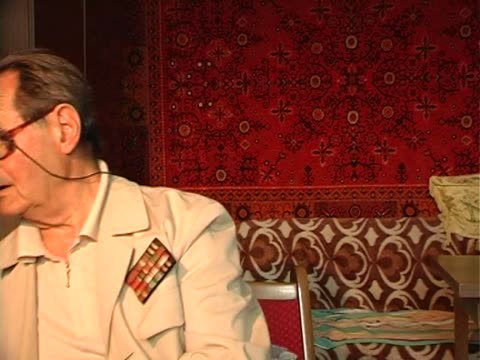
Endelshtein talks about his family after World War II, when he returned from his military service in 1945. He was involved in the memorialization of Jews who were killed in the synagogue and mass shootings during the war.
Endelshtein speaks about Romanians sending Jews from Odessa, Bessarabia and Moldova, and about relatives left in Bolgrad. He returned in 1945 and tells of memorials to people shot in Mykolayiv and at another place. He says Kaddish is recited there. Kerler asks how the word Kaddish was pronounced at home; there is a brief exchange about a book on Bolgrad, and the question moves to Purim.
The catalogue says he returned in 1945 from military service; the transcript adds the pronunciation of Kaddish and a book about Bolgrad.
Endelshtein answers questions about Purim in prewar Bolgrad: foods such as hamantashn-like pastries, reading the megillah, goose, and children's masks and play. He mentions a Jewish klezmer, Blender (clarinet), and the Purim-shpil. He then describes Jewish weddings, with the rabbi at the huppah, two rabbis in town, musicians, and a badkhn-like entertainer, and says that many of his classmates went to synagogue.
Beyond Purim and weddings, it covers klezmer musicians and the question of who attended synagogue.
Endelshtein talks about Jewish life in Mykolayiv today. He says young Jews marry Russians, that few attend the synagogue or events such as Victory Day, and that there is no one to speak Yiddish with. He mentions a Jewish school with about 180 children, many of whom have only one Jewish parent, and refers to Israel and Chabad. Lemster asks about Jews who went to Argentina from Bolgrad, and the question then turns to his army service.
Adds mixed marriage, the Jewish school, and the question of Argentina.
Endelshtein talks about his military service during the war, which he began in 1944, and his life during the war prior to the Red Army. As soon as the Germans invaded Bolgrad, his family escaped via Stalingrad, Kalmikye, Saratov, Svertlov, Orgentsh Kharenskover oblast Uzbekistan (there drafted and trained for two months. Then he served in West Ukraine, including Kerembol, volkskaya oblast, Chernivtsi, then Romania: Pleshtch, then Hungary: near Budapest, Uipesht (battle), he was injured. He finished his service in Dnepropetrovsk. He then talks about his military honors. He was in the division of cannon shooters with six other Jews.
Endelshtein tells where he was when the war began in Bolgrad. His family fled via Stalingrad and Saratov to Uzbekistan, where he was drafted and trained. He served in western Ukraine, Romania and Hungary, was wounded near Budapest, and was in hospital at Dnipropetrovsk. He names medals, including one for Budapest, serving as a machine gunner, and says six Jews were in his company. He says he felt no antisemitism in the army and tells how an officer helped with the registration of his name.
Adds the exchange about antisemitism, the name change, and finding no Jews in Hungary.
Endelshtein talks about his life after the war. He reunited with his mother in Dnepropetrovsk at the hospital. Endelshtein studied at the Moscow Institute for Folk 22:17, which he finished in 1950. During and after his studies, Endelshtein worked at a bank. He was the 22:50 of a bank for 64 years in Voznesenski, Russia.
Endelshtein says that after the war he found his mother in Dnipropetrovsk, his father having died, and no one left in Bolgrad. He studied at an institute in Moscow, finished around 1950 (?), and worked at a bank as cashier and controller. He was sent as bank manager to Voznesensk and worked in banking for 64 years, as he says. He says he had no one to speak Yiddish with.
Endelshtein talks about contemporary Jewish life in Voznesenski, as well as during the Soviet period. He then discusses the idea of Communism itself and in relation to Jewishness.
Endelshtein says about 80 Jews live in Voznesensk, none speaking Yiddish, and Kerler and Lemster say where they are from. He tells of a visit to the Moscow synagogue and a Jewish calendar he was given. He discusses Communism and Jewishness, saying he was a Communist and still a Jew, and that Communist ideas were good. The talk covers belief in God, a cousin who was a Communist imprisoned in Romania, and Trotskyism.
Adds the Moscow synagogue visit and a cousin imprisoned in Romania.
Endelshtein talks about his family and prewar Jewish life Bolgrad, in particular halutzim. He grew up as an only child. Endelshtein also mentions meeting a Jewish girl, who gave him a prayer book. The girl took the book from her grandmother after a mass shooting.
Endelshtein says he had no siblings. He is asked about Hasidim, Zionists and halutzim in Bolgrad before the war, and says his uncle left for Palestine in 1939 (?). He tells of meeting a Jewish girl who gave him a prayer book that came from her grandmother, who was killed in a shooting. The book was identified in Moscow as a Lithuanian siddur and he mentions Yad Vashem. He says his mother was found in Dnipropetrovsk, and gives the Bolgrad Jewish population before the war.
Adds the Zionist movement and halutzim, his uncle's departure and the siddur's origin.
Endelshtein says he came to Mykolayiv in 1989 (?) because he was ill and his children worked at a factory there. He has two daughters, one in Israel and one in Mykolayiv. Lemster asks about remaining Yiddish speakers there; he mentions a veteran in his 90s who speaks Yiddish, and talks about the veterans' council and a telephone number for him.
Adds the search for another Yiddish speaker and the veterans' council.
Endelshtein is asked about Yiddish theater visiting Bolgrad before the war: troupes came from Galați and Chernivtsi, and non-Jews also attended. He was a child and recalls little. Kerler asks about stories of Hershele Ostropolyer and dream interpreters, which he does not recall. The conversation closes with asking about Jews near Mykolayiv and the lack of Yiddish speakers.
Adds Hershele Ostropolyer stories, dreams and a search for Jews near Mykolayiv.