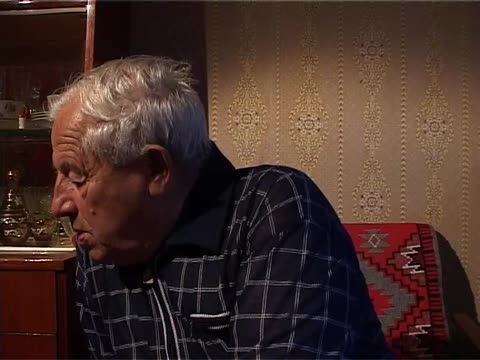
The first part of the tape is a continuation of a formal interview with Mikhail Vladimirovich Kenin. Kenin answers a series of dialectological questions from the AHEYM Yiddish linguistic questionnaire and about food customs.
Kenin answers questions on Hanukkah food: latkes made of potato, buckwheat and wheat flour, and the Hanukkah song. He is then asked for Yiddish words for flower, shop, ceiling beam, bridge, 'back', face and 'ugly', 'probably', and dreidel, and for a pious person's wish for the dead.
Includes many individual vocabulary items beyond food customs.
Kenin recalls his traditional Jewish wedding with a khupe and a rabbi, held after the war in 1946. He remembers Jewish klezmorim, men who led the bride to the khupe, and a badkhn (named Slanimski, uncertain) who told stories, sang and danced on the tables.
Street footage in Nizhyn, with talk in Russian with a woman neighbor. They mention the burial place of a great rabbi and that Kenin has been interviewed and is in poor health. She speaks of her children and acquaintances in Israel, a coming trip there, and a very low pension and high prices. She says life is bad economically and morally.
Content is largely Russian street talk about pensions, prices and relatives in Israel.
The team goes to the grave (ohel) of the Mitteler Rebbe, with a local guide. Katz explains that he is named Dovber after the rebbe of Lubavitch. There is a prayer or chant at the grave and talk about leaving a note.
The transcript does not clearly show Lipkovich; the passage is largely garbled.
The third part of the tape is a formal interview with Naum Ilyevich Masovich, recorded in Chernihiv. The team plans the interview with Masovich, born 1926 in Nizhyn. He briefly talks about his family. His father, an undertaker, was born in Nizhyn.
The team arranges an interview with Masovich in Chernihiv and asks him to stay for a conversation. Asked for the Yiddish name of Chernihiv and Nizhyn, he says his father was a caretaker at the Jewish cemetery in Nizhyn and lived there.
Includes a question about the Yiddish names of Chernihiv and Nizhyn.
Introductions among those present, with talk about the Yiddish names of towns: Snovsk (now Shchors), where one man was born, Konotop and Chernihiv. The interviewers ask how these were said in Yiddish and whether Masovich spoke Yiddish at home. He answers that his parents did.
Masovich shows photographs of his father, whose name sounds like Eliel (?), and of the father's sister and her child. His father died about thirty years earlier, and one photograph is dated 1965 (?). His father was a cemetery caretaker in Nizhyn and lived in a small house there. Kerler proposes a short interview.
The formal interview with Masovich begins. He provides personal information and talks about his family, including his father’s work as undertaker in Nizhyn. He also talks about his life before the war. His family left the town in 1941 and went into evacuation to Saratov, Russia.
The formal interview with Masovich begins with the date and the Jewish year. He gives his name, patronymic and surname, his Chernihiv address and phone number, and says he was born in Nizhyn in 1926. His father Elye, born in Nizhyn, worked at the cemetery with the burial society, was removed from it around 1929 and then worked in an artel making paints until the war. The family lived in Nizhyn until 1941 and then went into evacuation before returning to Chernihiv.
Masovich talks about his life after the war. His family lived in a communal apartment and shared the kitchen with two Christian families. He then talks about his family. He grew up with a brother, who was killed during the war.
Masovich recalls the postwar communal apartment in Chernihiv, where one Jewish and two Christian families shared a kitchen. His father hid under a wardrobe to put on tallis and tefillin so the neighbor would not see. His mother Khaye was a housewife. His brother Naftali, who graduated from the pedagogical institute in 1941, went missing in the war. His grandmother died in Saratov, and his grandfather Avrom, a tailor, lived at the cemetery in Chernihiv.
Masovich sings songs about a tailor’s work and shares more information about his family. He learned the songs from his father. He also discusses his childhood memories, including games.
Masovich sings a song about a tailor's work and says he learned it from his father; he repeats it more slowly at Kerler's request. He names his grandmothers and grandfathers and speaks of his parents' marriage. His mother's father was a tailor. He recalls childhood in a small house in Nizhyn, playing with a rag ball, and a neighbor now living in Boston.
Masovich says he attended a Russian school because there was no Yiddish school. As a child he was afraid to learn anything Jewish. He speaks of the former synagogue in Chernihiv, now a youth theater, and says he goes to the mikveh in the Desna every day, even in winter. Kerler and Katz respond to his account.
Masovich talks about his grandparents, a tailor and a grandmother with ten children, and says he learned his songs from his father. He recalls Friday evening and Sabbath at home in a poor family where the father did hard work in an artel, and a chicken for the Sabbath. Kerler asks about Litvak speech and Yiddish words, and Masovich recalls the Lubavitch rebbe.
Masovich talks about prewar Jewish life in Nizhyn and answers questions about cultural terminology and a series of dialectological questions from the AHEYM Yiddish linguistic questionnaire. He also mentions how he was not raised religiously during the Soviet period.
Masovich answers cultural-terminology and dialect questions on Schneersohn, synagogues, Simchat Torah, a golem, a ceiling beam, a bridge, 'skin', a hallway, a very sick person, a sleeper, a cross, a pious person and 'probably'. Katz asks about prayer and blessings. Masovich says he was not brought up religious: he went to Russian school and his parents spoke Yiddish at home.