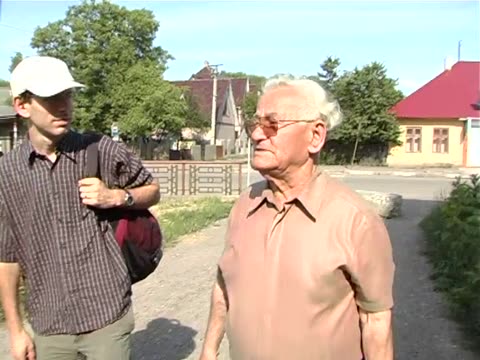
The team sets up the formal interview with Trachtenberg and walks toward his home. He briefly talks about his during the war, when he was imprisoned in the Mykolayiv ghetto. He then addresses prewar Jewish life in Novoseltsy with approximately 10,000 people. He then talks about his family and provides personal information. He raised two sons, one of whom lives in Israel.
From the machine transcript
Informal opening as the team talks about a visitor from America and heads toward Trachtenberg's home. Trachtenberg says he was held in a camp and ghetto in Mykolayiv, that Mykolayiv had a large Jewish population, and that he lives alone with a son in Israel. He gives his birth year as 1926 and says the Germans took him in 1941.
The first lines are a chat about the American team member, with the camp story coming in only partway.
Trachtenberg talks about his life during the war. He states that one thousand Jews were murdered within one night during a mass shooting. He hid during the shooting. Trachtenberg continues that in 1941 he was forced to march to the Kosharyntsi ghetto. When the Germans arrived at the ghetto, he was taken to forced labor. He then talks about prewar Jewish life.
From the machine transcript
Trachtenberg recalls the shooting of about a thousand Jews in one night under the Romanians. He was at home that night. In 1941 the Jews were driven to the Bershad district, to a ghetto, and later the Germans took him to forced labor. Kerler then asks him to describe Novoseltsy, and he mentions Jewish streets, including Khotin Street.
Adds the mass shooting of a thousand Jews and his remark about Jewish streets and Khotin Street.
The formal part of the interview begins. Trachtenberg talks about contemporary Jewish life and provides personal information. He also talks about his family and life during the World War II. His father was a leatherworker. His mother raised two sons and two daughters. Trachtenberg maintains that approximately one thousand Jews were shot by Germans, Romanians, Italians, and Hungarians on 25th June, 1941.
From the machine transcript
Formal part of the interview. Trachtenberg gives his name and Russian patronymic, says he was born in Novoseltsy, and mentions two elderly Jewish women he helps. His parents' names and his father's trade (coachman or leatherworker) are given, and his mother kept house for four children. He dates the mass shooting by the Romanians and others in 1941 at over a thousand people, with the date in June. He also describes how many Jewish families remain today and their ages, complains about the cost of medicines, and names his siblings.
Adds his family details, the current Jewish population of about fifteen families and his health and drug costs.
Trachtenberg talks about prewar religious life and shows his military awards. He then discusses his childhood memories. He attended a Yiddish and religious school. Trachtenberg recalls Jewish soccer clubs, including Imtzah*, Shomer, Beitar, and Maccabi.
From the machine transcript
Trachtenberg speaks about prewar Novoseltsy. He mentions that about ten synagogues were in the town and that he is a war invalid. He says he lived there until 1941, studied in a Yiddish school and a Romanian school and in cheder, learned Hebrew, and finished four classes. His teacher was called Mendele. He recalls the Jewish football teams Hakoah (?), Shomer, Betar and Maccabi.
Adds the details of his schooling, the Romanian language and the cheder teacher.
Trachtenberg talks about his school education. He then talks about his life during the war, in particular in Mykolayiv and the Bershad ghetto. In particular, Trachtenberg addresses the Mykolayiv massacre, where 939 Jews were shot. After the shooting, Trachtenberg and his family assembled to be taken to the Kosharyntsi ghetto, where they were imprisoned until 1943. In 1943, Trachtenberg was taken to the Mykolayiv concentration camp, where he was later liberated in 1944. He recalls that mainly Jewish boys from different place in Ukraine were imprisoned in the concentration camp and sent to forced labor.
From the machine transcript
Trachtenberg describes his schooling (Yiddish, Romanian, Hebrew) and then the war. He describes the camp in Mykolayiv, where Jewish boys from all over Ukraine did forced labor, were given little food and were shot when unable to work. He tells of the mass shooting in Novoseltsy in 1941 by Romanians, Germans and Italians, the 939 victims, the drive to the Bershad district and the Kosharyntsi ghetto, and his transfer to Mykolayiv in 1943. He compares Germans and Romanians and says he was freed in 1944.
Adds the comparison between Germans and Romanians and the schooling at the start.
Trachtenberg talks about his military service from 1944 to 1952. He was drafted into the Red Army immediately after his liberation and fought the Japanese army. He remembers how soldiers committed suicide among the Japanese. Trachtenberg and his brother were in the same division and he recalls peaceful relations among the soldiers. Trachtenberg worked as an engineer in his division and left the army with the rank of major. Before he left the army, Trachtenberg worked at an engine plant in Maloyaroslavets, Kaluzhskaya district in Russia.
From the machine transcript
Trachtenberg describes serving in the Red Army from 1944 to 1952, including at the front in Japan, where Japanese soldiers shot themselves. He says his brother Berl served with him and that he kept his surname. He served as a technician in a mechanized battalion and left as a major. He then worked in a motor-repair plant at Maloyaroslavets near Moscow until 1955.
Trachtenberg describes how he met his wife when they were childhood friends. He reunited with her in 1955 after his return to Novoseltsy. He then talks about his sons.
From the machine transcript
Trachtenberg says he met his wife in childhood in Novoseltsy, since they lived near each other. He found her again after returning in 1955 and was married to her for fifty years. He has two sons who studied at an institute; the elder lives in Israel (Kvutsat Kinneret?) and has a daughter and a son, and the younger lives elsewhere.
Trachtenberg discusses his childhood memories, including games. He then talks about holiday celebrations, in particular Purim. He also addresses prewar Yiddish culture. He recalls Yiddish theater troupes visiting from Chernivtsi.
From the machine transcript
Trachtenberg recalls children's games and plays in childhood and what children did on Purim. He mentions visits of a Yiddish theater from Chernivtsi and says Yiddish was the language of the home, while after the war people spoke Russian and Romanian. His children speak Russian but understand Yiddish.
Adds his remarks on language use at home before and after the war.
Trachtenberg talks about prewar Jewish life, including the different synagogues. He then talks about the devastations of Novoseltsy after the war. Trachtenberg and his brother were the only surviving members of his family. He then describes living conditions in barns and barracks, located in the Kosharyntsi ghetto and the Mykolayiv concentration camp.
From the machine transcript
Trachtenberg describes prewar Jewish life in Novoseltsy, with the number of synagogues and the Jewish Culture House. His house, which had two floors, was burned down. He says he and his brother were the only survivors in the family, and that his mother and sisters died in the ghetto and camp. He describes living in barracks and a kolkhoz barn in the ghetto and the Mykolayiv camp, and the shooting of ten escapees.
Adds the deaths in his family and the conditions in the camp.
Trachtenberg talks about life today, before addressing prewar religious life. In particular, he mentions his bar mitzvah.
From the machine transcript
Informal chat about Kerler's daughter, smoking and drinking, then talk about rabbis in prewar Novoseltsy. Trachtenberg says there were many rabbis before the war and none after, and recalls learning tefillin and his bar mitzvah, held in Novoseltsy in the 1940s. Kerler asks about the pronunciation of 'bar mitsve'.
Adds the opening chat about the interviewer's daughter and smoking and drinking.
Trachtenberg answers questions about cultural terminology. He also addresses contemporary Jewish life and traditional weddings after the war. Trachtenberg then talks about Jewish life in the immediate postwar period. According to Trachtenberg, one thousand Jews lived in postwar Novoseltsy and met up for private services.
From the machine transcript
Answers questions on Yiddish terms such as dybbuk, golem and 'a yidish feld' (?), after a phone call and a remark about a Jewish neighbor. He mentions rabbis in Chernivtsi and a Jewish center in a restaurant. He recalls Jewish weddings after the war with a huppah and klezmer musicians, says about a thousand Jews lived in Novoseltsy afterward and that they emigrated, and that prayer was held at home.
Adds the remarks about the local Jewish center, the Yiddish terms and weddings.
Trachtenberg talks about holiday food customs and general dishes. He then recalls how much money he collected as a child during Purim.
From the machine transcript
Answers questions about food customs in his childhood: Hanukkah and Purim, fried treats, challah baked on Sabbath (called 'boym bilke'), fish on Sabbath, and terms such as flodn and broth. He also describes salads, bread and raisins. He recalls the small amounts of money, in Romanian lei, that children got on Purim.
Adds the food terms (flodn, challah, fish) in the discussion.
Trachtenberg answers a number of dialectological questions from the AHEYM Yiddish linguistic questionnaire.
From the machine transcript
Answers a dialectological questionnaire. Kerler asks how to say sentences such as 'please give me the book' and 'thank you', and words such as house, groats, skin, sour, sweet, grey, blue, deaf, 'to kiss', later, cold, cool, quick, near. He also asks about an American interview Trachtenberg gave, in Russian, on videocassette.