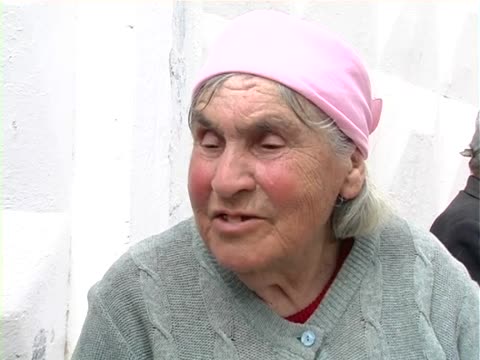
A brief opening exchange whose first words are unclear. Dubinskaia then begins to say that the Germans killed her parents, and that her sister brought a child to her at the start of the war.
Dubinskaia's interview already begins here, not just footage.
Dubinskaia says she was left an orphan after the war. She speaks of a brother who was in the war and of her husband, who has died, so she is now a widow. Kerler then asks her name.
Dubinskaia gives her name as Sonia (Sara/Sotsl) Dubinskaia. She was born in Berdychiv in 1927, and her son and husband have died. She gives her father's name as Azik and her mother's as Reizl, and says there were five children, naming siblings Yasl, Sima and Dvoyre. She recalls how her mother salted meat before Passover. Her father and others were killed in 1941, when she was 14. She does not remember his trade.
Gives birth year, siblings' names and parents' names, which the catalogue label does not.
Dubinskaia says she fled with her sister Sima, while her eldest sister Dvoyre was already older. Her brother Yasl served in the army throughout the war and died some years afterward. She speaks of evacuation in Uzbekistan, where local people were kind and one man gave her a piece of liver. As a child she carried post six kilometres between villages. She came back to Berdychiv in 1945 (?), since no one was left. She says she does not want to go to Germany or take money from Germans, after they killed her father, brothers and mother.
Adds her refusal of German compensation and travel, and her work carrying post.
Dubinskaia talks about being left alone after her son's death and about her own illness and pills. She mentions a niece who went abroad and a bus episode with visitors from America. She says she married in 1946; her husband's name sounds like Isaak, and the transcript is unclear on his origin and on how well he spoke Yiddish. She says she attended a Yiddish school and not a Russian one.
Includes her marriage in 1946 and husband, and her illness and son's death.
Dubinskaia says she still remembers the Yiddish letters from her school, though many years have passed and there was a four-year war. The passage then trails off into talk between the participants about where Kerler lives, and she appears tired.
Kerler asks whether Dubinskaia remembers old women who warded off the evil eye, and about extinguishing coals as a cure; she does not remember either. She then talks about good years of married life while her husband was healthy and his death. She tells of a man who invited her to a café and her polite reply. Kerler ends by asking her to sign something.
Includes the married-life story and the closing request for a signature.
Brief closing talk with Dubinskaia. She asks where Kerler lives, and mentions that her husband's sister Manya lives in Brooklyn. Kerler thanks her and wishes her health, and Bakmayev's interview is about to begin.
Gives the Brooklyn relative; the catalogue only calls this the concluding interview.
Bakmayev gives his name as Itsik and his surname as something like Bak Meir. His mother was Jewish and from Berdychiv, and his father was a soldier there who named as Otman Abramovich. Born in 1929, he lived in the synagogue building, which in Soviet times was used by soldiers. His mother had 23 children, of whom five survived. His mother's brother and others were killed by the Germans in 1941.
Concerns the second interviewee, Bakmayev, rather than Dubinskaia.
Bakmayev describes the arrival of the Germans in 1941 and the order for Jews to move and wear a star. His family hid in a cellar with other families. He went out to beg for food in villages, walking about twenty kilometres. They were freed by the Red Army in 1944. He also names the siblings he lived with there, and the passage includes a question on how many hid and survived.
Brings in the cellar, the begging trips, and the Red Army's arrival, beyond the label.
Bakmayev lists the names of surviving siblings and of relatives killed, including maternal uncles. The other children of the 23 died, mostly when young. He also says his father spoke Russian and understood Yiddish, while his mother spoke it and taught him.
Bakmayev says that he worked as a shoemaker, in an invalids' artel after the war. He mentions his pension, and Kerler ends by asking what nationality was recorded in his passport.
Bakmayev answers the question about nationality, saying his brother was Jewish. He explains that he himself went to a Russian school while his brother had gone to a Yiddish one. Only five children were alive when the war began, not 23, and the mother's brothers and families were killed in Krepes (?). He names a son in Israel and a daughter in Kyiv. He also gives family surnames, including Karavanets, and Kerler asks for his Berdychiv street address.