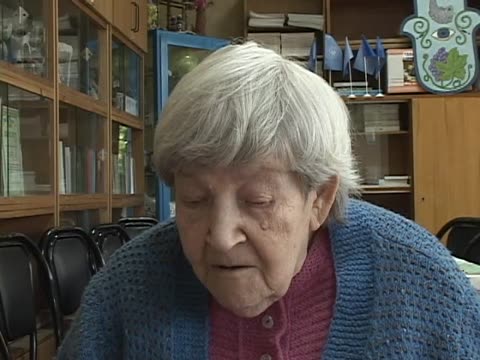
Medved provides personal information. She talks about life today and her family. Her father worked as 5:15 until the war and was killed fighting in the Red Army. She describes how her father perished.
Opening talk about addresses and phone numbers, and Medved's hearing and Yiddish speaking. She explains her Yiddish and says she was born in Miskivka (name unclear) in the Kryzhopil district, in 1927. Her father was named Borukh and her mother Lea, and her father was killed in the war; she describes his journey by rail and the bombing of a train. She also talks about her son, daughter-in-law and Yiddish today.
The catalogue omits the Yiddish-language talk, her mother's background, and the train journey.
Medved talks about her life before the war. She moved to Odesa in 1932. She then discusses childhood memories. When she was five years old, her family moved to Bershad due to her father’s work assignment. Medved also addresses her grandfather’s work as a textile merchant.
Medved says she moved to Odesa in the 1930s and recalls that her family came to Bershad from Miskivka when she was small; her father's work and a grandfather who was a trader are discussed. Her maternal grandfather, a textile and shoe merchant, was shot. Her mother's sister Rakhil is mentioned.
Adds the grandfather's name, Marke, his trading trips to Łódź and Warsaw, and his death by shooting.
Medved recalls how her father sang in Russian. She also remembers Yiddish tailor songs, she heard during her childhood. Medved then talks about her family, in particular her grandfather.
Medved recalls her father singing, in Russian and Yiddish, including a tailor song; she recites a few lines. She then talks about her grandfather, who had a red beard.
Medved talks about her childhood memories in Bershad. She grew up with two siblings. She also addresses the Great Hunger of 1932/33. Medved then talks about her life during the war in evacuation. Her family worked on a kolkhoz.
Medved recalls a childhood sledding accident in Bershad and the 1932–33 famine and 1939 hunger in Odesa, and how Jews helped one another. She tells of evacuation to a kolkhoz by way of Orenburg and Chkalov regions, where she worked and was fed with milk and kasha. She also reflects on good and bad people regardless of nationality.
The famine is dated by her to 1939 (?) in the transcript; includes the evacuation journey and reflections on people.
Medved discusses her childhood memories in Bershad. She then talks about her life in Odessa in the 1930s. She attended Ukrainian schools in Bershad and Odessa.
Medved recalls childhood in Bershad: a neighbor's dog, and her father's wish for respect from neighbors. She says that non-Jews also spoke Yiddish in the shtetl and talks about languages in school and at home. She attended Ukrainian schools in Bershad and Odesa; Kerler asks about life in Odesa in the 1930s.
Adds non-Jewish Yiddish speakers and language use.
Medved gives her mother's birth year (1895) and recalls her mother's sayings in Yiddish, Ukrainian and Russian; she explains one Yiddish saying. Kerler mentions his travels to Israel and England, and asks about further proverbs, including one about many governments and few blessings.
Includes Kerler's asking for proverbs and his own remarks.
Questions on Yiddish words and phrases: the meaning of dibbuk and golem, how to say 'alive but sick', and 'come here or go there'; Kerler asks the meaning of 'aber'. Medved says she never attended a Yiddish school and learned Yiddish from her parents. Kerler then asks about children's games in Bershad.
Medved discusses childhood friends and holiday celebrations. In particular, she mentions a girlfriend, who spoke in the Tatar language. Medved met her in evacuation on a kolkhoz on Crimea. Medved tells a proverb in the Tatar language.
Medved talks about neighbors and friends of different nationalities and holidays in Bershad, and about friends in Odesa, one of them now in Israel. She describes her Tatar girlfriend from the evacuation, with whom she spoke Yiddish and Tatar, and recites Tatar sayings and a Tatar anecdote about kisel.
Adds a girlfriend from Odesa now living in Israel and the Tatar anecdote.
Medved talks about her life during the war. She evacuated to Crimea and then the Stalingrad region, where she was liberated, and returned to Odesa in 1946. Medved then talks about her life after the war. After graduating from an institute in Odesa, Medved worked in Makhachkala for 43 years.
Medved says that after evacuation her family was liberated, and she returned to Odesa in 1946, studied, and worked 43 years in Makhachkala. She mentions that contact with relatives abroad was lost during the war.
Medved talks about her close friend from Makhachkala, who was like a sister, and about relatives in Belarus. She also mentions mobile phones and the internet, and raising two children. Kerler then asks for an anecdote.
The friend appears Russian here, while the catalogue says Tatar.
Medved tells an anecdote that takes place at a cinema in Odesa. She then talks about her family and learning the Yiddish language. Medved then talks prewar Yiddish cultural life and Yiddish schools. Her father participated in the local Yiddish theater in Horodkivka. Medved lists several theater pieces and recalls a performance by Clara Young at a summer theater in Leninogorsk in 1943. She also remembers performance by Anna Guzik in Makhachkala in the 1960s.
Medved tells an anecdote about two Jews who go to a cinema in Odesa. She talks about her mother's literacy and her cousin who learned from her, a Yiddish school in Odesa, and prewar Ukrainian schools. She recalls Yiddish theater, her father's acting in Miskivka and the plays performed, a Clara Young concert in Leninogorsk in 1943 and Anna Guzik in Makhachkala. She also mentions a kommunalka and an apartment with a sea view.