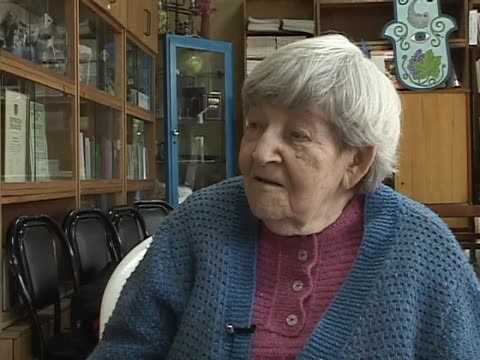
Medved talks about her life after the Perestroika, when she returned to Odesa. She then talks about her school education and addresses cultural performance in Odessa after the war.
Medved speaks about her time in the east, with the many Dagestani peoples and their languages and Russian as the common language. She mentions learning some Kazakh and Tatar, and a teacher's remark when she entered the seventh grade. Kerler then asks about a performer's visit to Odesa after the war, and the passage ends with a remark about her husband understanding Yiddish through his grandmother.
The transcript shows Dagestan languages, Kazakh and Tatar, and a visiting performer; the return after Perestroika is only touched on.
Medved talks about gefilte fish, made from pike for the Sabbath, and about how Russians in Odesa also make it. Kerler asks whether sugar was added, and she recalls her mother's cooking in Bershad'. She also describes a fish dish her mother made from her husband's catch, and Kerler asks for a Yiddish word for it.
Medved discusses prewar holiday celebration, including food customs. She also mentions the Yiddish theater in prewar Bershad and a kosher butcher in prewar Odesa.
Medved recalls Passover celebrated with Russian neighbors and the Yiddish theater in Bershad', which her father loved to attend. Kerler asks about Purim and Hanukkah food and customs, and she describes her mother's fish cutlets and the cooking method. She also mentions buying live fowl and a shoykhet in Odesa before the war.
Also covers Passover with Russian neighbors, Hanukkah latkes and Purim, and her mother's cooking of cutlets.
Medved recalls songs sung before the war, in Yiddish and in Russian, including a song about Birobidzhan and a kolkhoz. She talks about Jewish kolkhozes, including in Crimea, and tells a joke about a Jewish kolkhoz worker. She then says that the best doctors before the war were Jews, including one named Rabinovitsh (?) in her courtyard.
Also covers Jewish kolkhozes and the joke, besides songs and doctors.
Medved speaks about her mother's kosher cooking before the war, taking fowl to the shoykhet and soaking and salting meat. She then tells about the Beilis-type blood-libel trial, in which a Russian writer defended the Jews and explained Jewish meat practices.
The trial is a blood-libel (Beilis) case, with Korolenko's defense of the Jews.
Medved says her father did not go to synagogue but went to the cemetery twice a year for the yortsayt, and she gives his ethical summary of religion in Russian. Asked about her family, she names two brothers, Yitskhok, who died in Israel, and Khayim, and says her mother did not work. She describes her work as a port dispatcher in Kazakhstan, sending materials by rail and ship.
Kerler asks about the best time of her life, and Medved first answers in Russian, then says life goes in stripes, black and white. She tells an anecdote about two Jews meeting and talking of good and bad days. Kerler thanks her at the end.