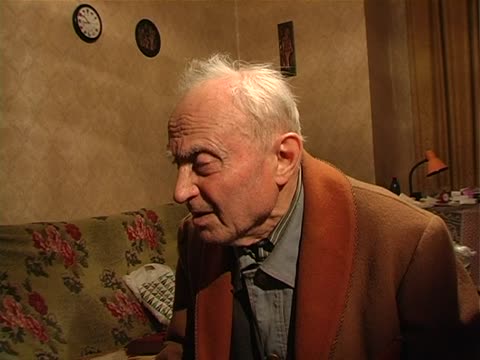
Tokar talks about his military service and his injuries, as well as addresses antisemitism. He fought in the artillery division as officer of observance. He started out his military in Ordzhonikidzevskaya, near Vladikavkaz, joined by other Jewish evacuees.
After a break for a glass of water, Tokar answers questions about his war service: he was wounded in Crimea and nearly lost his arm. He served as an artillery reconnaissance observer, and was drafted at Ordzhonikidze near Vladikavkaz, where there were few Jews apart from some evacuees. He says there was bitter antisemitism among the soldiers, and the interviewers then talk about where they live (Israel, America).
Includes the interviewers' talk about where they live and work.
Tokar talks about life today, before talking about his life after the war. He attended evening courses at a Construction Institute for six years. His wife worked as the doctor for the district.
After joking about beards, Tokar talks about his health since his wife died: a doctor, prescriptions and a volunteer who comes twice a week to cook. He says there were no good times before or after the war, mentioning the crisis in Poland. After the war he studied in the evenings at a construction institute for six years. He says his wife, born in Odesa, was a district doctor, and that her relatives live in the United States.
Also covers his illness, a community volunteer who cooks for him, and the interviewers' beard joke.
Tokar describes Jewish communal life in Odesa today: the several synagogues and Chabad, the lack of a single Jewish committee, and Joint-funded aid such as food cards, medicines and the Hesed. He then names his wife as Maria (?) and says her mother, who came from Grodno and spoke Yiddish, died in the 1970s.
Tokar talks about prewar religious life in Zheludok. He then talks about his religious education. Tokar’s father hired a private tutor. Tokar then discusses life today, including journals published by the community.
Tokar says prewar Zheludok had a community with a rabbi, ritual slaughterers and a cantor, but no slaughterer after the war. He recalls his father hiring a private tutor, studying Bible, putting on tefillin at thirteen, and later studying at a trade school in Lida. He then discusses the Jewish newspapers he reads in Odesa, including a Chabad paper, and what he knows of Israel from the press, while Lemster asks about Hershele Ostropolyer.
Adds the newspapers he reads and the opinions on Israel.
Tokar gives his opinions on politics and Jewish life today. He thinks American Jews are divided between parties and are assimilating; he is hostile towards black Americans, whom he describes as often Muslim and antisemitic; and he says Jews are split into many parties. Kerler mentions Barack Obama. Lemster then asks him for a poem, and he says he remembers many Yiddish songs but cannot sing, naming a few titles.
The passage ranges to American Jewry, race and antisemitism, and Yiddish songs.
Tokar recites the opening of a children's poem and says he remembers its author as Abraham Reisen (?), but not for the poem about the green trees; he mentions Bialik's poem written after the Kishinev pogrom. Asked whether he will see Katz, he says he is angry at him over a letter. He complains about a Yiddish newspaper editorial office that would not send him a copy without a sponsor, and Lemster asks to photograph him with the Forverts.