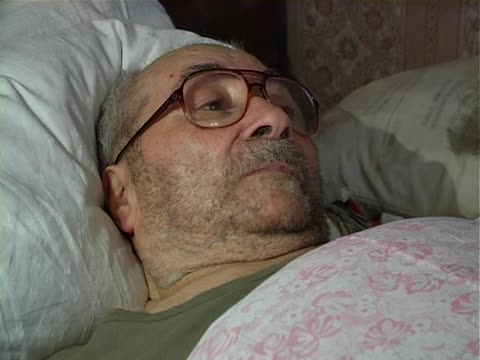
Vainbrand talks about Passover preparations in his childhood home: the mother baked matzo for other families, who brought their own flour, and the attic held the Passover dishes. He describes how utensils were made kosher with heated stones in a pit of water, and the burning of leavened bread by the rabbi at the synagogue. Kerler then asks about the rabbi and his cheder teacher, who was also a shoykhet from whom the mother had meat for Sabbath. Vainbrand recalls the teacher's face but not his name.
Adds the kashering of utensils, the burning of leavened bread, and his recollection of his cheder teacher.
Vainbrand answers questions about the Sabbath fish his mother made: gefilte fish, cooked in a pot over layers of onion, with potatoes on top. He says he adds no sugar, and Lemster asks about pepper and beets. He still makes it himself and the grandchildren like it. Kerler then asks about the rebbe and the tsadik, but he remembers nothing.
Adds Lemster's questions about ingredients, and that Vainbrand still cooks the dish today.
Vainbrand talks about traditional weddings during the prewar Soviet period. He then addresses prewar religious life, including Sukkoth celebration, as well as answers questions about cultural terminology.
Vainbrand speaks about weddings and the wedding canopy during Soviet times, the shoykhet who was also a circumciser, and the study house with its tables and benches. Kerler asks questions about the words batlen, dybbuk and golem and about stories of the Valedniki rebbe, mostly answered with no recollection. The talk turns to the synagogue and the Sabbath routine of carrying a prayer book, to the sukkah built beside the house, and to the town bathhouse and mikveh near a small river. Lemster asks whether people feared the Communists.
Adds the study house, the mikveh and bathhouse by the river, and the questions on dybbuk and golem.
Vainbrand touches upon Yiddish literature. He then talks about his family, in particular his wife. He then talks about prewar life and recalls a non-Jewish boy who attended a Yiddish school. During the war, he became a police officer and worked as a translator for the Germans.
Vainbrand says he read Yiddish books, among them Sholem Aleichem, and recalls the journal Der shtern (?). Kerler asks about Yiddish spoken after the war, and about his wife, who was also from Valedniki; he gives her family name, his own name and patronymic as in the passport, and his Yiddish name. He then tells of a non-Jewish boy who studied at the Yiddish school and, during the war, worked with the Germans as a translator.
Adds the personal-name questions and the German-employed translator; the catalogue says Vainbrand himself became a police officer, but the transcript indicates it was the non-Jewish boy.
Vainbrand says he married after the war, and Lemster asks whether a wedding canopy was used and, after Vainbrand directs him to a photograph, about the son's birth. He says there were two shoykhets in town and one was the circumciser. His son married in Odesa under a canopy. He reflects that no one is left who remembers these things, and begins to speak of kosher meat.
Adds the son's marriage in Odesa and the reference to photographs.
Vainbrand talks about prewar Jewish life and how his family prepared for Sabbath. He then mentions his mother’s matzos baking. Vainbrand then talks about his family.
Vainbrand speaks about how meat was salted and about his father buying a calf in the village and having it slaughtered in Valedniki. Kerler asks about his mother baking matzo for others, who brought their own flour, and about the perforating wheel. Vainbrand says his parents died before the war. He tells how he and his wife attended the same school and married in Valedniki, and he praises her.
Adds the salting of meat, the calf bought for slaughter, and the death of his parents before the war.
Vainbrand talks about visiting the rebbe’s grave in Valedniki and his life after the war. After Vainbrand returned from his military service, he joined his wife in Ovruch.
Vainbrand speaks about visiting the rebbe's grave in Valedniki and about his wife's burial, which the transcript places in a town whose name is unclear. After the war he came to live where she lived. He feels he has lived too long and mentions his age. He gives his father's trade as shoemaker and his wife's father's as a rope-maker (?), and answers questions about the Chernobyl rebbe and the Khabne preacher with no recollection.
Adds the wife's burial, the fathers' trades, and the questions about Chernobyl and Khabne.
Vainbrand says he cannot recall the Hershl Ostropoler stories and that his memory is failing. He mentions a prayer book and his poor eyesight, and reads or recites from the prayer book when Kerler asks. Kerler then asks whether the cheder teacher examined the pupils and about the term for the fee paid to the teacher, which Vainbrand's father paid.
Adds the question about the fee paid to the rebbe.
Vainbrand talks about life before the war. He visited Zhytomyr, Ovruch, Korsun*, and Slovechne. He then talks about his favorite moments in life, which Vainbrand associates with holiday celebration. Vainbrand also briefly addresses the Four Questions for Passover.
Vainbrand names towns he visited before the war, including Zhytomyr and Ovruch; he passed through Berdychiv once. He names Simchat Torah as his favourite holiday and describes the procession with the Torah scrolls round the bimah in the synagogue. Kerler asks about Sabbath songs at home, and Lemster asks who asked the Four Questions on Passover. Vainbrand, the youngest son, asked them each year at home in Valedniki.
Adds Sabbath songs, and the passing visit to Berdychiv.
Vainbrand talks about prewar religious life, when pilgrims stayed at his home in Valedniki. He then talks about his family and mentions the Ukrainian police officer who attended a Yiddish school.
Vainbrand describes how, in the month of Elul, pilgrims with children stayed at his family's house near the rebbe's grave in Valedniki, and how a man wrote notes (kvitlekh) that were taken to the grave. He then says how old he is and why he did not remarry, that his wife died after the war, and that he says Kaddish and lights yahrzeit candles. Kerler and Lemster then ask about the non-Jewish boy who learned Yiddish and became a policeman or translator for the Germans, who he says needed someone to tell them about the Jews.
Adds the pilgrims' stay, his wife's death, and the Kaddish and yahrzeit candles.
Vainbrand addresses Jewish life in Valedniki during the war. According to him, the Germans did not set up a ghetto because Valedniki was considered a holy place. Vainbrand then discusses his life in Odesa.
Vainbrand says there was apparently no ghetto in Valedniki because the Germans feared the holy place and did not go to the rebbe's grave. Most older Jews were evacuated to Uzbekistan and elsewhere, or died. Lemster asks about Jewish life in Odesa after Vainbrand arrived, and he answers that he had no one to speak Yiddish with there. He says it is a Jewish city because many Jews live there, and he is asked about Natan Lurie, Drucker and Shloyme Mikhoels, with little recollection. Lemster asks about his daughter in the United States.
Adds the evacuation of the older Jews, questions on Natan Lurie, Drucker and Mikhoels, and mention of the daughter in the United States.
Vainbrand talks about his daughter, who works in New York and has visited him twice, and about his grandchildren in Odesa. Kerler and Lemster ask about faith. He says God exists in his heart and speaks of lighting two Friday-evening candles and reciting the blessing from his prayer book.
Adds the daughter in New York, with her visits, and his answers about God, candles and prayer.
Kerler thanks Vainbrand and invites a message for Yiddish students. He wishes them health and says Jews should remember they are Jews. Vainbrand says he is a Valedniki Jew and recalls going on Fridays to the shoykhet for his mother. Lemster asks about Israel; he says he would go but travel costs money, and that his son has to work. He thinks Jews should live in the Land of Israel. He adds that he reads the newspaper and hopes to live to a hundred and twenty.
Adds the farewell message, his views on Israel and the cost of travel, and his reading of the newspaper.