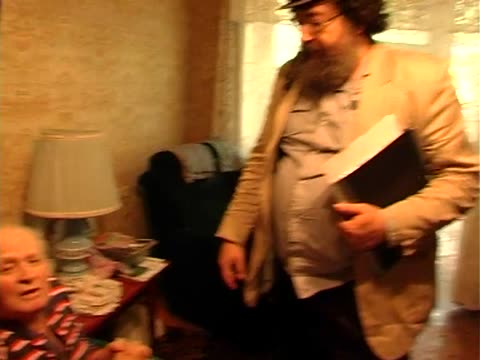
The camera collects outside footage on the way to the Brodskys’ apartment. The team enters the Brodskys’ apartment and sets up the formal interview with them.
Arrival and set-up in the Brodskys' apartment. The interviewers introduce themselves and explain that they come from Israel and America (Bloomington, Indiana), and that they are professors of Yiddish language and culture. They tell the Brodskys that the project has recorded hundreds of Jews. The hosts speak a mix of Yiddish and Russian, and say they understand Yiddish better than they speak it. Brodsky is puzzled as to why anyone wants this recorded.
Beyond the arrival and set-up, the passage is mostly Kerler and Lemster explaining the project and their university work to the Brodskys.
Brodsky gives his surname and patronymic, and the interviewers ask the names of the couple. He says his grandparents spoke Yiddish, while his parents did not speak it to the children. He was born in Odesa, and his parents and grandparents were from Odesa too, three generations. Some of the answers are in Russian.
Besides his birthplace, the passage deals with who spoke Yiddish in the family and a question about Odesa generally.
Brodsky talks about his life during the war. He served in the Red Army for four years and fought at the Romanian front as tank driver and then part of the motorized infantry. He spent the remaining days of the war in Vienna, after moving through Hungary. Brodsky then provides personal information and talks about his family.
Brodsky says he was in the war for four years, first as a tank driver and then in the motorized infantry. He passed through Hungary (Budapest) and ended the war in Vienna. He states his birth year as 1924. The conversation then turns to whether his family was related to the Brodsky sugar manufacturers, which he denies, and to the Brodsky synagogue in Odesa. Kerler explains what the archive is for.
The catalogue sentence does not mention the question of kinship to the Brodsky sugar-manufacturer family or the Brodsky synagogue.
Brodsky talks about contemporary Jewish life and his family. They also address prewar holiday celebrations. Brodsky’s father was a manufacturer and his mother was a dressmaker, working from home.
The couple say that Brodsky's parents did not speak Yiddish to the children, but his paternal grandfather did, and he was a synagogue warden (gabbay) and an honest man. Brodsky gives his father's name as Abraham Yankel and his Yiddish name as Berl (Russian Boris Abramovich). His father attended synagogue on holidays only, and worked in textiles or as a manufacturer (a doubtful Russian word); his mother, Basia, sewed at home. The synagogue is named as Chabad Lubavitch. The interviewers talk about their American university and give Brodsky a card.
Beyond the family trades, the passage includes the grandfather's role as synagogue warden and talk of Kerler's and Lemster's work.
Brodsky talks about his life during the war in evacuation. His family evacuated to Tashkent, Uzbekistan. He then talks about his work before the war. He attended courses to become a locksmith. Brodsky recalls Yiddish schools before the war. Brodskaia attended a Yiddish school in Odesa and finished ten years of schooling.
Brodsky mentions evacuation to Tashkent with his mother, via Novorossiysk. Before the war he studied and then worked as a locksmith's apprentice. Asked about Yiddish schools, he and the others recall that Odesa had many, including a vocational school and technical college (Evramol, "Yevramol"), where trades such as locksmith and fitter were taught. Brodskaia says she attended a Yiddish school, and finished ten grades.
The Yiddish vocational school called Yevramol, and the trades taught there, are not in the catalogue text.
Brodsky talks about his life before the war, in particular mentions Jewish kolkhozy. His school volunteered working on kolkhozy. He then talks about his family. He grew up with one brother, who died on the Leningrad front.
Brodsky mentions Jewish kolkhozes in the Odesa region, and says that students from all schools, not only Yiddish ones, were sent to help at kolkhozes. He had one brother, Misha (Mikhail Abramovich), who was killed at the front. Asked about his childhood, he says he lived on Prival Street (Privoz market area), with many Jewish children.
The home street near the Privoz market is not in the catalogue entry.
Brodsky talks about prewar Jewish life in Odesa and his childhood memories, including sports. He then talks about his life after the war. After he returned from his military service, he worked as a chauffeur for fifty years. Brodsky also mentions religious activity in postwar Odesa.
Brodsky recalls sports as a boy, football and basketball, and the clubs he went to, where Russian was spoken. He knows of Zionists and Communists in Odesa, and says chess and cards were not played for money. After the war he worked for fifty years as a driver, in a taxi. Kerler and Lemster ask about synagogue-going in postwar Odesa; the passage ends in a recogniser loop.
Zionists and Communists in prewar Odesa and card games are mentioned too.
Brodsky says his wedding after the war had no huppah; they only registered. The conversation covers a grandson's circumcision and the question of what a real Jew is. His mother cooked gefilte fish and other holiday dishes, and his wife cooked as well. They talk about the sukkah put up in Odesa before the war and in a Yiddish school, and ask what Odesa was famous for, which they answer with Jews, thieves and good people.
Brodsky talks about his life after the war when he worked as a taxi driver, as well as prewar Jewish life, including occupations. He addresses Yiddish theater performances.
Brodsky and his wife say Yiddish was spoken on the street in Odesa before the war, mostly privately, but not afterwards, as many Jews had left. They discuss the Odesa Yiddish theater, with the actor Mikhoels coming to Odesa and Clara Young mentioned, and a Yiddish technical school. They recall the occupations of Odesa Jews: shoemakers, tailors, and a few who kept cattle or drovers' wagons while non-Jews brought produce from the villages. Brodsky mentions his taxi work after the war.
A Yiddish technical school and the question of Yiddish on the street before and after the war are also covered.
Brodsky describes prewar Jewish weddings in Odesa, with dancing on the table and Jewish songs, and a klezmer trumpeter who liked his vodka. They talk about a Yiddish library, Yiddish newspapers (the Odesa worker) and journals. Kerler and Lemster ask if the couple knew writers such as Babel, Bialik and Nate Lurie. The couple recall a love song and a Jewish film director.
Klezmer music, wedding songs and Yiddish writers asked about, among them Bialik and Babel, are named.
Brodsky is asked about the best time in Odesa, and the talk turns to matchmaking and marriage arrangements, with his parents' wedding mentioned. They recall wedding customs including a song for the in-laws. Lemster asks whether Jews drank vodka, and Brodsky says yes, with many drunks.
Brodsky talks about his life during the war, when he liberated Budapest. He then answers questions about cultural terminology. Brodsky also talks about fellow Jews serving in the Red Army, postwar antisemitism, Jewish life at the beginning of the war, and his non-Jewish friend who helped Jews.
Brodsky remembers Budapest and Hungary at the end of the war and a landlady there who spoke of a Jew. He answers questions about words (dybbuk, golem), and says there were many Jews in the Red Army and no antisemitism there. Postwar antisemitism and Jews in Odesa during the war are discussed: evacuation was not total, and there were ghettos and camps. He says a non-Jewish friend (Yanya Manevich or Maniovich, now in Israel) was among those who rescued Jews, and mentions a memorial with trees.
A non-Jewish friend's rescue of Jews and a memorial with trees are mentioned, with Budapest and Debrecen questions.