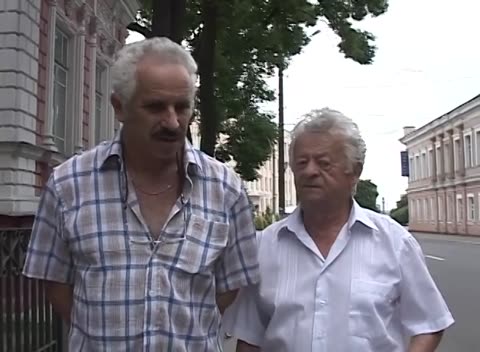
The team arrives and greets Lerner, with some talk about finding the house and settling in. Lerner explains that he was born in Ostroh (Yiddish Ostrog), then in Poland, and lives there with his wife. They discuss his name: he is called Moyshe, his father was Avrom, and his documents give Mikhail Yakovlevich. He says he was born in 1936. He says very few Jews are left in town and that he understands Yiddish but speaks mostly Russian. He spoke Yiddish with his mother at home.
The catalogue omits the discussion of his name and patronymic, and his statements about speaking Yiddish.
The formal interview begins. He speaks about his family. Lerner's daughter lives in Israel and his wife was also born in Ostroh. His father owned a shop and both of Lerner's parents were born in Ostroh. Lerner also has relatives in America.
Lerner speaks about his family. He and his wife were both born in Ostroh and lived on the first street, near the synagogue. His father had a small shop and his mother was Beyle, née Harpak (?). Uncles were killed by the Germans, one with his wife and children in the ghetto. A grandfather named Aron is mentioned, a grandfather worked at a sawmill for a Jew, and relatives lived in America. His daughter lives in Israel. Lerner has difficulty recalling Yiddish words and several details are unclear.
Also names an uncle's family shot in the ghetto, his grandfather Aron, and a grandfather working at a sawmill.
Lerner is asked what he remembers of Ostroh before the war; he was seven when it began and did not attend cheder. He says he nearly forgot Yiddish because there was no one to speak it with, apart from his mother after the war. Kerler points to the old synagogue, from the sixteenth century (?). Lerner says Yiddish was his first language and that he grew up on a Jewish street. The Ukrainian neighbors spoke Yiddish with the Jews, better than he does, but none of them is alive now. His wife does not know Yiddish.
Adds the old synagogue and the loss of Yiddish speakers.
Lerner speaks about his schooling and work: he and his wife are both teachers, he of Russian language and literature, she in the lower grades. Relatives who were teachers are in America and Canada. Kerler and Lemster then discuss his Yiddish, which Kerler identifies as Volhynian rather than Polish; Lerner counts from one to eight as an example. Kerler asks about words he cannot recall.
The Kyiv University detail is not in this passage (it comes in s0005); this passage also covers the Volhynian-versus-Polish Yiddish exchange.
Lerner answers dialectological questions from the AHEYM Yiddish linguistic questionnaire. He then remembers a couple of Yiddish songs and speaks about his early school education.
Kerler and Lemster put a few dialect questions to Lerner, such as how he says 'please', and ask for Yiddish words or songs his mother used. He cannot recall most of them and produces only fragments of a rhyme or song about someone's wedding. He then explains that he went to school knowing only Yiddish, learned Russian, forgot Yiddish, and studied at Kyiv University. The talk turns to going to see the old synagogue and the Jewish street.
Says the song remembered is only fragmentary and the question was unanswered; also the offer to visit the old synagogue.
Lerner is asked about the war and says his family was evacuated via Chkalov and Orenburg to Central Asia, to Fergana. He mentions that he reads a Jewish newspaper. Lemster then asks him to talk in Russian about Jewish life before the war.
Lerner speaks in Russian, with Yiddish interjections, about prewar Jewish Ostroh. Wealthy Jews lived in the center and the poor on the outskirts, working as porters, shoemakers and tailors. There were several synagogues, including a women's one; the main one survives, and he mentions photographs and a chandelier given from America, now in the museum. He then talks about Yiddish books and ritual objects in the museum and the Jewish calendar he owns. He also says the Jews were shot nearby and he can show the graves. Lemster and Kerler ask about Slavuta and Zaslav, and about distances.
The catalogue says Orhei; the town is Ostroh. The passage also includes the museum collection, the mass killings, and questions about distance to Slavuta.
Lerner and the team drive toward the Ostroh synagogue, with Russian directions and a mention of a village in Ostroh district. Lerner begins to explain, in Russian, the circumcision ritual once held at a table in the synagogue.
At the old synagogue Lerner gives Kerler and Lemster a tour in Russian. He says it was damaged in the war by the Nazis and Banderites, and an inscription dates it to the sixteenth or seventeenth century (?). He points out a cannonball (Crimean War?), the women's balcony, and the museum with a chandelier given from America. He recalls being brought here by his father, a rich man throwing apples from the balcony at Hanukkah, and a visit by Piłsudski. He returned in 1946 and later saw it used as a Soviet storehouse. He also says a famous rabbi is buried in the Jewish cemetery.
The catalogue says Orhei; the town is Ostroh. Adds the damage in the war, the balcony memories, and the Soviet-era storehouse.
The team arrives in Slavuta, greeted by Kipervaser and a second woman (Leah), and sits down to set up the interview. Kipervaser says her husband Moyshe died about three months earlier. Kerler introduces himself and Lemster, and asks her to speak Yiddish. She says her parents were Jews who attended synagogue and that she was born in Berezdiv, a shtetl near the Donetsk (?) area, with many Jews.
Adds the recent death of her husband and her birthplace Berezdiv.
The formal part of the interview begins. She provides personal information and speaks about her family. Kipervaser's father, who worked at a Jewish kolkhoz, was born in Velykyy Pravutyn and her mother was also born in Berezdiv.
The formal part begins with the date and place of the interview in Slavuta. Kipervaser gives her name and family: her father was Yankl Milshenker and her mother Yente, from Berezdiv. Her father was born in nearby Velykyy Pravutyn (?). He had no special trade and worked on a Jewish kolkhoz until the war. She was born in 1924 and grew up in Berezdiv. She also says the Kipervaser family were from Berezdiv.
Adds her birth year and her husband's family also from Berezdiv.
Kipervaser discusses prewar Jewish life, including holiday celebration, in Berezdiv. She also talks about her family, particularly her husband. Kipervaser met her husband at school in Berezdiv.
Kipervaser describes prewar Berezdiv: everyone had a trade (shoemakers, tailors), people got along and knew each other, and the synagogue was near their home. She remembers a chuppah. Her parents kept a kosher home, and her grandmother lit Sabbath candles. Her husband, also from Berezdiv, went to cheder; they studied together at school. He was called up in 1940, served at the front and ended up in Germany, and learned German. They keep Yiddish books, observe holidays and light memorial candles. Their son speaks Yiddish and knows the holidays.
Adds her parents' kashrut, her grandmother's Sabbath candles, and her husband's army service.
Kipervaser speaks about prewar holiday celebration, in particular Purim and Sabbath. She also recalls the family's Sabbath goy and addresses food customs. Kipervaser then explains how to kosher meat.
Kipervaser speaks about prewar holidays and Sabbath in her parents' home. At Purim they baked pastries with poppy seed, sang, danced and exchanged gifts. On Sabbath nothing was done and a non-Jewish woman came to milk the cow and heat the stove. She also mentions Friday evening candles and the Sabbath bread, and she explains how meat is koshered by soaking and salting. She does not remember the Purim play.
Adds Purim pastries and the cow-milking Sabbath helper.
Kipervaser recalls traditional weddings and synagogues before the war. She then addresses postwar religious life, including private services in 1944 and how the community rebuilt the synagogue after the war. Kipervaser helped to collect money, she explains.
Kipervaser recalls weddings and the synagogues of Berezdiv. There were two or three, including a workers' synagogue and an intelligentsia one. After the war there was no synagogue, so in 1944 people prayed in a house for the holidays. The community then rebuilt the synagogue, and she went round town collecting money. Kerler asks whether it was wooden. She speaks warmly of a rabbi, Itsik Libersohn (?), who helped everyone, and of his daughters.
Adds the rabbi who advised the community and his daughters.
Kipervaser talks about her husband's family and fate during World War II. She then speaks about her and Jewish life in Slavuta after the war. She moved to Slavuta (Yiddish: Slovita) in 1944. Kipervaser then speaks about her daughter's education.
Kipervaser speaks about her husband's family, whose three sisters and other children were killed; she says that she and her husband mark their yahrzeit every year. After the war they did not return to Berezdiv, as no Jews were left there, and came to Slavuta in 1944. She says the Yiddish name of the town is Slovite (?). She talks about Yiddish at home, a child named Itsik who died, and the Jews who came back from evacuation. Her daughter completed an institute. Lemster asks whether a Yiddish theater came to Berezdiv.
Kipervaser speaks about prewar cultural life in Berezdiv. She then speaks about her education. Kipervaser attended a Yiddish school for seven years and then finished her school education at a Ukrainian school.
Kipervaser answers questions about cultural life in Berezdiv. She says there was no Yiddish theater after the war and that people sang Russian songs. The library had a few Yiddish books, and few people could read them, including her husband and the rabbi's daughter. She finished seven classes at a Yiddish school, as did her husband, and the Yiddish schools were later closed and the pupils moved to a Ukrainian school.
Adds the library with Yiddish books and the closing of Yiddish schools.