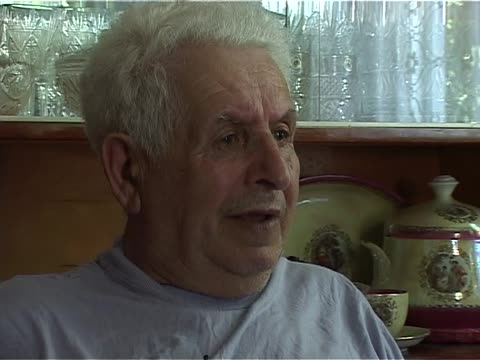
Opening formalities: Kerler gives the date and Stotland states his name, address, telephone number and birth date (5 August 1926). He says he had no father or mother and lived in an orphanage in Ovruch; his parents came from Narodychi, and his father was a shoemaker and his mother a housewife. He completed five grades in a Yiddish school.
Stotland talks about the only Yiddish school in Ovruch, closed a year before the war, and about his childhood in the orphanage. Twelve Jewish children lived there and spoke Yiddish among themselves, switching to Russian or Ukrainian when a teacher came. He names teachers and says subjects were taught in Yiddish. They read Sholem Aleichem and Itzik Pfeffer.
Names teachers and authors read and the number of Jewish orphanage children.
Stotland sings a school song about how to make a whistle. He mentions Yiddish translations of Pushkin and Shevchenko. He then describes the evacuation of the orphanage by horse cart, its bombing by German aircraft, and the few survivors. He names his brother and two sisters, one of whom emigrated to America and another to Israel.
Also gives details on his siblings and the bombing.
Stotland says Jewish holidays were not marked in the orphanage. As a child he and others ran away to his maternal aunt and uncle in town for Passover. He recalls five synagogues in Ovruch, including a large wooden one near the orphanage, where the children went for treats. The aunt and uncle were poor, with five small children.
Also covers the synagogues and his aunt and uncle's poverty.
Stotland tells of his wartime experience: after the bombing he wandered, arrived at the railway station in Kharkiv, and helped at a field kitchen beside a military train. He then volunteered for the front and served until the end of the war. He was wounded twice and became an invalid. On returning to Ovruch he found no one, worked at a hotel, and met his future wife.
Stotland says he married Beyle, a native of Ovruch, and they were married 52 years until she died. He studied at two institutes in Kyiv and worked as a teacher, then as a school director in Ovruch for some twenty years. He has two sons, one also a teacher.
Stotland says he taught his son Yiddish so he would not forget Jewish culture. He describes Jewish life in Ovruch after the war: returning evacuees found their houses occupied and lived in hardship, with no housing or work. Jews were then still found everywhere and Jewish children and teachers were numerous. Today almost no Jewish children remain in the district, the old have died, young people left, and only a small number of Jews are left, many of them in mixed marriages.
Also covers his son and the present-day shrinking of the Jewish population.
Stotland says that before the war they did not know the word antisemitism and religion was not taught against in school. Yiddish writers visited the Yiddish school, and Yiddish plays were staged in the local theatre by a Yiddish company in Ovruch. He remembers a visit by Itzik Pfeffer.
Also covers antisemitism and the absence of anti-religious teaching.
Stotland recalls Jewish weddings and canopies before the war, which children ran to in hope of food. He names a wedding entertainer with a beard, called Shiman (?), and recalls singing and dancing at weddings, including the sher dance. Kerler asks about the badkhn, the mitzvah dance and the rabbi.
Stotland speaks of prewar Jewish institutions in Ovruch: the rabbi, two ritual slaughterers (Shiman (?) and Kaptsan (?)), and the Yiddish periodicals Shtern and Emes that reached the school. Children borrowed Yiddish books and held discussions with teachers. The synagogues were demolished in 1937, after which Jews met in private houses. He also mentions Jews from Belarus and Moldova, and visits to Transcarpathia where the Yiddish differed.
Also covers the slaughterers, periodicals, and Transcarpathian Yiddish.
Stotland compares Yiddish in Transcarpathia with that of Ovruch, noting that school subjects and oats had different names. Kerler gives examples of Transcarpathian forms for 'pour', 'village' and 'my'. Stotland says that despite differences they could understand each other.
Stotland explains how as a child he ran from the orphanage to his poor aunt and uncle, a tailor with many children, for Sabbath and Passover. They gave him a piece of matzo. Katz moves on to the questions that follow.
Kerler asks about cultural terms; Stotland explains what a dybbuk and a golem are, and what a good Jew is. He says people have visited the tsadik's grave near Ovruch since the 1990s and that he has been there often. He says there are no Hasidim in Ovruch today, though a religious man who speaks Yiddish and attends the minyan has recently arrived. Kerler also asks about a sanatorium for Chernobyl children.
Also covers the Chernobyl sanatorium and a present-day religious Jew in town.
Dialectological questionnaire: Kerler gives Russian words and sentences for Stotland to translate into Yiddish. Items include household and body words, colours, adverbs of time and place, speed and nearness, greetings, prepositions with 'street', the sun, the bed, numerals, and sentences about the war. Katz adds follow-up questions about the answers. Stotland often notes that he mixes German and Yiddish.