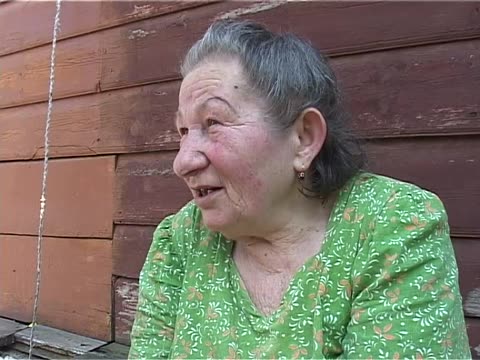
Turovskaia says she keeps the yortsayts (memorial days) for her parents and grandparents, as her father told her, and recalls them. She names her maternal grandparents (Reyzl, daughter of Yitskhok, and Binem Shloyme, family name Vaynbrand) and her paternal grandparents (Shloyme and Fayge). Her grandfather had a matzo machine and a wool-carding machine and her father baked matzo. She distinguishes Novyye Veledniki from Staryye Veledniki, her grandparents' village, and says her father knew many tales of the rebbe.
Gives grandparents' names and the grandfather's matzo and wool-carding machines, beyond the mention of the memorial days.
Turovskaia retells stories her father told about the Volednicker rebbe, who helped people who came to him. One is about a mother whose son was to be conscripted into the army, one about a baby lost in the winter and found alive after a wolf, and one about a Jew who stayed with a robber one Sabbath. The longest is about a woman with several daughters to marry off who sells bagels and loses her money to a lodger, with the rebbe's help. Kerler and Katz ask about Russian and Yiddish words, such as the verb for abandoning a wife. They also discuss photocopying her father's handwritten notebook of the stories.
Includes the tales of the lost child and the bagel-seller, and discussion of photocopying her father's notebook and of Yiddish and Russian words.
Turovskaia says she taught history in schools in Ovruch before she married. Her husband was a veterinary doctor, and they went to Siberia, where they worked in schools for thirty years. She returned to Ovruch in the 1980s, after retiring on a pension, to care for her father; her sisters and brothers lived elsewhere. Kerler and Katz ask when her father wrote his notes, and she cannot give a year.
Katz asks about tzaddikim and she names one in Uman and mentions Vilna, saying she only knows that tzaddikim lived there. She also mentions receiving a Jewish newspaper from Opshtshina (?). Most of the passage is Katz and Kerler talking among themselves about finding a photocopying machine for her father's book.
Much of it is the interviewers discussing photocopying the book.
Turovskaia talks about holiday observance and food. She did not eat bread on Passover even in Siberia, and she describes her mother's baking and foods for Rosh Hashanah and the Sabbath. Geese were fattened and their fat rendered for Passover, and matzo was bought in Opshtshina (?). Before the war the family kept their own cow, sold milk to the hospital and neighbors, churned butter, planted potatoes and made wine from currants and cherries.
Adds Yom Kippur fasting and eve food, Sabbath cholent, the cow Pasolye (?), butter-making and homemade wine.
Turovskaia describes the two-story beys medresh in Veledniki, with women praying on one floor and men on the other. She also mentions a former Polish church and a Christian cloister, which she says Jews called kloyster. Nothing remains of the study house, the church or the cloister. The interviewers ask for Yiddish terms.
Asked about songs from her girlhood, Turovskaia instead describes her childhood: an uncle on her mother's side who died young just before his wedding, her mother's grief, and her own work as the eldest child. She played the fiddle and could play melodies she knew. She says her mother, father, brother and husband have since died.
Adds her fiddle playing and the story of her uncle's death before his wedding, and her family's later deaths.
Turovskaia says she is not in good health. Kerler asks whether she remembers a charm against the evil eye, and she recites one about three women sitting on a stone, partly in Russian or Ukrainian. The interviewers react appreciatively.
Turovskaia speaks about her present life and her health. The interviewers say where they come from, Kerler near Chicago and Katz born in New York and living in Vilnius. She says she knows little about Vilna beyond that tzaddikim lived there. Katz tells a story of meeting the Lubavitcher Rebbe and receiving two dollars for charity from him.
Much of it is the interviewers introducing themselves and Katz's story of the Lubavitcher Rebbe.
Turovskaia recites blessings, including the candle-lighting blessing for Sabbath and the festivals. She says her father had her write down how many blessings are said on each holiday. She says the mourner's kaddish for relatives, lights memorial candles and sends memorial notes to Opshtshina (?). Katz tests her on Hebrew month names. She asks about the eleven months of kaddish and the leap year, since her husband died on 14 July.
Includes the recited blessings, the Hebrew months and the question about kaddish and the leap year.
The conversation turns to religious life today, including where a rabbi might be consulted: Zhytomyr, or a rabbi who comes on Sabbath. Turovskaia says there is a prayer gathering on Lenin Street, and she names local Jews who live nearby. She recalls how her father led the seder before the war. She says two visitors, one from America and one from Israel, came recently for Passover, with a translator. Kerler asks about the word for translator and then about the dybbuk.
Adds the seder led by her father and the recent visitors from America and Israel.
Turovskaia says a dybbuk story is among her father's written tales. Katz and Kerler ask what the word means, and she describes something entering a person or animal. They discuss related Yiddish words such as 'apir' (?) and 'efremye' (?). She then mentions Yiddish records: after the war her father brought a record player and they bought records. She says she lived in Siberia until the 1980s.
Turovskaia says where her children live: one in the Krasnoyarsk region of Siberia, one near Leningrad, and a daughter in Brooklyn. She says she is almost the only Jew left on her street. She expresses hopes for her children and criticises Bin Laden and terrorism. Kerler then asks about Sukkot.
Turovskaia says a sukkah was built in the corridor at her father's house, where the family ate. Answering Kerler, she says there was anti-religious propaganda in Soviet schools, even Yiddish ones, with informers, though believers kept faith. She recalls the war years in Siberia, the death of her grandmother in 1943 (?), and her trips to Mongolia (?).
Turovskaia describes her memorial practices, including saying the 'El maley rakhamim' prayer, and that people from Kyiv and St Petersburg ask her to say kaddish for their dead. Katz and Kerler ask her to recite the traditional prayer as her father said it, and she hesitates. They ask about other blessings for women, such as the 'modeh ani'. She says her father had her write down the blessings. She recalls her mother's geese, schmaltz and matzo for Passover.
Adds the requests from relatives in other cities to say kaddish and the interviewers' attempt to elicit the prayer.
Turovskaia remembers her mother's charity: sharing cherries from their tree, sending food and matzo, and going with other women to collect for the poor. She says her father visited the tzaddik every Elul and, when too old, still kept the practice. She tells how her grandmother's dream gave her mother's name Alte, and of a 'good Jew' (a tzaddik) who gave it. The passage ends with her account of Leybl of Khabne in Polesye, who could foresee events and was approached for advice.
Adds her mother's charity, the dream behind her mother's name, and the tale of Leybl of Khabne.