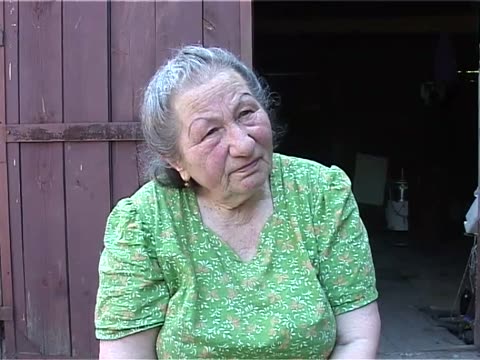
Turovskaia tells how, when the Germans occupied Khabne, the tzaddik Leybl of Khabne was asked who would win and told them to take two roosters, a white and a red one, and see which won. Katz and Kerler ask which rebbe this was; Kerler notes that the town appears in literature (Sholem Aleichem). Katz also asks about the story of the tzaddik who gave blows.
The story concerns the German occupation and a prophecy by two roosters
Turovskaia describes a small stream at Velednik and a bathhouse with a mikveh there in the past. She recalls her time in Siberia, where she worked in a school and fasted all day on Yom Kippur, eating only potatoes when she came home.
Also covers a mikveh, and Yom Kippur fasting while working in a school
Asked whether she read anything in Yiddish after the war, Turovskaia says there were no newspapers and there was no time, because she worked, studied and had a household to run. She speaks of hard years and of finally having a home of her own with children. Kerler then asks about a phrase for a good place.
Kerler and Katz ask about the term for a holy place. Turovskaia speaks of the graves of her grandparents and relatives in Velednik, and of the tzaddik buried there, with Katz and Kerler asking about Hasidic groups (Breslov, Chernobyl, Chabad) behind the restoration of the tomb at Uman(?). She names a rebbe from Kotelnitsh(?). Kerler then asks about visitors who spoke a different kind of Yiddish.
Also lists relatives buried at Velednik, and the question of who restored the tomb
Turovskaia compares the Yiddish of Velednik with that of Korostyshiv or elsewhere, and Katz asks about word forms such as town, the name Moshe, people and come. She then tells of a Lithuanian Jew who once lived there, and of a family whose members were sold into a business, and mentions an address she tried unsuccessfully to obtain from a man from Argentina. The passage ends with Kerler asking about weddings in Velednik.
Includes a story of a Lithuanian Jew and the search for relatives abroad
Turovskaia recalls that weddings took place in Velednik, that her father arranged a wedding canopy for her and her husband there, and that klezmer musicians played. As she was still a child she does not remember who led the celebration. She says the shtetl later became a village, and Kerler asks for the Yiddish word for a sitting-position, getting the word for Satan.
A stretch of questionnaire work led by Kerler and Katz, with the answers often discussed in Russian and Ukrainian. The items cover the devil and its epithets, a fool, daily greetings and farewells, house and room words, a porch, a window pane, pots, birds, building and stone wall, the grave of the holy tzaddik, borscht, blind, late, near, words like high and higher, breath and breathing.
Covers daily greetings, house, window, building and adverb items
A Russian-language exchange between Kerler and a neighbor, with Turovskaia chiming in, about numbering the pages of a book (her father's, according to the catalogue) and thanks for the loan.
The talk is mostly in Russian about page numbering
Kerler continues the dialectology questions, asking for words such as run away, honest, pious and religious, honest, and headache. Turovskaia gives answers, adding that one man ran away from the Germans.
Turovskaia tells of the tzaddik's help, noting that he knew a visitor's story as soon as he entered; he rebuked a man who had struck his mother. She describes traveling to the grave by bus, putting pebbles on graves (a custom she calls by a Hebrew-sounding name) with a spoken message, and pressing a note, as well as the old trees and the monument. Kerler and Katz ask about measuring graves and about notes (kvitlekh).
Includes visits to the grave, leaving pebbles, and questions about kvitlekh and measuring graves
Long dialectology questionnaire led by Kerler, with Katz joining. The items include numbers, vodka, street prepositions, a flowerbed, a bed, a midwife and great-grandmother, plurals, sick and well, potatoes and flowers, a shop, people, another town, half, knowing, using, and adjectives and grammar: how to say 'the way' and 'wagons'. Turovskaia mentions her father's praying and Kol Nidre in synagogue, and Katz asks about gender and diminutive forms. The tape ends with her offering to show her children.