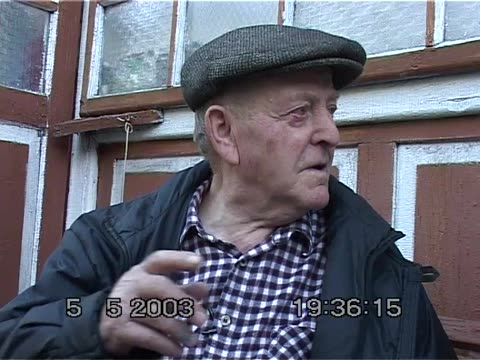
This tape begins in the middle of a formal interview with Isaak Grigorievich Vainsheinboim in Slavuta. It begins with Professor Kerler asking questions related to Yiddish linguistics.
From the machine transcript
Kerler asks Vainsheinboim about the difference between a rav and a rebbe, including the Hasidic rebbe (a 'good Jew' whom non-Jews also visited), and about their plural forms. Vainsheinboim answers briefly, and Kerler then turns to his war years.
Mainly questions on the terms rav and rebbe and their plurals, plus non-Jews visiting a rebbe.
Vainsheinboim describes his wartime experiences as a tank mechanic/driver on the Belarusian front.
From the machine transcript
Vainsheinboim recalls his war service as a tank mechanic and driver on the Belarusian front. He describes a long mortar bombardment near Berlin, a mortar crew member collapsing from exhaustion, and a later mortar hit that killed comrades. He mentions repeated recommendations for decorations and his pension today.
Gives specific battle episodes near Berlin and mentions his pension.
Vainsheinboim mentions that he participated in battles in and around Stalingrad and describes the difficulties there during the winter. He also speaks of his many awards and medals given for his service during the war.
From the machine transcript
Vainsheinboim speaks about Stalingrad: washing in the Volga in winter, hauling water and running naked to a tent heated by a stove, and daily fighting. He says he has fifteen to seventeen medals and three orders.
He ended the war in Berlin, and talks of liberating German cities along the way. He spent six months in Berlin after the war.
From the machine transcript
Vainsheinboim says he ended the war in Berlin, took part in a parade, and mentions Brandenburg. He stayed in Berlin six months after the war.
Vainsheinboim does not remember any converts to Judaism in his shtetl, but he does recall Jewish converts to Christianity. When he was young, he and his friends would throw stones at them.
From the machine transcript
Asked about converts to Judaism in Ostroh, Vainsheinboim says there were none, but remembers Jews who converted to Christianity. He and the other boys would run after them and throw stones as they rode to the monastery.
Mentions the stone-throwing at converts.
He describes the singing of zmires on shabes and shares a fragment of kol mekadeysh shvi.
From the machine transcript
Kerler asks about Sabbath songs (zmires); Vainsheinboim hums or sings a fragment of one and says that after the war he did not go to pray because it was not allowed. Kerler also prompts for other melodies, and Vainsheinboim comments on how prayer is done in America versus Ostroh.
Vainsheinboim shares his views on language and how loshn-koydesh words have changed change in modern Israeli Hebrew.
From the machine transcript
Vainsheinboim gives his view of how Hebrew words, such as shabes and the Bible, have been changed in modern Israeli Hebrew. Kerler adds his own remark about the Zionists' word for an orphan and then asks about synagogues.
He speaks about the sixteen synagogues in the shtetl, divided by profession. Some of these buildings were made from brick.
From the machine transcript
Vainsheinboim talks about the synagogues of Ostroh: the large Krasnohirka (?) synagogue, brick buildings rather than wooden ones, and about sixteen small prayer houses, including a tailors' and a shoemakers' synagogue.
He shares his memories of various Jewish holidays, including: how to build a sike with string and skhakh on Succoth; eating humentashen, sending shalkeh-munes and seeing pirimshpiln on Purim, as well as the pirim-bal parties for rich Jews; eating corn, buckwheat and potato lotkes and receiving khanike-gelt on Chanukah corn.
From the machine transcript
Vainsheinboim describes the sukkah with a roof raised by a rope, and Purim balls for the wealthy. For Hanukkah he recalls potato, buckwheat and corn latkes and giving Hanukkah money. Kerler also asks about shalakhmones and Purim plays, and the family seder where Vainsheinboim was the youngest.
Includes Purim balls and being the youngest asking the questions at the seder.
Vainsheinboim also remembers reciting the fir kashes, or Four Questions, at Passover and recites the first kashe for the researchers.
From the machine transcript
Kerler asks Vainsheinboim to sing the Four Questions and other Passover songs; he says he has forgotten most of them. The passage then moves to Soviet school and whether he belonged to a youth movement or the Party, which he does not remember.
Includes questions about Soviet school and youth movements.
Vainsheinboim describes the sheve-kikh in his town, a kind of cafe where he drank hot chocolate with rolls
From the machine transcript
Vainsheinboim describes a 'shive-kikh' (?) in Ostroh, where children were given rolls with cocoa. Kerler asks who organised it and when, and then asks about a fire brigade.
He also briefly mentions going to the Jewish library in Ostroh, which carried both Yiddish and Hebrew book.
From the machine transcript
Vainsheinboim says there were Jews in the fire brigade, with Soviet people, and then answers Kerler's question about the Jewish library in Ostroh, which held Yiddish and Hebrew books.
Professor begins asking questions from his sociolinguistics survey. Vainsheinboim in this context shares his perceptions of Lithuanian Jews and their hard to understand Yiddish, and explains several concepts, such as gefilte fish, the definition of dibek, different words relating to funereal practices and other topics.
From the machine transcript
Kerler puts a long sociolinguistic and dialectological questionnaire to Vainsheinboim. Items include the word for a Lithuanian Jew and how Litvaks spoke Yiddish, misnagdim and maskilim, and gefilte fish and its taste. They also cover tomato, vodka, dibek, golem, words for a cemetery, and many Russian sentences and words for him to put into Yiddish, among them comparatives, 'sick', 'run away', 'cross', 'house', 'head hurts', 'grandmother', 'breathe' and 'all Jews'. A bottle of zubrovka is also brought up.
Covers lexical items, sentence translation and the Ostroh dialect boundary.
The researchers purchase and share a bootle of alcohol with Vainsheinboim. As everybody drinks, he toasts lekhayem veloy lemuves! (To life and not to death!)
From the machine transcript
Kerler and the others share a bottle of vodka with Vainsheinboim and drink together. Kerler offers toasts to life and good health, and there is some talk about the camera and film.
Includes a toast and talk about the filming.
Professor Kerler returns to his dialectological questionnaire.
From the machine transcript
Kerler continues the dialectological questionnaire with Vainsheinboim. Items include words for 'half', 'attic', 'blue', 'belly', 'mouse' (singular and plural), 'house', 'pigeon', 'groats', 'rich man', 'ditch', 'boy' and the word for a shpilke. Kerler repeatedly asks for forms as said in Ostroh, then wraps up.
The camera cuts to the research team being shown an old wooden synagogue to which brick walls have been added.
From the machine transcript
At an old wooden synagogue, Kerler and Fish and others discuss the building and what survives inside. They note that the original wooden structure is hidden behind brick walls, and Kerler hopes that Jews will pray there. Fish says that Jews were a large share of the population in the region and that they were all killed.
The tape then switches to a formal interview (Part 1 of 2 See MDV 640) with Moisei (Moyshe ben Zalmen) Zelmanovich Fish b. March, 1922 in Rivne. He talks about how towns and villages in the area were heavily Jewish before the war, but most of his family was lost during the war. His son lives in Russia, near Finland. He can read and write in Yiddish.
From the machine transcript
Fish gives personal information in his interview: he has no relatives in Saransk (?) and in Rivne only his sons, and his middle son lives in Karelia in Russia. He gives his name as Moyshe ben Zalmen, his surname and address, and his phone number and postal code, and says he was born on 13 March 1922. Kerler notes the date of the interview as the sixth of May 2003, the first in Rivne.
Includes the interview date, Fish's address and phone number, and his birth date.
Fish begins to discuss his family life in the pre-war era. His father was known as Zalmen der Miler (b. 1883 in Koloniya Olizarka) since he worked as a house-builder and brick-layer, a profession called miler in that region. Fish remembers his father being called to the Torah in synagogue as Zalmen ben Reb Shleyme-Khayim haLeyvi. His mother, Khaye, was born in 1887 in Zholuds’k, a nearby town. His parents moved to Rivne at the start of World War I in 1914. Since birthdays were not celebrated in his youth, he does recall the day his parents were born, but only the years. His mother worked as a balebuste and raised the family’s five children, of whom he was the youngest. His siblings included: Etl-Raytsl Gratsh (b. 1904), who was married to Pinkhes-Refuel, and with she had three children. The first of these children was named Berl (b. 1925) at birth, but as he was a sickly child, he was brought to the Rovner Ruv, who renamed him Alter [This short story is found at 00:58:42-00:59:32]. The other two children in this family were: Peretsl (b. 1935) and Gitele (b. 1941). This whole family was killed in the early years of World War II.
From the machine transcript
Fish describes his family before the war. His father was Zalmen der Miler, a bricklayer and house builder, born in Koloniya Olizarka (?), and his mother Khaye was from Zholuds'k. The family built a house in Rivne in 1932 and had five children. He gives the names of his eldest sister and her children, including a nephew renamed Alter because he was sickly, and says they were all killed in the war.