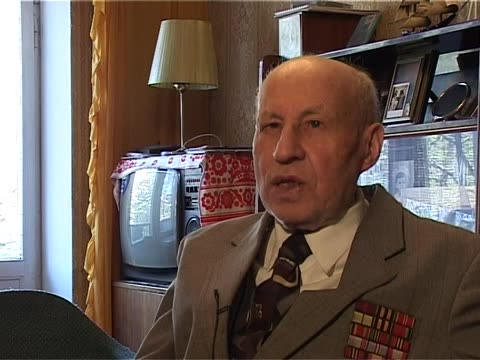
This tape begins in the middle of a formal interview with Moisei Zelmanovich Fish. He further describes his pre-war family life. His siblings further included: Mordkhe-Yoyne (b. 1909), who worked as a tailor. He was married to Rukhl (b. 1915); they had one child: Gitele (b. 1939). Fish had two more sisters: Genye-Leye (b. 1913), who married Ayzik Bednyi (b. 1912) (both killed); and Miryem (Mirl) (b. 1918), who married Berl Plotnik (b. 1910) seven days before Germans entered Poland. Fish states that he had approximately one hundred relatives before the war, but does not remember them all.
From the machine transcript
Fish continues listing his siblings and their fates: a brother who was a tailor, with his wife and a small daughter, and two sisters, one married shortly before the German attack on Poland. All the family were killed, and Fish says he had more than a hundred relatives. Kerler and Fish discuss the dates of the outbreak of the war and the Soviet and German entry into Rivne. A mention of a cousin in Israel and a visit to Yad Vashem opens the passage.
Also includes the discussion of the date of the German invasion and the cousin in Israel.
Fish shares his memories about his childhood, early education and pre-war Rivne. He started going to a kheyder at 3.5 years of age where he learned how to pray. According Fish, pre-war Rivne had a population of 40,000 people, 85% of who were Jews. There were 44 synagogues in the town, which were always packed during holidays.
From the machine transcript
Fish describes his early childhood in Rivne. He began kheyder at about three and a half, with a private teacher of the Yedlen (?) family, and learned to pray. He gives the size of prewar Rivne and the Jewish share of its population, mentions the many synagogues that were crowded at the major holidays, and says the family lived on Dombrovska Street.
Names the kheyder teacher's family and the street where the family lived.
One synagogue remained opened during Soviet times on School Street, but this institution was closed in 1955. Fish also speak in more detail about the establishment of Soviet authority in 1939.
From the machine transcript
Fish answers Kerler's questions about when the last synagogues in Rivne were closed under the Soviets, giving the mid-1950s. He says there were no Jewish schools under Soviet rule, only state schools in Russian, and that in 1939–41 the Soviets merged all schools without setting up Jewish ones.
The School Street synagogue is not clear in the transcript; the passage focuses on Soviet schooling.
Education: Fish went to kheyder until age five. At the age of five-six years old, his father got him a personal teacher, who for an hour a day in the afternoon would teach him how to pray. There were approximately 20-30 kids in kheyder. He would learn liturgy, the hagode, the fir kashes for Passover and other religious texts. Fish then recites a fragment from fir kashes from memory, but reports he could do it better if he had the text to read in front of him.
From the machine transcript
Fish returns to kheyder and the private teacher who came to his home daily for an hour in the afternoon. He recalls learning to pray, and the Haggadah and the four questions before Passover. He tries to recite them, says he knows prayers by heart, and notes that he is a leader (gabbai and cantor) in the Jewish religious community.
He is a leader/cantor [gabe un aleyn a khazn] in the local Jewish religious community.
From the machine transcript
Kerler asks whether there is anyone in Rivne who can lead prayers and whether the term for a prayer leader was used; Fish does not recall it. Kerler then begins to ask about friendships in his youth.
The catalogue gives Fish's role as gabbai and cantor, but this passage is mostly Kerler's questions.
Fish continues to describe his education: at the age of seven he began to attend a “shule,” a Polish-language Jewish school for seven years. There the students spoke Polish to the teachers (who were ethnic Poles) and Yiddish among themselves (only Jews).
From the machine transcript
Fish describes attending a seven-class Polish state school from age seven. The pupils were all Jews, the teachers were Poles, and the pupils spoke Polish to the teachers and Yiddish among themselves. Kerler asks whether the teachers knew any Yiddish.
There were a few individual non-Jews who spoke Yiddish. Fish yells a story about one ethnic Russian who spoke Yiddish “exactly like a Jew” to him in the post-war period. He had grown up in a village populated almost entirely by Jews and the children played among themselves in Yiddish.
From the machine transcript
Fish speaks about non-Jews who knew Yiddish. After the war, the manager of a restaurant, a Ukrainian woman, spoke pure Yiddish to him, having grown up in a small town with many Jews. He says Poles and Ukrainians did not learn Yiddish, and that streets with twenty or thirty houses had only one or two non-Jewish ones. A second voice asks about children's games.
The catalogue calls the speaker ethnically Russian, but the transcript suggests a Ukrainian woman working in a restaurant.
Fish then remembers his own childhood games: football (soccer) played with a ball of rags, volleyball, handball and checkers.
From the machine transcript
Asked about children's street games, Fish recalls playing football with a ball made of rags in a sack, volleyball, handball and checkers. Kerler asks for the Yiddish word for ball and about a game called kaldovane (?), which Fish does not know.
Adds Kerler's questions about the Yiddish word for ball and the game name.
In the 1930s, he would participate in Shomer Akiva, a socialist youth group, where young people learn how to work, dance and singing. He then sings a fragment of the movement’s anthem in Yiddish [starting 21:20]. At the club, the young people learned Jewish history, as well as different songs in Yiddish and Hebrew.
From the machine transcript
Fish talks about the Zionist-socialist youth movement Akiva in Rivne, where members studied Jewish history and sang in Yiddish and Hebrew, without observing kashrut. He sings a fragment of the movement's song, names its leader as Khayim Mekel (?), and mentions the Hatikvah. He then recites a rhymed Yiddish–Hebrew word list he knew from childhood.
Adds the Hebrew-Yiddish rhymed word list that begins at the end of the passage.
Fish then sings a Yiddish-loshn koydesh rhyming song, which he learned from his mother.
From the machine transcript
Fish continues the rhymed Yiddish–Hebrew word list, naming pairs such as dove, fire, water and meat, and ends with a toast. He says he learned it from his mother, who died in the war, and that Soviet life made people forget much of what they knew. He adds that he did not feel badly under the Soviets, being a chief bookkeeper.
Fish briefly comments on the difficult realities of Jewish life in the Soviet Union and why his children do not speak Yiddish.
From the machine transcript
Fish briefly comments on the state of Jewishness in the Soviet years and says his children do not know Yiddish because it was spoken less at home. He then mentions finishing the seven classes.
After 7th grade, fish a entered Polish-language Jewish gymnasium, where he learned Jewish history, Hebrew language and bookkeeping. He finished in 1939 three months before war, and worked for two months before war started. After the war, he completed a higher Soviet accounting institute.
From the machine transcript
Fish describes the Polish-language Jewish commercial gymnasium he attended after the seven classes, where he studied bookkeeping, Jewish history, religion and Hebrew; the teachers were Jews and the director's name is given as Yosefsberg (?). He finished a few months before the German attack, worked three months, and after the war completed a Soviet trade institute.
Names the gymnasium director.
He then describes his experiences during the war years: He relates how and his brother’s wife’s brother ran on foot to Kotsk at the former Soviet-Polish border, eventually being officially evacuated to a Korean kolkhoz in Kazakhstan. There, he worked in rice fields, and then in the bookkeeping office. He wanted to serve in the army, but was sent back because he was a former Polish citizen and did not speak Russian well. He wanted to be closer to the front to know what was going on in the occupied territories and so moved to Stalingrad to work in a war-factory for two months and was finally mobilized and sent to front in 1942.
From the machine transcript
Fish tells of fleeing Rivne on foot with his brother's wife's brother, just before the Germans entered, heading east. He describes the chaos, trains via Novograd-Volynskyi and Kyiv, evacuation to a Korean kolkhoz in Kazakhstan where he worked in rice fields and bookkeeping, and being refused army service as a former Polish citizen. He then went to Stalingrad to a war factory, and was mobilised in 1942 into the sappers; he describes the siege, the encirclement and the winter, and the move to Kursk.
Adds the Kyiv leg, the Voronezh stop and the Kursk front, beyond Kotsk and Stalingrad.
Fish then details the final years of the going through Belarus, Poland and Germany, where he was wounded in the leg by grenade shrapnel. He moved back to Rivne in 1946 and found a job as the head account in Restaurant Ukraine, where he worked until 1982. In 1946, Fish married a Jewish woman from Kalinindorf, one of the Joint-supported Soviet Jewish kolkhozy, where she attended a Yiddish school. Fish and his wife had three sons: the middle son lives in Russia, andthe others live in Rivne.
From the machine transcript
Fish follows his army service from Kursk through Belarus, Poland and Germany, where he was wounded in the leg and later took part in the battle for Berlin. After a short officer course he was demobilised and, after a stay in a Moscow hospital, returned to Rivne in February 1946, where he found his house occupied. He began work as chief bookkeeper at Restaurant Ukraine, studied at an institute, and married Ida from the Jewish colony Kalinindorf; they have three sons and six grandchildren, and one son lives elsewhere.
Adds the Berlin battle and the Moscow hospital stay.
He describes the early post years in greater detail and tells about how he met his wife, Ida. They were quickly married in the ZAKS (Official Marriage Registration Bureau) then had a religious ceremony later.
From the machine transcript
Kerler asks about his first days back in Rivne. Fish recalls finding his father's house occupied, meeting friends at the market and staying with them, and trying to recover documents. He then describes meeting his wife Ida; they registered the marriage at once, without a wedding, and had a religious ceremony months later. She lived with him forty-eight years.
Also covers the occupied family house and his friends' help.
Fish also reflects on how he and his wife prepared to immigrate to Israel, but could not go in the end because of his wife’s health.
From the machine transcript
Fish speaks about his wife's illness and how he thought of emigrating to Israel with her but could not. He continues recalling his first days of work, being offered the job of bookkeeper at a restaurant, and the high food prices in the early postwar years.
Adds the early postwar food prices and the job offer.