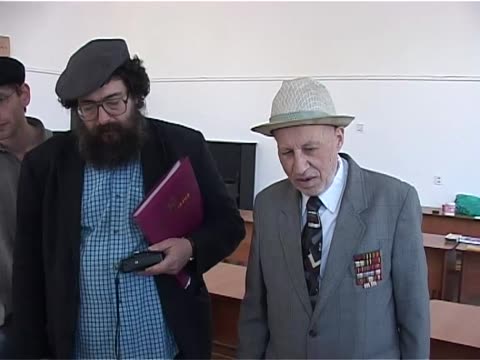
This tape begins with footage of the researchers at dinner at the Jewish community center with an ethnic Russian woman practicing her English; her late husband was Jewish and her in-laws were both teachers in Rivne.
Dinner at the community center with a Russian woman who wants to practise English with the visitors. She says she is Russian, her husband was Jewish, and his parents were teachers in Rivne. She also mentions her long teaching career and a small pension. Kerler and Veidlinger respond and compliment her English.
The woman also speaks of her pension and 40 years teaching.
The camera cuts to Moisei Zelmanovich Fish showing the researchers around the community center/ synagogue stopping at photo exhibits on war veterans, war victims, and the Jewish mass graves found in villages in the 1990s.
Fish shows the visitors photographs of mass graves in villages of Rivne oblast, including Sosnovye/Sosenki (?), and explains where the Jews were shot and bones found. He says the memorials date from the 1990s and that all Jews, young and old, were killed because they were Jews, and that his whole family lies there. He remarks that half of the old community members have left or died.
The exhibit includes mass-grave photographs and Fish's own family's fate.
Fish explains that the building is the former tailors' synagogue, since each trade had its own synagogue in Rivne. The Great Synagogue, now a sports hall, was closed in 1955. Kerler asks about Yiddish newspapers; Fish says they come from Birobidzhan and he distributes them among the community.
Fish gives a small English-Hebrew booklet with memorial prayers to Professor Kerler so he can say the proper blessing at the mass graves where some of his relatives lie.
Fish gives Kerler a small prayer booklet so that he can say the Kaddish at the mass grave of his mother's family. Kerler thanks him and names the relatives lying there.
Fish then describes contemporary religious services in the synagogue: he reads the service aloud in Hebrew as tradition dictates, while the congregants follow along in Russian. The community does not have a Torah Scroll.
Fish describes services today: he reads the prayers in Hebrew and the congregants follow in Russian because few can read Hebrew. Kerler asks the Yiddish terms for the prayer platform and the ark. Fish says there is no Torah of their own; one is brought for the holidays. Kerler then asks him to tell about Jewish life in Rivne today.
Fish talks about Jewish life in Rivne after World War II. Few local Jews survived, he says. Post-war Rivne Jews were either locals who had served in the army or migrants from nearby small towns. During perestroika, in 1989 a Jewish communal organization known as the Osher Shvartsman Rivne Jewish Cultural Organization, was founded. They rented a room from the Ukrainian owner of the former tailors’ synagogue. In 1990, they established a religious Jewish communal organization, to the synagogue was restituted by the Ukrainian government. Fish was the accountant for the cultural organization from 1989 to 1997, and has been involved with the religious community since 1995. He also briefly speaks about relations with younger Jews and other Jewish organizations in the city.
Fish tells of Jewish life in Rivne after liberation: few local Jews survived, and the community was made up of returnees and newcomers from small towns. A Jewish cultural organization named for Osher Shvartsman was founded in 1989, rented a room in the tailors' synagogue, and in 1991 registered a religious community and had the building returned. He was its bookkeeper and has been gabbai and cantor since the mid-1990s. He explains that younger leaders of the other Jewish organizations and the Hesed do not attend, and that only three community members are native Rivne Jews.
Gives the dates and the organizational history, his roles as bookkeeper and gabbai/cantor, and the relations with other Jewish groups.
Fish describes the Jewish cemetery in contemporary Rivne, the religious leadership of the community in the late 1940s and mixed marriages in recent years.
Fish speaks of the old Jewish cemetery, destroyed by the Soviets and replaced by a school, with only a small mixed plot left. He says there is no holy place or tsadik's grave in Rivne and that no real rabbi remained after 1941, though Hasidim once visited. He mentions Ben-Gurion's visit and cantor Kusevitsky's broadcasts. He then explains that Jews and mixed families receive meals and help from the community.
Also covers Hasidim, famous visitors and the community meal program.
Fish takes the interviewers to the former Great Synagogue (a sports hall) and he describes the paintings and inscriptions that used to be on the wall, as well as his memories of the town’s cantors.
At the former Great Synagogue, now a sports hall, Fish describes the women's section, the bimah and the Torah ark, and the paintings and Hebrew inscriptions (animals, the Shema). He recalls famous cantors, particularly Kusevitsky, whose services drew crowds outside. He also says the synagogue worked until 1955 and later became a sports hall, and the visitors discuss a small icon.
Fish and the research team then talk to the sports hall’s administrators about the possibility of putting up some kind of signage to indicate the past of the building for tourists.
Outside, the researchers and Fish talk, largely in Russian, with the sports hall's staff about putting up a sign marking the building's past for tourists. They mention the number of synagogues once in town and Fish says he was born in Rivne and his family were all shot.
Fish shows the interviewers old Jewish buildings while walking through the streets of Rivne. He remembers old Yiddish theater performances, reports on old communal institutions, and points out the old Polish and Jewish sport stadiums, where the Jewish sport teams played.
Walking through Rivne, Fish points out former Jewish buildings and streets, including the Jewish bath and mikveh, and recalls Yiddish theater and a solo performer he saw with his brother. He describes the Jewish football team and the Polish and Jewish stadiums, and a quarry site near Yanova Dolina (?). Kerler asks him to tell the stories again at home.
Fish and the interviewers ask a passer-by, speaking Ukrainian and Russian, where the prewar bath was. He remembers a bath and a library near it, and they note another former synagogue site.
Fish shares his personal recollections of the town’s pre-war baths and mivkes. He also speaks about growth of Rivne after the war, and how Christians move into former Jewish homes.
Fish recalls going with his father to the Jewish bath on Fridays, and the mikveh inside it. He says the city was smaller than Tarnopol (?) and that after the war the Soviets rebuilt it and Christians took over the emptied Jewish houses. He recalls his brother's synagogue and says each trade had its own synagogue, with some forty-four in Rivne.
Adds the number of synagogues claimed and the Jewish homes occupied after the war.