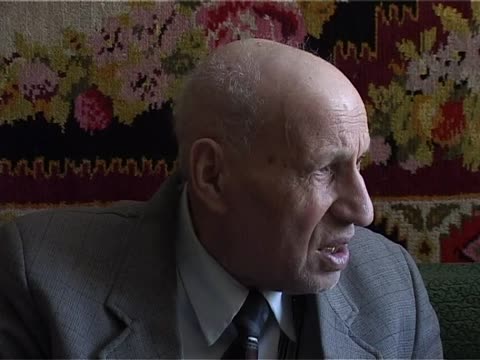
This tape is a continuation of a formal interview with Moisei Zelmanovich Fish.
From the machine transcript
Fish describes his housing in Rivne: the father's house on a side street had no running water, and he had an operation in the 1940s that left him unable to carry water or fuel. He later moved into a cooperative house and bought into it, and says he worked throughout. Kerler then turns to questions about the prewar bathhouse.
Fish talks about his own housing and health, and Kerler introduces the bathhouse topic.
Fish describes the pre-war Jewish bathhouse and swimming in the town’s rivers.
From the machine transcript
Fish describes the prewar Jewish bathhouse in Rivne, where there was no shower or bathtub room. Before the Sabbath the family heated and carried water for the bathhouse, and he went there with the hired non-Jewish attendant. He also covers the ritual bath and the separate women's section. In summer the children swam in the river and at a lake outside town, where they sunbathed and rested, but nobody bathed in winter.
Besides the bathhouse, the passage covers the ritual bath and summer swimming at a lake outside town.
Fish then reminisces about the Jewish sports stadium Hasmeneye and its famous, successful Jewish teams.
From the machine transcript
Fish recalls the stadiums of prewar Rivne. A Jewish stadium (whose name is given in the transcript as Hasmoneia, doubtful) stood on one side and a Polish stadium on the other. He speaks of the famous Jewish and Polish teams, which the children followed, and of newspaper coverage of them.
The passage also covers the Polish stadium and the children's following of the players.
He then talks about Yiddish and Polish-language Jewish newspapers from before the war.
From the machine transcript
Fish speaks about prewar newspapers: Jewish papers in Polish, some brought from Warsaw. He cannot recall a Rivne Yiddish paper, and he mentions the very low prices of papers and bread in Polish times.
Fish also mentions the low prices of the time.
Fish explains the concept of a Git Yid (Good Jew), as he understands it, not connected to Hasidism or tsadikim, but to particularly generous people.
From the machine transcript
Fish says he knew nothing of Hasidim or rebbes in Rivne. He explains a "good Jew" as someone who gives help and charity to the poor. As an example he describes a Rivne cloth shop whose owner gave small coins monthly to long lines of poor people, and he mentions that he worked briefly as a bookkeeper there after the gymnasium.
Fish gives an example of charity from a Rivne cloth shop and mentions his own bookkeeping job.
He describes the differences between a Rabbi, who certified marriages in the pre-war period, and a tsadik, who was a very learned man, immersed in the “kleyne eyselekh” (“in the fine print,” i.e. the details of Jewish religious law).
From the machine transcript
Fish distinguishes a state-appointed rabbi, who issued birth, marriage and death documents before the war, from an ordinary rebbe, who could be a teacher or pray in a synagogue. A tsadik, he says, is very religious and learned, knows the fine details of the law and can interpret the Torah.
The passage also covers the state-appointed rabbi who issued documents.
Fish then elaborates on the concept of erlikh (piety/decency/honesty) and relates it to debates on assimilation in America and global Jewish politics.
From the machine transcript
Fish explains the word for an honest or pious person (erlekher) as meaning someone who prays daily and keeps the laws, and says that in Rivne it was treated as the same as a religious one. Kerler and S2 ask about other terms, which he does not know. Fish then reflects on assimilation, the Jewish population in America and Israel, and mixed marriages.
Fish also gives views on assimilation, mixed marriage and population figures; S2 joins the questions.
Fish describes the Jewish youth clubs of pre-war Rivne.
From the machine transcript
Fish says Jewish youth clubs in prewar Rivne included the Shomrim, and that he himself attended a club for a few years. His friends all belonged to the same club, which met in the evening on Shkolna Street, and he recalls the club's location near the bathhouse. Kerler then asks about the fire brigade.
The passage also locates the club on Shkolna Street, near the bathhouse.
Jews were not members of the fire brigade, police department or state bureaucracy, according to Fish, but did hold highly respected positions in Soviet times as doctors, lawyers, or in the army.
From the machine transcript
Fish says no Jews were in the police or the state bodies before the war. In Soviet times there were Jewish prosecutors, lawyers and generals. The Soviets ruled for two years before the war and closed Jewish schools and organizations. S2 joins in with comments.
Fish adds the closing of Jewish schools and organizations by the Soviets.
Professor Kerler begins his survey of sociolinguistics and dialectological questions, in which context Fish discusses his attitudes towards “Askhenazi vs. Lithuanian” Yiddish, gefilte fish recipes, gefilte fish, and Jewish drinking practices.
From the machine transcript
Kerler begins a questionnaire on language and customs. Fish discusses Lithuanian, Galician and Ukrainian varieties of Yiddish and the accents of different regions, and says he prefers the Yiddish his mother spoke. He answers questions about gefilte fish (stuffed and not too salty or sweet) and gives Yiddish words for several foods such as tomatoes, sausage, plums and grapes. He also answers about filled pastries and strudel, and about Jewish drinking, such as vodka at a minyan.
The questionnaire includes the dialect varieties, food terms and drinking customs.
Fish compares Jewish weddings from before the war (with their klezmer musicians, specially hired cooks, and a special person hired to greet the guests at the door of the wedding party), to those in Soviet times and weddings today.
From the machine transcript
Fish compares prewar Jewish weddings with Soviet-era and later ones. Before the war a big wedding had hired klezmorim and cooks, someone to greet the guests, and a proper chuppah, whereas after the war weddings were held in restaurants, often in Russian. He mentions his brother's and sisters' marriages but cannot recall the title of the greeter.
Fish adds family details (his brother and sisters) and the shift in wedding language to Russian.
Before the war, according to Fish, Rivne had its own Yiddish theater. After the war, Nehama Lifshitsaite and other Yiddish performers came to the city.
From the machine transcript
Fish says that after the war some Yiddish artists, including a Lithuanian woman singer and an accordionist, still came to Rivne, but Jewish audiences had dwindled. He mentions the Hesed. Kerler asks about prewar Yiddish theater, and Fish recalls a Yiddish theater under Polish rule that his brother took him to as a child.
Fish also mentions the Hesed and the prewar Yiddish theater.
Fish briefly reflects on different Jewish holiday celebrations.
From the machine transcript
Fish answers questions about Purim and Shavuot. He says a Purim play might have been held in the Jewish gymnasium but he did not see one. He says Shavuot food was dairy, with cheese and blintzes (terms discussed).
Fish also answers about Shavuot dairy food.
Professor Kerler continues with his linguistic questionnaire.
From the machine transcript
Kerler continues the questionnaire with the word dibbuk. Fish explains it as a spirit entering a person, describes the exorcism by rabbis, and recalls the Yiddish film The Dybbuk and its song, shown in Rivne.
Fish also recalls the Yiddish film Der Dybbuk and its song.
Fish sings a fragment of a variant of Yidl mitn Fidl and mentions a movie theater in Rivne that showed some Yiddish films as well as silent films with Polish intertitles.
From the machine transcript
Fish sings a fragment of a song about Yidl mitn fidl and recalls the Yiddish film of that name. He describes the cinemas in Rivne, where Yiddish films were shown, a theater behind the bridge, and silent films with Polish intertitles. He says Yiddish titles were not available because Jewish youth studied in Polish schools.
Fish describes the cinemas of Rivne and the language of silent-film titles.
The rest of the interview consists of further questioning related to linguistics and dialectology.
From the machine transcript
The rest of the tape is Kerler's dialectological questionnaire. Fish gives Yiddish words and phrases for kinship (father-in-law and mother-in-law, grandmother, grandfather), adjectives such as sick and ill, words for building and for deserters, and numbers. He also translates sentences about walking on, across and along the street, and often explains in Russian. Kerler also discusses a Polish word for settlers in the Rivne area.
The questionnaire includes kinship terms, sentences with prepositions of place, and sentences about illness.