Recordings › Rivne

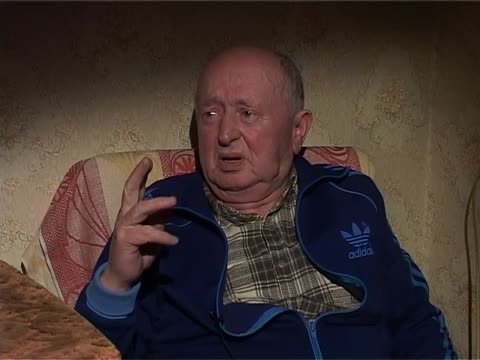
MDV 644 · Zorekh Motelevich Kurliandchik

Rivne, Ukraine 6 May 2003 Interviewed by Dov-Ber Kerler, Jeffrey Veidlinger Part 2 of 2 45 min · 5 passages

One conversation with Zorekh Motelevich Kurliandchik, continuing over MDV 643, MDV 644.

This tape is not yet on the project's channels.
Watch it on Media Collections Online — the time links below open the player there at the right moment.
Passages

0:00

This tape is a continuation of a formal interview with Zorekh Motelevich Kurliandchik. He recalls the first Yom Kippur in Novohrad-Volyns’kyy after the war with his sister-in-law and her mother’s constant urging that “If you’ve survived, you must fast”.

after the war Other holidays · MCO
From the machine transcript

Kurliandchik recalls returning to Novohrad-Volynskyi after the war, when a few Jews had come back. His sister-in-law and her mother tell him that those who survived must fast on Yom Kippur. He also describes his school class, in which few of the eleven girls and nine boys survived, and says about half the town was Jewish before the war.

Also covers his school class and the town's Jewish share of the population.

3:32

Kurliandchik relates some of his official anti-religious education in the early Soviet period, such as the staged royte seyders (“Red” Passover Seders) in school while he was a pioneer. He then sings a fragment of a Communist Jewish New Year song, and recites the words from a variant of the famous Soviet Yiddish song Dzhankoye.

SingingRecitation before the war Soviet systemOther holidaysPassoverSongs and musicSchooling · MCO
From the machine transcript

Answering Kerler, Kurliandchik recalls the anti-religious campaigns at school, especially the staged "red seder" held while he was a pioneer. He did not join the Komsomol, as his mother objected. He sings a fragment of a Soviet Rosh Hashanah song and then, prompted by Kerler, a variant of Dzhankoye.

5:40

Kurliandchik lived for two-three years on a Jewish kolkhoz [collective farm] in Crimea from 1931 to 1933. He emphasizes the help the collective farm received from Agro-Joint, including the technological assistance that was so impressive that the Tatars would come just to stare at it.

From the machine transcript

Kurliandchik says he lived in a Jewish kolkhoz in Crimea from 1931 to 1933 and gives its location. The family returned because the climate was bad for his mother. He credits Agro-Joint with great help, including tractors, which the local Tatars came to look at. He answers Kerler's question about Mikhoels (he did not see him) and mentions the Yiddish theater in Chernivtsi.

Adds the reason for leaving Crimea and the talk about Mikhoels and the Chernivtsi Yiddish theater.

9:25

He also recalls reading the Soviet Yiddish press at home before the war, including papers such as: Der emes (until 1948) and Der shtern.

before the war Yiddish literature and press · MCO
From the machine transcript

Kurliandchik names the Soviet Yiddish newspapers read before the war, Der emes (until 1948) and Der shtern, which came to Novohrad-Volynskyi. He also mentions Eynikayt and the journal Sovetish Heymland. Kerler asks how they were obtained.

Also covers Eynikayt and Sovetish Heymland, and how the papers were received.

11:31

The camera cuts to later in the same interview. Professor Kerler begins his sociolinguistic and dialectological questionnaire. In this context, Kurliandchik discusses tsadikim, words pertaining to funereal customs and the differences between various dialects of Yiddish as he perceives them, among other topics.

From the machine transcript

After a cut, Kerler begins his questionnaire (the first part is garbled). Kurliandchik answers about the expression "a gutr yid" and the tsadik, and says he once visited a rebbe in Chernivtsi. He is asked about terms for the cemetery and graves, the Lithuanian Jews and how their Yiddish differs from his, and the word dibbuk. Much of the rest is translation and elicitation of Russian words and sentences into his Yiddish: please, late, earlier, cold, high, soon, near, evening, very, beautiful, ill, build, head, mouse, soup, groats, attic, well, street, road, and kinship words. Some dialect forms are discussed, with a few Russian remarks from a second person.

Adds the long questionnaire on grammar, vocabulary and dialect differences.