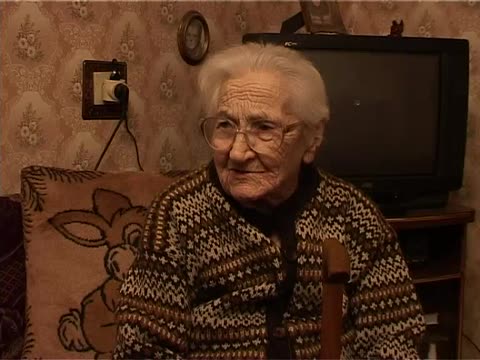
This tape begins with a formal interview with Maria (Makhlye) Leibovna Frayerman née Khiterman. She was born in 1915 in Berezdov, a small town not far from Slavuta that was populated primarily by Jews before the war. In the 1930s, she worked for two years as a bookkeeper in a village called Kutki and then moved to Novohrad-Volyns’kyy in 1933.
From the machine transcript
Opening chat about coffee and her sons, one of whom lives in Novohrad-Volynskyi, which many Jews have left. Frayerman then gives her birthplace Berezdov, in Slavuta district, where no Jews remain, and her work as a bookkeeper in the village of Kutki. She gives her Yiddish and Russian names, birth year and maiden name, and she and her son discuss her address in Novohrad-Volynskyi.
Includes talk about emigration of Jews from Novohrad-Volynskyi and a discussion of her street address.
Khiterman describes the hardships in those years relating to food shortages and famine.
From the machine transcript
Answers questions about the famine of the early 1930s, saying that hunger was general and that Russia fared a little better than Ukraine. Relatives in Leningrad sent parcels of bread, and each household baked its own bread. She came to Novohrad-Volynskyi at the end of 1933 and has lived there since.
She details the severe poverty of her childhood, but notes that it was nevertheless a happy time. Her father, Leybke worked with horses and died of typhus in 1919 when Khiterman was still young. Her mother, Khane, worked at home and as a cook. Khiterman had two younger brothers: Shaye and Shleyme.
From the machine transcript
Describes a happy childhood home in Berezdov with her mother, two uncles and a sister (?). Her mother was Khane (name heard as Khaye), and her father Leybke died of typhus around 1919; he worked in forestry, hauling timber for wealthy owners, and her mother worked at home and later as a cook. She names her two brothers, Shaye and Shleyme, who did not return from the war; they served as a pilot and in rocket forces.
Adds her parents' occupations and the fate of the brothers in the war.
Khiterman briefly talks about her family’s experience during the war. Her brothers were sent to the front, while she was evacuated to the Caucasus region.
From the machine transcript
Recalls the outbreak of the war, her evacuation, and letters from her brothers, who served as a pilot and in rocket forces. She was the eldest of three children. She worked in Novohrad-Volynskyi from 1933, and a bystander gives the town's alternative name.
Includes a discussion of the town's other name, Zvil, supplied by another person.
Khiterman returns to the subject of pre-war life in Novohrad-Volyns’kyy, describing her work in the town bank, the early death of her husband, Gershon, in 1943, and how she raised their two sons by herself. Khiterman also talks about her sons’ later careers in the military and shows off photographs of her grandchildren.
From the machine transcript
Frayerman worked in the bank and transport office in Novohrad-Volynskyi until the war. Her husband Gershon died in February 1943 (?), four months before the younger son was born, and she raised their two sons alone. Both sons became military officers, the elder a lieutenant colonel (?), and her son talks in Russian. She shows photographs of grandchildren and the family.
Adds her work at the bank and her photographs of grandchildren.
Khiterman shares the few memories she has of her father from before his death.
From the machine transcript
Frayerman says she remembers only one thing about her father, who died when she was four: he used to bring sweets from his pocket for the children.
Khiterman’s mother was a very pious woman [an erlekhe], but was frequently sick, and so the rabbi allowed her to eat on Yom Kippur. Khiterman tells other short stories about her mother and other family members from the pre-war period.
From the machine transcript
Her mother was a pious woman, often ill, and the rabbi permitted her to eat on Yom Kippur; her kitchen kept meat and milk separate. Her mother headed a committee helping poor families. She tells how she was kept from learning of her mother's death, which she heard of in Novohrad-Volynskyi only after her relatives told her much later.
Khiterman went to a religious teacher at the age of six who taught her how to read Hebrew and prayer, although she states that she remembers very little of “yidishkayt” outside of speaking Yiddish. Expanding on this point, Khiterman then comments on the lack of people with whom she can speak Yiddish in her everyday life.
From the machine transcript
She went to a teacher at about the age of six and learned to read Hebrew. She remembers nothing of the prayers and says she has not forgotten how to speak Yiddish. She now has no one to speak Yiddish with.
Khiterman shares her family’s gefilte fish recipe and comments on her mother’s cooking and baking.
From the machine transcript
Answers Kerler's questions on her mother's gefilte fish for the Sabbath. She gives the ingredients, in part in Russian, including pepper, salt, garlic and a little sugar. She recalls how her mother taught her to knead bread and bake cakes, cookies and other baked goods.
Khiterman also speaks about her sons’ inability to speak Yiddish. Her older son does speak some Yiddish, but, Khiterman laughs, with a very strong accent. Before the war, according to Khiterman, there were many non-Jews who spoke Yiddish. She remembers one such person, Nikolai, who spoke the language particularly well.
From the machine transcript
Discusses her sons' Yiddish: the elder speaks it with a strong accent, like a non-Jew. She says there were non-Jews who spoke Yiddish well and names one, Nikolai, who learned it among Jews.
Khiterman briefly comments on the many converts to Christianity from Judaism that she knows, stating that not even this strategy could remove their “fifth point” (ethnic nationality designation) in their passports.
From the machine transcript
Asked about non-Jews who became Jews, she knows of none. She says many Jews became Christians, but the 'fifth point' in the passport remained.
Khiterman speaks about her and her family’s difficulties reconciling religious duties with the harsh realities of everyday living. On this topic, her grandfather Alter would say: “vos mir zaynen, zaynen mir, ober yidn zaynen mir” (What we are is what we are, but [in the end] we are Jews).
From the machine transcript
She did not light Sabbath candles, since she had no opportunity: she worked on Sabbaths and holidays. She still says that a holiday is a holiday. Her mother baked with matzo meal for Passover, and her grandfather Alter used to say that whatever they are, they are Jews.
Khiterman's grandfather was descended from a family of cantors, and as such his family was very religious. They once went to Jerusalem, Khiterman reports, and brought back soil, which people would buy [for their burial plots] before they died.
From the machine transcript
Describes her grandfather as very pious and from a family of cantors. He had been to Jerusalem and brought back soil, which people took before they died. She is the only survivor of two families.
Khiterman explains that “they didn’t have time to sing” in her childhood as people needed to work in order to survive. Khiterman further clarifies, saying how she had to raise her two younger brothers after her mother died.
From the machine transcript
Answers Kerler's question about singing: she had no time and had to work. After her mother died she raised her two younger brothers. She recalls that the older, Shleyme (?), studied and later became an officer, and she mentions her children and grandchildren.
Khiterman describes how the children in her family celebrated Passover with a seder led by her grandfather Alter. This same grandfather would bake matzo for the whole family. Her mother celebrated the holiday separately with her siblings.
From the machine transcript
Answers questions about Passover: as children they held the seder at their grandfather Alter's table, while her mother celebrated with her own siblings. She tells of stealing the afikoman and getting presents. The grandfather had a matzo machine; his wife is named Sarah. She trained as a bookkeeper in a place whose name is unclear, perhaps Slavuta.
Khiterman describes the three synagogues in her town before the war, two of which were for poorer members of the community.
From the machine transcript
She describes the three synagogues in her town: a large one with a women's section, and two small ones that poorer people attended. She and Kerler discuss when they were closed by the Soviet authorities.
Her son shares his memories of going to synagogue in Novohrad-Volyns’kyy in the post-war period, stating that this place was closed down by the authorities in 1952-53. Khiterman further describes the synagogue in Novohrad-Volyns’kyy, and who went there. According to Khiterman, Komsomol (Communist youth league) members would receive penalties if they went to services in the synagogue.
From the machine transcript
Her son says in Russian that the Novohrad-Volynskyi synagogue stayed open after the war and was closed in about 1952–53. Frayerman recalls it as very beautiful on the street; Jews then prayed in private homes, mostly older people. Komsomol members who prayed were fined at work, and finding a minyan was hard. She ends with Jewish life in the town, with children singing Yiddish songs.
Includes the son's Russian account of the synagogue's closure and the fines on Komsomol members.
Khiterman describes Yiddish performances both from today and before the war. She once saw a production of Tevye the Dairyman performed by a troupe visiting from Kyiv. Khiterman also talks about a club in her town that would put on plays in Russian and Yiddish.
From the machine transcript
Discusses Yiddish performances: children singing Yiddish songs today, and prewar events. She saw a production of Tevye the Dairyman, probably by a Kyiv troupe, and the film later on television. She recalls the town club with a Yiddish drama circle putting on plays in Yiddish and Russian, and the amateurs included tailors and shoemakers.
Adds the club's amateur Yiddish drama circle and the amateurs' trades.
Khiterman shares her memories of her grandfather, explaining how he was a “sheyner yid”, a pious, decent and observant Jew. Her childhood, she states, was a very happy time.
From the machine transcript
Describes her grandfather as a 'sheyner yid', a pious and observant Jew who would not take money on the Sabbath. She and the other children visited on the Sabbath, where her grandmother gave them treats, and childhood was happy. Kerler asks whether Friday-night songs were sung.