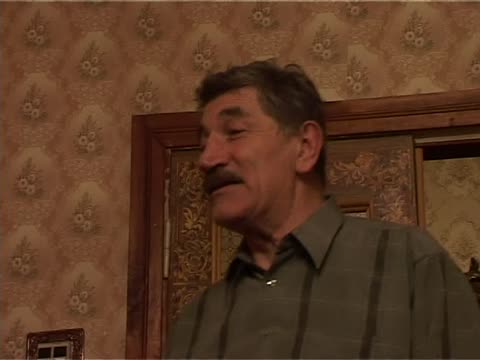
Kerler asks Khiterman about Jewish life in her town and what a 'good Jew' (a holy man or rebbe) meant. She answers that such men helped many poor people and that food was sent for Sabbath. A Russian exchange with a relative, probably her son, follows about whether she and others still speak Yiddish and about the language of the film. She says she once spoke Hebrew and had a teacher, but cannot remember his name.
Khiterman talks about the rabbi, the priest and a Hasidic rebbe and his wife in her town, and Kerler asks for terms such as 'pious Jew' and a pejorative for a Hasid. She mentions Jewish records she had at home and how she fled from the Germans leaving everything behind. Kerler asks how a Russian sentence about running away from the Germans is said in Yiddish. She then recalls the Germans of the First World War from her childhood.
adds the Yiddish dialectology questions and the flight from the Germans
Khiterman recalls a German who lived near the family before the war. She then tells how she spent the war in evacuation: Samarkand, Katta-Kurgan, and later the Urals (Molotov), where she worked in construction and then in an office or factory. Her husband died there. Kerler asks about antisemitism on the return home.
Khiterman says there was no antisemitism after the war. Kerler asks about Zionists in Berezhov (Berezov?), which she does not remember. She recounts being arrested in the early 1950s (?) and taken to Kyiv, apparently over a mix-up with a woman connected to a committee. She says her small child died in evacuation at Katta-Kurgan at the age of two and was named after her mother. Her relative, mostly in Russian, describes her poor health and how isolated she is.
adds her arrest and the child who died in evacuation
Khiterman says she had a Jewish wedding at home with a canopy, officiated by the rabbi of Berezhov (Berezov?), with many Jewish guests, music and singing. Kerler asks about the town, which had many Jews who were later killed. Her father was a forest overseer. Kerler then thanks her and winds down the interview.
The transcript begins at about 21:06. Shvartzbroit mentions having run a factory and relatives in America and Brazil. She says she made a film for America and that everyone from Mohyliv in Podolia was killed in the Pechera camp while she alone survived and told it all. Kerler proposes a longer interview and asks whether anyone born in Luts'k who speaks Yiddish could be found. A Russian-speaking woman starts telephoning a prospective interviewee. The speaker labels are muddled throughout.
A Russian-speaking woman telephones Evgenia Abramovna, a possible interviewee. Kerler introduces himself in Yiddish as a researcher of Yiddish from America. The woman is asked where she was born and gives a Volhynian village or town (Saprievka?) that was in Poland before the war. A callback is arranged. Shvartzbroit then starts to speak about her time in the camp, when Kerler turns to her.
adds the phone call to another prospective interviewee
Kerler formally begins the interview with Shvartzbroit. She gives her name as Etele Shnayder, now Shvartzbroit, patronymic Kalmanovna, and says her grandfather was a rabbi. They note her Yiddish is that of Mohyliv-Podilskyi. She names a man, Avraham Finkelshteyn (?), connected with her family or her coming to the interview. Kerler states the date as 8 May 2003.
adds her grandfather the rabbi and the Mohyliv-Podilskyi dialect
Shvartzbroit gives her name and patronymic for Kerler to write, with the Russian spelling of Kalmanovna. Her father and a son were both called Kalmen. She mentions her address, postal index and telephone.
Shvartzbroit speaks about her grandfather the rabbi, kosher Passover dishes kept in the attic, and her giving money to the poor for Passover. She mentions her husband's trade and travel to Romania and Moldova. She says her father arranged weddings for poor orphans in their home. She gives her birth year as 1928, though her papers say 1930, and says she came from Pechora aged about fourteen. Much of the passage is garbled and the sequence is unclear.
adds Passover customs, her husband's work and the dating of her birth
Shvartzbroit describes her family's life before the war: her father's sewing workshop with two non-Jewish servants, and her mother's weekly Sabbath help for old people whose wealthy relatives had been deported to Siberia by the Soviets. She also recalls taking in homeless people and giving her house for poor couples' weddings, and she mentions grandchildren in Germany and America.
Shvartzbroit names her father Kalmen and her paternal grandfather (Tsalik), and says her grandfather the rabbi played the violin. Her grandmother Etl kept a shop, and she herself is named after her. Another grandfather was a ritual slaughterer, and the family numbered about four hundred. Her father had a sewing workshop for fine garments. Kerler asks about a women's Sabbath headdress (shterntikhl), which she does not recognise, and she describes the Sabbath headscarf and the sealing of the cholent oven with clay.
adds the grandparents' names and trades and the headdress question
Shvartzbroit describes Sabbath cooking at home, including cholent, beans and fish kept in the cellar. She also describes Passover practice: separate kosher dishes, silver and clay pots kept in the attic, the first seder with candles, and the removal of all bread from the house.
Shvartzbroit says her mother worked with her father in the sewing workshop, which sent goods to Moscow and Leningrad until the late 1920s and 1930s. Her mother did not teach her to bless, lit Friday candles and worked on non-Jewish holidays. She lists the Jewish holidays and retells the story of Esther and Mordecai, offering Kerler a booklet. She says she had one sister and that both parents' fates and her sister's killing in Pechora are told here. She describes her father's death from an illness.
adds the Purim story, the list of holidays and her sister's death
Shvartzbroit names her sister Rivke and describes the deportation to the camp in cattle wagons, the Romanians and then the Germans, and the gold teeth pulled from prisoners. She tells of a Bessarabian Jew killed by a policeman, of Tulchin Jews like skeletons and of her mother. Her escape is told in detail: she walked about two hundred kilometres on foot as a child, hid in the forest and was helped by a non-Jewish woman, and some of it is hard to follow. She reflects that Jews are only guests in this world, and mentions a son in Israel and a daughter in Germany with two grandchildren, promising photographs.
adds her sister's name, the escape and her children abroad
Kerler and Shvartzbroit clarify who the visitors are, a professor of Jewish history and a Yiddish professor. She tells a religious parable about a rich man who wanted paradise and about Solomon asking for wisdom. She says she attended Jewish school no. 3 for four grades and that all subjects were taught in Yiddish. She names the director (Terk? the transcript is unclear), says she now reads Russian but can only sign her name in Yiddish, and says she has forgotten the old songs.
Shvartzbroit says an aunt knew Yiddish songs. Her son made a Yiddish concert and a Yiddish film. A composer friend is named (Gershenzon?), and a cassette is now with her daughter in Germany. She talks about a son named after her father who died at about fifty, apparently killed by a non-Jew, and who gave generously to the poor. She also mentions saving a family in a later period and her sense of obligation to her children.