0:00
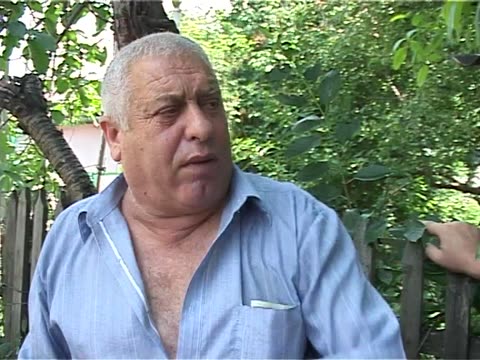
Yerikhman explains his views against emigration to Germany, Israel, etc. and why he is in love with his shtetl. His nephew Igor’ takes the team inside to look at and read from old religious texts. Scenes of Sharhorod and exterior of the synagogue. Yerikhman explains more about Jewish life in the shtetl as the team goes inside the synagogue (it is now a wine factory). More scenes of Sharhorod from the exterior of the synagogue. Screen goes black for a moment until it reveals Luda, his sister-in-law, inviting the research team inside Luda’s cafe-restaurant Dana (named after grandaughter). Dov-Ber Kerler explains to the camera that although Luda is not Jewish, she learned to speak Yiddish by talking with her mother-in-law. Luda understands most of the questions posed to her in Yiddish, but finds it easiest to respond in Russian. The research team meets and interviews “Bobe Klara” (Klara Lvovna Kurman), who was born in 1930 in Sharhorod. (Part 1 of 2. See MDV 660) Kurman speaks first of all about her family, including her grandfather Leyb the apothecary, her father Leyb the feldsher (born in Kam”yanets’-Podil’s’kyy, d. 1954), her mother Rivke (d. 1976) and siblings Boris, Etta and Misha. During the war, her family hid in a cellar in the house where she still lives. She remembers the Romanians and the Romanian Jews who came to Sharhorod during the war and how they paid for help.
Yerikhman argues against emigration, especially to Germany, saying people abroad struggle and that he is attached to Sharhorod, a Jewish shtetl, and answers Katz's questions about its future. The team then goes into the former synagogue, now a wine factory, with his nephew, who shows and reads from old religious books (a book of laments for Tisha b'Av, a handwritten letter, a kind of wedding gift); a man explains the building and the street. The team then sits in Luda's café-restaurant Dana, where Kerler explains that she learned Yiddish from her mother-in-law, and she and her family answer questions in mixed Yiddish and Russian about the town's Jewish population (a figure of 4,000 is mentioned), emigration, and her son Igor'. Finally the team meets Klara Kurman, who gives her name and her parents' names (father Leyb, a feldsher; mother Rivke), mentions her grandfather as an apothecary, and begins describing her work and hiding in a cellar during the war.
Adds the café scene with Luda's family, the discussion of Sharhorod's Jewish population and emigration, and Kurman's cellar and wartime work.