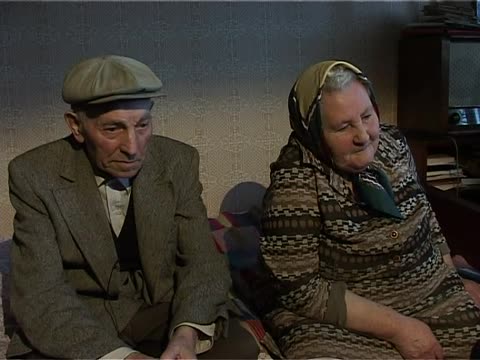
Kerler elicits Kleiner's Yiddish and official names, with a second voice helping with the Russian form. Kleiner was born in 1917 and moved to Shepetivka in the 1930s, where he worked in the post office. His father Avrom (Shike) was a butcher born in Lyakhovtsy near Yampil'. His mother Malke was from Yampil'. There were nine children, and Kleiner names several siblings. He alone survived, because he was in the army.
Gives the names of siblings and the birth date, which the catalogue label does not mention.
Kleiner recalls two years in cheder and the Ukrainian school. He says he was pressed to join the Pioneers and refused. He describes the synagogue, beis medresh and kloyz of Yampil' and the cheder teacher, known by a nickname from his house. He mentions the synagogue building's later use and his own part in the prayers. Kerler also asks about dialect.
Adds the Pioneers recruitment attempt and the description of the Yampil' synagogues.
Asked about his friends, Kleiner says they were both Jewish and non-Jewish. He recalls growing up poor in a family of nine children, and his eldest brother who worked in the fields. He was the only one of the family to survive and served in the army. He kept the Sabbath, worked with horses, and says he was a Jew. A second voice adds that he worked in the post office and was drafted in 1939.
Adds friendships with non-Jews and Sabbath observance.
The second voice says Kleiner served in the Far East, returned and was called up again when war began. He is now a retired major. After the war he worked in the post office, as did his wife and daughter. He says he never joined the Party, the Komsomol or the Pioneers.
Adds the refusal to join the Party and other organisations.
Kleiner answers questions on Sabbath, going to synagogue with his father, and the Sabbath and Sunday school days. He speaks about bar mitzvah, and Passover customs: removing and burning leaven and kashering. Kerler asks about holiday songs, and about Purim and Hanukkah. The terms for the river and for 'tehom' are asked. He says the Torah scrolls of Shepetivka were hidden and returned after liberation.
Adds the hiding and return of the Torah scrolls and the seven scrolls in Shepetivka.
Asked about the Jewish population, the second voice gives a figure of fourteen thousand for Shepetivka. Few Jews survived or returned, in Shepetivka or Yampil'. Kleiner used to travel to Yampil', about seventy kilometres away, and talks about the river.
Kerler asks the meaning of several words (a non-Jewish holiday, the cemetery, 'good place'), and about the sukkah in Yampil', and the house where the family lived. Kleiner recalls his older brother Nute, a learned young man who died. He remembers Sabbath songs and kiddush. Kleiner then sings the memorial prayer for those killed, with a few words about Yampil', Lyakhovtsy and Karnitsa. Kerler praises it.
Adds the sung memorial prayer and the sukkah and house descriptions.
Kerler asks dialect questions: the word for 'cantor', when Soviet rule came to Yampil', the word for mouse, and 'luck'. Kleiner and a second voice say that Shepetivka and Yampil' speech differ. Kerler comments that Kleiner's Yiddish is mixed because he was not in a Yiddish school and has lived in Shepetivka.
Adds the dialectological items and Kerler's remark on dialect mixing.
Kleiner describes his cheder teacher, Pinkhes, and the books studied, from age seven to nine. He says he finished ten classes and speaks Ukrainian well. He recites Ukrainian verse by Shevchenko. In the army he did not eat non-kosher food. He also says there were three ritual slaughterers in Yampil'. The Pioneer question comes up again.
The second voice says that they have a son in Chernivtsi and a daughter in Shepetivka. They discuss Jewish life today in Shepetivka and Khmel'nyts'kyi. There is a Hesed, but few Jews and few speak Yiddish. People are emigrating, factories are closed and pensions are small. After the war Yiddish was not taught. Kleiner has no one to speak Yiddish with; his daughter understands but does not speak it.