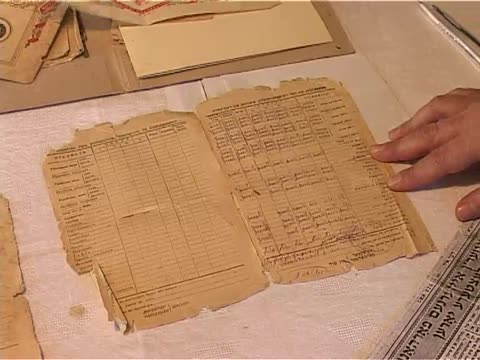
Liberzon and Kerler look at her school report cards and certificates from the Yiddish school. They name the subjects, such as arithmetic, algebra, geometry, history, geography, physics, chemistry, drawing, music and singing, and note the excellent marks, including for conduct.
Liberzon recounts the start of the war and how her family left Slavuta around the tenth day, with German paratroopers already there. They went on foot to Shepetivka, took few belongings and a school satchel, and sheltered under railway wagons during the bombing at Kozyatyn. A grandmother's bundle and the family's things were lost or taken.
Liberzon goes through documents and school books that survived. Some date from after the war, and she mentions a younger sister who died three years earlier. Kerler discusses getting a portable copier for the papers.
Informal talk with the team, partly in Russian, about drinks and tea, and about a visiting Polish photographer who publishes albums on Jewish sites. A microphone test follows. Liberzon remarks that Yiddish today is mixed with Russian words and that Yiddish speakers are rare.
Liberzon says she read Soviet Yiddish magazines and spoke Yiddish at home. Kerler steers her toward memories of the Soviet school. She then speaks of her father's love of music and singing, and of a gift she bought him while he was ill.
Liberzon continues about her sick father and the gift she bought him. She mentions his fine voice and his study with a cantor, and an apartment where a recording could be heard. She names a Rozenblat (?) in connection with his singing.
Liberzon talks about the hard years after the revolution and the war, when many rabbis died, including relatives, some of them with relatives in America. She says that after the synagogue in Shepetivka was closed, people travelled to Slavuta for the High Holidays.
Liberzon describes how worshippers from nearby towns came to pray after the war, with talk of cantors and music. A relative named Margolis (?) used to stay and the rabbis sat up talking all night, which she as a child could not follow. She also mentions her father's brother, a great scholar.
Liberzon talks about her father's brother, a learned man who after the war headed the Jewish religious community. He is called a shamash, and she says he later gave up the post and worked in schools. She mentions another, younger brother who was killed at the front. Kerler asks about the relatives.
Adds her uncle's work after he left the community and a brother killed at the front.
Liberzon and Kerler discuss her uncle's Hebrew learning, which almost no one knew about until the 1980s. She says he hid it for fear of the authorities. After his wife's death he left his main work and took on school jobs. Kerler then asks about Yiddish literature teaching at school.
Adds fear of the authorities and his move to school work.
Liberzon names her Yiddish school teachers: the literature teacher and director with his saying to get pupils to study, and teachers of mathematics and history. She says that in school they learned poems by Kvitko and Peretz and passages from Sholem Aleichem and Mendele by heart, and that she finished the early grades under one teacher. Kerler asks what she remembers of the verses.
Adds the names of the teachers and the authors she learned by heart.
Liberzon and the team discuss familiar interviewees and the writer-teacher Berlman, who lives in Germany and writes about Slavuta klezmers and food. S4 mentions an old man who prayed in the synagogue and his wife. They also talk about where Berlman publishes.
Kerler explains that the interview goes into a video archive for researchers and students of Yiddish history and culture. Liberzon then begins to speak about her father, one of the last rabbis, whose age she gives when the war began, and whom she places at the front after the war. A phone call and lunch are mentioned.
Mostly chat about practical matters, the equipment and travel to Rivne, with Russian speech. Liberzon tells about her father, who used to travel to a tsadik's grave, and a neighbour who advised him. A tale of two strangers buried near the grave of a holy man is told, and a Hasidic site was fenced in. A recorder is brought in, and the transcript shows no clear chanting.
Liberzon discusses whether people in Slavuta were called pious or honest, with Kerler explaining the term. She says that before the war Slavuta had some great scholars and a yeshiva once existed. Her father prayed with older men and wore two sets of tefillin; her grandfather was more devout still. She recalls the pioneer's conflict with her religious grandfather.
Adds the terms for pious and honest Jews and the two sets of tefillin.
Liberzon recalls a Polish count whose estate and factories gave work to Jews and who helped the Jewish poor at Passover and the synagogue. A street in Slavuta bears his name. She says Poles and Gentiles who worked with Jews spoke Yiddish, and she mentions Jews working in the surrounding forests.
Liberzon recalls the old Sabbath before the revolution: the shamash warning against carrying, the fence round the town, and young people picking berries in the forest. A forest owner knew Yiddish and Hebrew. She says she was a representative for a holiday (?).
Kerler asks about converts to Judaism and about Jews who became Muslims, and Liberzon tells of a man who was taught prayers in a hospital. She says her father knew much about such matters.
Kerler asks about Yiddish words for a good place, a holy place and the cemetery, and Liberzon says she knows beis-oylem and beis-khaim. Talk about the Polish cemetery and church in Slavuta follows, with some Russian.
Liberzon describes Sabbath at home, with her grandmother putting the cholent into the oven and the household eating when it was ready. She says the grandparents lived with them.