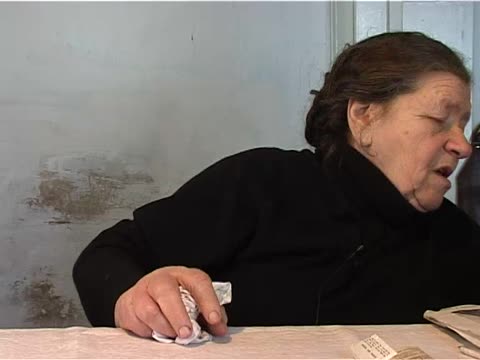
Liberzon talks about Sabbath at home: heating the oven and keeping food warm in the town, and how Kiddush was not allowed in her father's synagogue, so people came to his house to make it, with a cold kugel prepared on Friday. Kerler asks whether her mother read on the Sabbath; Liberzon describes her mother's education, her knowledge of Russian and Yiddish, and that no letters survived the deportation.
Liberzon mentions a relative who lived in a town whose name is unclear in the transcript and who was smuggled across the border dressed as a peasant on the way to the Land of Israel. She also says her father could have left but stayed, to keep the synagogue from being closed. She also refers to stories of tsadikim sent from America.
The transcript also shows her mention of a story about tsadikim from America and her father's reason for staying.
Kerler remarks that few traces of Hasidism are found among the old Jews. Liberzon answers that the Jews of Slavuta were, as she understands it, Misnagdim in later years, though earlier there were Hasidim; she says people in the last period no longer went to a rebbe. She also reflects on her half-Soviet Yiddish.
Liberzon talks about Yiddish today: Hebrew words entering it, the rich Yiddish literature, and Yiddish books she read as a girl, including translations. She describes asking a neighbor for a Yiddish school book. Kerler then asks whether she sang the Sabbath songs with her father.
Liberzon speaks of her sisters Sheyndl and the elder Khayke, and explains the surname Shapiro, discussed in a university ethnography exam. Asked by Kerler for her father's stories, she recalls a joke about a woman asking about Passover dishes and a story about a dream about a bridegroom, with sukes mentioned at the end.
Kerler and Liberzon discuss Shemini Atseres and early morning prayers, and Liberzon recalls the sukkah in the corridor of her father's house, where neighbors sat at a table. She recalls carrying shalakhmones to her grandfather and calls the holidays happy ones. The passage is partly garbled by Russian asides; Kerler then asks about brandy in Slavuta.
Liberzon says drinking brandy was forbidden in her father's synagogue after the war, though Jews gathered at the house on Sabbath for kugel; her father avoided drink apart from an occasional measure. Kerler brings up the Purim commandment to drink.
Asked about Chanukah latkes, Liberzon says they were made on the oven. She remembers the Great Hunger, when her father traveled to Moscow to buy bread and bread was later baked at home. She also describes the American rebbe Rokeach, who brings bread from America, and her sister in Chernivtsi who keeps a Jewish home.
The transcript adds the visit of the American rebbe and bread brought from America.
Kerler asks about interviewing Liberzon's sister in Chernivtsi, who is ill, and about the telephone number. They discuss when he is going there and phone contact with the family.
Liberzon recalls a teacher who came to the house daily and wrote Yiddish verses for her small sister. She says they studied with a melamed at home for two or three years before the war, learning to pray. Slavuta's telephone code is then discussed partly in Russian.
Liberzon returns to the American rebbe who brings bread, and to the baker who sold challah after the war, when her father was alive. She describes making shmire matzo and fish, with Kerler adding remarks about bread in Russia.
Liberzon recalls Passover before the war: going with her father by sleigh to the mill for shmire flour, and the family's strict customs about matzo and about foods not used at Passover. Kerler asks about stringent customs concerning matzo.
Liberzon and Kerler discuss Yiddish dialect and speech: the word for "everyone" (a dialect question), the Litvak way of speaking and what plain Yiddish was at home. She also recalls her father's remark about a fast-and-pray person. Kerler returns to latkes on Chanukah made in the oven.
Kerler asks whether Chanukah latkes were made of flour or potatoes; Liberzon is unsure and recalls a Chanukah text. Much of the passage is garbled, with Russian asides, and covers her memory of a Chanukah tune.
Liberzon talks about her father's synagogue after the war: he sang cantors' songs, outsiders were not admitted, and she recalls a man in Zaslav. She looks for the Chanukah prayer text in a calendar and briefly recites it, with Kerler repeating it. The passage ends with Kerler thanking her for her help and offering to spare her linguistic questions.
The transcript adds her recitation of a Chanukah prayer from a calendar and cantors' songs.
Liberzon says she spoke only Yiddish at home and attended a Hebrew school; her father knew little Russian. She mentions making blintzes and describes holiday food: kreplekh with soup before Yom Kippur, and dairy dishes with blintzes on Shavuot. She notes that no beef was slaughtered in Slavuta then. Kerler ends by asking about the public library.
Kerler asks whether the public library in Slavuta had Yiddish books. Liberzon says libraries held many Yiddish books before the war but not after. She says Yiddish is still spoken in nearby towns and talks about what she can contribute on language and history.
Liberzon recalls being a guest in Chernivtsi in the late 1940s with her father's brother. She describes the Yiddish theater that moved from Kyiv after the war and the Ukrainian artists who lodged there, with Russian talk of the closing of the Moscow Yiddish theater.
The transcript shows details about the Kyiv Yiddish theater moving to Chernivtsi and Ukrainian artists lodging with her uncle.
Kerler talks about his own writing in English, then asks how Litvaks and Galicians were referred to; Liberzon discusses Litvak speech, Belarusians, Lubavitch and Brestlov Hasidim and an unclear conflict between them. She describes a Jewish religious school in which Yiddish and Jewishness are taught with sponsors from America.
The transcript also shows Kerler's discussion of his own work and talk of Lubavitch and a Jewish school.
Liberzon talks about her grandfather Khayim Shapiro, who moved from Bessarabia to Slavuta and went to a rebbe after losing children. She describes her father's father, a physician for fifty years who took no money and called it a mitsve. Kerler then asks what her father told about the Vilna Gaon.
Kerler asks about misnagdim versus Hasidim, the Vilna Gaon and the Annopol rabbi. Liberzon looks for and shows a note about the grave of a rebbe, and a family lineage of rebbes is read out. They also discuss Lubavitch, Breslov, and the debate about the messiah, and she mentions a Jewish school where children learn only to pray.
The transcript adds the search for a family note and documents, and a lineage of rebbes read aloud.
Kerler asks about gefilte fish and Liberzon describes the family way: the fish head with a worm-like bone, the special kosher knife, no sugar or pepper, and the custom for Rosh Hashanah and Yom Kippur. She explains how the family tested flour for being kosher by pressing it in the hand, with Russian asides, and mentions Passover without matzo kugel.