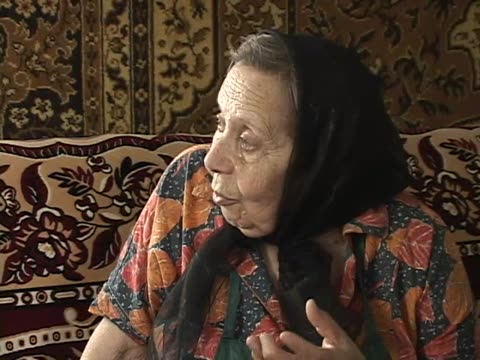
Kipervaser says the school subjects were taught in Yiddish by Jewish teachers, including a director from elsewhere and his wife, whose name she cannot recall. She remembers that the pupils studied well and that discipline was strict. She then turns to her memories of Sabbath at home.
The teachers (a director and his wife) are discussed and the passage moves to Sabbath.
Kipervaser recalls a non-Jewish woman who came to light the Sabbath lamp, and what her mother said at the end of the Sabbath. Kerler asks about a prayer to the God of Abraham. She mentions men who worked in shops and prayed for a livelihood, but says her father did not.
Sabbath customs, the non-Jewish helper and a prayer for a livelihood.
Kipervaser says her mother could read and write Russian and Yiddish and wrote letters in Yiddish to her brother and sister in America. She mentions family in Brooklyn. Most of the passage is a dialectological questionnaire from Kerler and Lemster, with many Russian asides: words for animals and household things, greetings, adjectives, verb forms and comparisons, numbers, words for Christians and peasants, Hanukkah and the dreidel, parts of a house and the face. She also sometimes switches into Russian or Ukrainian.
The catalogue's 'family' is only the brief mention of the mother and the American relatives; the rest is a long questionnaire.
After the questionnaire, Kerler and Kipervaser chat about language and about the team's search for a wooden synagogue in Slavuta. She asks whether they have been to the synagogue, and she and Kerler discuss whether it is wooden.