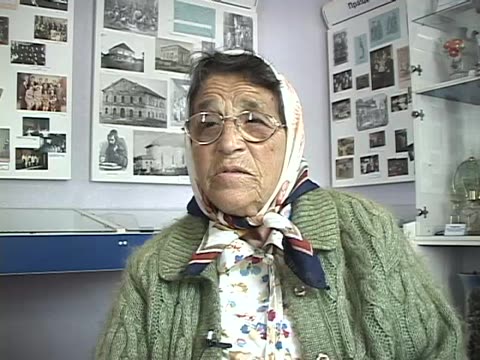
Bivson gives her name, address, Yiddish name, and birth year 1926 in Polonne. She names her father, whose work was paving clay floors, and her mother Frume, who worked in a rag-processing factory. She says she remembers no grandparents and names her two older sisters, Mindl and Khaike. She then starts to speak about her Yiddish school.
Bivson describes the good if not wealthy life of working people among many Jewish neighbors in Polonne. She recalls her father making prayer books and the Passover seder: opening the door for the Messiah, the festive food, and Passover dishes kept in the attic. She also describes Purim, with baking, gifts to the poor, singing, dancing and masks, all in Yiddish.
Bivson says she studied six grades in a Yiddish school and could write Yiddish. She does not remember a Purim song. She speaks of the good prewar life of her whole family, of which she is now the only survivor. She mentions Hanukkah gifts and latkes, then explains how her mother made gefilte fish and how she still prepares it herself.
Bivson talks about Jewish religious life before the war. She mentions the shoykhet, kapores, several synagogues, a large synagogue with a poorhouse, a rabbi and a minyan, and women attending. She describes Sabbath preparation and kosher meat. She also recalls building the sukkah with neighbors' help and sleeping in it.
Bivson begins to tell about the war years, when she was evacuated to Birobidzhan. She describes the hard journey on an open platform in the rain and says she survived on hardship. She traveled with her sister Khaike and her parents to her older sister Mindl, who lived in Birobidzhan.
Bivson says her sister Mindl had studied at a Yiddish pedagogical institute and worked as a teacher or educator before the war. She recalls the long trip to her in Birobidzhan and the hunger there: green borscht, little bread, and cards.
The sister's education (a Yiddish pedagogical institute, a transcript detail) is only partly clear.
Bivson answers questions about Yiddish reading, a library in her school and in town, and the writer Peretz, who she says was from Polonne. She recalls Yiddish theater visits and applauding until her hands hurt, but remembers no actors' names.
Names the writer (Peretz) as someone she claims is from Polonne.
Bivson says she returned to Polonne in 1945 from Birobidzhan. She answers questions about the Jews there, fewer than before the war because many were killed and tortured, and about relatives, neighbors and friends. She mentions the ghetto and non-Jews who rescued Jews.
Bivson says she worked as a telephone operator for forty years. She describes postwar Jewish life in Starokostyantyniv, with a rabbi, a synagogue, a minyan and a shoykhet who came from Khmelnytskyi. She also answers Lemster's question about the Yiddish name of the town.
Also covers the Yiddish name of Starokostyantyniv and her move there.
Bivson regrets that so many people were killed and speaks of the son she lost, a physics and mathematics teacher who had finished an institute. She mentions a holy place and a monument, which she says are worth visiting. Lemster then turns to weddings.
Bivson recalls Jewish weddings with klezmer, a chuppah, gefilte fish and kosher food, and challah baked on Fridays. She answers questions about the word getoyg and about women who exorcized the evil eye (opshprekhn) with coals, saying she does not remember the formulas.
Includes the term getoyg and the coals used in healing.
Bivson says she wanted to go to Israel and longs for her friends from Donetsk and Starokostyantyniv. She answers questions about dybbuk, golem and geshmad, and says she knows no Christians who speak Yiddish, though some elderly people understand it. She says she knows a Hebrew prayer and recites or speaks a Yiddish prayer for the cemetery. She also talks about her grandchild, her son who spoke Yiddish, and her Jewish wedding.
Adds the cemetery prayer, Israel, grandchildren, and the answers about dybbuk, golem and geshmad.
Bivson says no chuppah was set up at her wedding and recalls the postwar gap in synagogue life in Starokostyantyniv. She answers Lemster's question about whether the Yiddish in Birobidzhan differed from hers, saying it did not, and gives a few word variants such as mame and broyt.
Lemster gives Russian words and Bivson answers in Yiddish: greetings, everyday words, colors, adjectives and adverbs of time and place, and verbs in sentences. Many items are garbled. She also says that before the war only boys went to synagogue, while girls knew a holiday was coming because of the festive food. The tape ends with her saying she did not go to synagogue after the war.