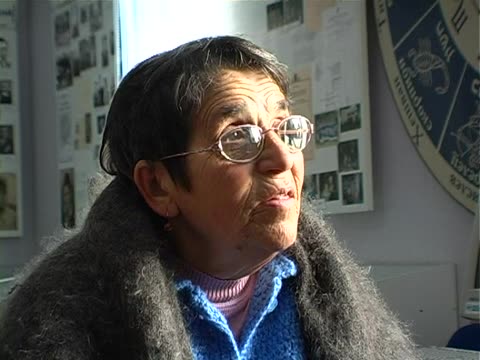
Greetings and small talk before the interview, including the cold weather and a brief introduction of the visitors; Kerler then states the date and that the team has arrived in Starokostyantyniv to speak with Bivson.
Bivson, born in Polonne, recalls a good childhood there: her father was a laborer and her mother worked. She attended a Yiddish school for five grades, later a Ukrainian school, and describes the Jewish life of the town. She mentions the poet Peretz Markish as a native of Polonne, the many shoemakers and tailors, and the synagogue, and says she fled on foot when the bombing began.
Adds Peretz Markish, the crafts in Polonne and the flight on foot at the outbreak of war.
Bivson says she has forgotten most songs but recalls fragments of a Yiddish song. She answers whether Polonne had a bathhouse and several synagogues. She explains that after the war she left Polonne for Starokostyantyniv because her house was bombed out.
Adds the songs, the synagogues of Polonne and the reason for the move.
Bivson talks about her family: there were three children, one sister is still alive and one has died. Her mother was Fruma and her father Elye Melekh (?). Her mother worked at a paper factory far from home and walked there.
Bivson talks about childhood friends and about languages: she played in both Yiddish and Ukrainian, and Polonne was a Jewish town. She mentions the holidays kept there, children's games and customs, and non-Jews who knew Yiddish. She says there is now little opportunity to speak Yiddish.
Bivson asks about the visitors and learns they are from America and Canada (Kerler from Israel) and teach at universities. She welcomes them warmly, with some Russian, and they chat about the cold. Kerler then steers to her wartime evacuation.
Bivson recounts her evacuation to Birobidzhan, where her sister lived. They travelled partly by train and partly on foot for about three months, receiving food at stopping points. She was there from 1941 to 1945 amid cold and hunger and recalls the Yiddish signs and school. She also names her sister Mindl (Mindel) and the family name Fuhrman, and describes her work as a kindergarten teacher.
Adds the sister Mindl and her work, the journey and the hardship.
Bivson recalls celebrating Purim: baking, giving shalekhmones and visiting guests. She does not recall Purim songs. Kerler then asks which language she spoke with her husband; it was Yiddish when the children were not to understand, but mostly Russian, and she worked many years at a telephone job.
Adds the question of languages with her husband and her working life.
Bivson tells that her husband was a Jewish hairdresser from Starokostyantyniv (?). They married through a matchmaker when she was about forty-eight, after his first wife died, and lived together for over thirty years. She says there was no chuppah at her wedding, discusses the local shoykhet and his death, and Kerler asks about Yiddish in Starokostyantyniv.
Adds the shoykhet and his death, and the chuppah question.
Answers questions about Yiddish in Starokostyantyniv versus Polonne: she says the local speech is basically the same and mutually understood. She states she studied Yiddish for several grades and could read and write it. Kerler asks about Sholem Aleichem and Leyb Kvitko (?), and S2 asks about matzo baking.
Kerler asks various items about customs and terms: the occupation of a maker of rolled cookies, how gefilte fish was made, going to the rebbe for a blessing, and quenching coals against the evil eye. Bivson knows little of charms, and the passage ends with her mentioning her son, a teacher and physicist, who has died.
S2 asks Bivson about Jewish life in Starokostyantyniv after the war. She says there were several large synagogues and they still attended, and mentions a woman, Bella, and the lack of Jewish loneliness. Much of the passage is garbled or in Russian.
Largely garbled with Russian: general remarks of good wishes, then Kerler asks about a Yiddish library, newspapers and theater in Polonne, and about visiting a rebbe or a 'good Jew' for a blessing, which Bivson explains.
Terminology questions: how a Yiddish word for a cemetery is said (?), Hanukkah foods and customs (latkes, dreidels, Hanukkah money) and Purim masquerading and singing. Bivson mentions her granddaughter and daughter and says the holidays were celebrated well after the war.
Bivson says that after the war the holidays were kept well despite the damaged synagogue and the sorrows she lived through. She says her sons (?) live in Israel and call on holidays, and that a female relative sends gifts. Kerler asks about the Yiddish word for celebrating a holiday.
S2 asks about Birobidzhan during the war and Bivson describes hunger, eating groats and leaves, her mother working in a canteen and her father's odd jobs. She says her sister later worked in a kindergarten and died five years ago in Pervomaisk, and that her sister's husband was a Russian colonel who liked Yiddish.
Kerler asks the meaning of Yiddish terms and sayings (such as dybbuk, golem and expressions about the dead). Bivson explains and says she speaks to her late father in Yiddish at the grave. She says the best time of her life was when her son was healthy, and speaks of his death at about fifty, shortly before his jubilee.
Asked about antisemitism, Bivson says she never heard any in her many years of work or from neighbors, as she lives with Russian neighbors and others. Kerler then asks the Yiddish word for potato.
Terminology questions: the words for potato, baked goods, cookies and tsimmes-type dishes, foods for Yom Kippur and gefilte fish. Kerler asks about the weddings, what litvak means, and wedding roles including the tomada (?) and the mother-in-law leading the bride to the chuppah. She says she saw a chuppah in Starokostyantyniv after the war. At the end Kerler talks of finding her son's picture on the Internet.
Bivson and Kerler discuss her late son's presence on the Internet, with a portrait by an artist, Vilen Abramovich Kurman. Kerler notes visitors come from various countries, and Bivson closes with wishes for peace, health and not being forgotten. Kerler thanks her, in Yiddish and Russian.