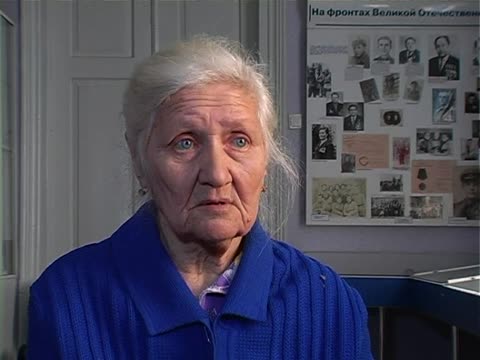
Klein says Starokostyantyniv was a very Jewish town of about 30,000 Jews before the war, and that many were killed there. Kerler asks about the proportion of non-Jews. The talk then drifts to language and to Kerler's background in Moscow and Israel.
Kerler's own background and language comes up at the end.
After the date is stated, Kerler asks Klein her Yiddish name, and she explains she bears her grandmother's name. She tells of her carpenter father, born in Hrebenynky (?), her mother from Sakhnovytsi (?), and her four siblings. One sister lives in Israel and one elsewhere in Ukraine, and she mentions a niece. They talk briefly about the cold and about which language she uses with them.
Details siblings, relatives in Israel and the sisters' languages.
Klein recalls that she was still a schoolgirl when the war began and that many relatives were lost. She says she finished the Yiddish school and then a Russian school for the tenth grade, with the war breaking out a day after graduation. She describes her religious mother, who baked matzo, and her grandfather, who managed an estate for a landowner and knew several languages. The name Sakhnovytsi comes up again.
Adds the grandfather's work for a landowner and the mother's religious observance.
Klein names her grandfathers (Berl and David) and a grandmother (Mirl), most of whom she did not know. She describes her mother's family, with its educated sons. Kerler asks about prewar Starokostyantyniv, and she says Yiddish was spoken on the street and her mother also spoke Ukrainian. She begins to say where the family was evacuated and when they returned.
Adds the grandparents' names and language use on the street.
Klein says her family was evacuated to Central Asia for about three years, while her father was mobilized as a specialist to the Donbass. They returned in 1948, to a town with far fewer Jews. She says the town was known prewar and that few Jews remained afterward.
Gives the return year and the postwar Jewish population.
Klein says an old castle (zamok) and a church still stand in the town, and that as children they were not interested in such things. The talk turns to her mother and then to making gefilte fish.
Klein says she makes gefilte fish without sugar and discusses holiday foods, including dairy and meat dishes for Passover, in a Jewish home. She says the town was Jewish before the war and that Yiddish was still spoken afterward. She mentions the Russian school and the languages taught there.
Klein and Kerler discuss school languages: Russian, Ukrainian and German were taught, and other subjects were taught in Yiddish. She mentions reading Mendele and Sholem Aleichem in school, with some unclear remarks about Yiddish teachers.
Kerler asks about reading Sovetish Heymland in the 1960s, and Klein says she subscribed for a time. She says she worked as an accountant and head of a group, and describes siblings and relatives who studied at technical schools and held senior positions in Moscow. The talk is mixed with remarks by another voice.
Adds Klein's work as an accountant and relatives' careers.
Klein recalls religious life in the 1930s: the home was Jewish, services were held in small private prayer houses, and people kept the holidays. She describes the Purim baking and the absence of masks, talks vaguely about weddings she attended as a child, and mentions klezmer. Kerler then asks about poetry.
Klein talks about Yiddish writers from the town. She names Avrom Ber Gotlober as born in Starokostyantyniv and mentions a grandson of Lenin's family named Blank (?) and another local man who died in exile. She says her books on them are unavailable and that Kerler knew some of these people.
Klein reflects on the purpose of the recording, which will go into an archive as history, and on books and a Yiddish journal she reads, noting that few Jews remain to read them. Kerler asks what a term for wedding bread (?) means.
Klein explains a wedding custom (?) and recalls that the town was Jewish and that Yiddish was spoken until the war, and less afterward. Asked about non-Jews who knew Yiddish, she says there were many, and that after the war a non-Jewish man even prayed in Yiddish. Kerler then asks where she is now.
Adds the non-Jewish man praying in Yiddish and the wedding term.
Kerler and Klein talk about Jews in America and the archive, then about dialect differences, including how father and mother were said in the town and in a nearby one. She recalls a trip to a Ba'al Shem Tov site, and Kerler asks about the term 'good Jew' and a wonder-working figure. She cannot say whether a related practice existed.
Adds the dialect comparison and the Ba'al Shem Tov and 'good Jew' questions.
Klein says a man she knew was very religious, but people did not take interest in such things then. Kerler asks the Yiddish words for a cemetery, a holy place and a Christian cemetery, and she gives the terms she knows, as well as a Polish Catholic cemetery in town.
Kerler and Klein discuss the planned route of the expedition to nearby towns and Klein talks about a rabbi in Zhytomyr whom she spoke with in Yiddish. They then talk about Kerler's own background in Moscow and his family. The passage ends as Kerler turns to Yiddish theater.
Klein recalls Yiddish theater in the town, with touring Yiddish actors coming before and for a time after the war. As children from the Yiddish school they went to see the performances. Kerler asks about specific actresses, and another voice then asks how Passover was celebrated.
Klein says her father led the seder, and that after the war Passover was kept less fully. Kerler asks who asked the four questions (the boys), then whether the school taught religion. She says math, algebra and physics were taught in Yiddish until the shift to Russian, and names several teachers and professors.
Adds the schooling languages and the teachers named.
Asked about Yiddish songs, Klein names a few that she half remembers and mentions gramophone records. She recalls a song about Itsik's marriage and a death, then speaks of Yiddish life as lost. Kerler asks whether she had children.
Klein says she has a sister and a niece, and tells of the niece's trip to Yad Vashem, and of a dream. Kerler compares it to experiences of his own generation. They talk about making the recording into a booklet.
Klein says her school taught many subjects and produced professors, and that many relatives were killed. Kerler and Klein discuss sending copies of photos and material through a Hesed. They talk about the great synagogue and about Gotlober, whose name she checked, and Kerler says he left memoirs and works in Yiddish, Hebrew and Polish.
Klein reflects that life was peaceful before the war and that the best years were lost to it. After the war it was hard but she studied and finished a technical school, and she is pleased with the visit.