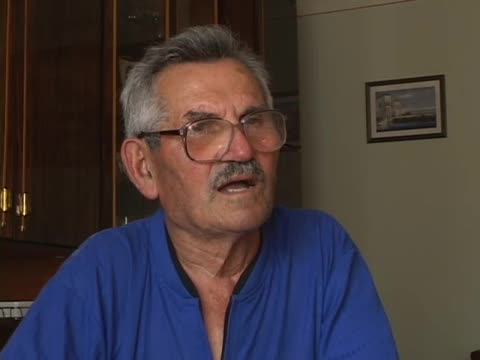
This tape is a continuation of a formal interview with Mikhail Abramovich Zhovtis (b. 1927 in Khmil'nyk) in Bar, Ukraine (part 3 of 3. See accession #09-010.02-F MDV 330 and MDV 331). He answers questions relating to sociolinguistics and dialectology.
The informant answers Kerler's questions about the wording of Yiddish items. These include measures of liquid, the attic, the verbs 'to come' and 'to come back', 'enemy', and the words for 'face' and 'foresight'. Kerler checks which forms he knows and which he does not. Some Russian is mixed in, and at the end Kerler asks him to tell what he remembers of his parents.
The passage opens with a street question and ends with a turn to the informant's parents, which the catalogue does not mention.
Zhovtis reports that there were no Yiddish-speaking non-Jews in his town. The Jewish children in the shtetl thus spoke Ukrainian to each other on the streets. He further comments on linguistic relations between different ethnic groups and shares his attitudes towards non-Yiddish-speaking Jews.
Asked about his friends, the informant says that at home he spoke only Yiddish, and tells a story about a Jew from the Caucasus who did not understand Yiddish. Kerler remarks that many Soviet Jews do not know Yiddish. The passage touches on attitudes toward Jews who do not speak the language. The transcript does not clearly show the claim that Jewish children spoke Ukrainian in the streets, and the details are partly garbled.
The transcript shows a story about a Caucasian Jew and Yiddish, and a question about the word for a measure (?), not the street-language remarks in the catalogue.
Dialectological questions continue: the word for a measure (?), the words for digging or raking the earth, and a word meaning luck. Kerler and Katz then ask a closing question, and the informant sends good wishes to the Jews in America, thanking those who help and mentioning money sent for Passover. Kerler ends with thanks.
Ends with greetings and thanks to Jews abroad for their help.
The camera records a walk through an unidentified town led by a Russian-speaking guide, who points out a church, an old wall and a river. Kerler, with some Yiddish from the second voice, remarks on the church and the view.
The camera cuts to a formal interview with Izrail (Yisruel) Yosifovich Gliazer (b. 1919 in Podgaytse, Ukraine) (part 1 of 3. See MDV 691 and MDV 693). Gliazer speaks about his father (b. 1880), who served in the Austrian army during World War I. His father worked as a glass and window maker. His mother, Pesye Levit, was from the town of Skalat. Gliazer was the youngest child in his family.
Introduction to Gliazer: Kerler records the name Israel ben Yosef Glazer, the date 30 June 2005 and Ternopil'. Gliazer gives his birth year as 1919, and says that he was born in Podgaytse, and explains the name's meaning. His father, Yosef, served in the Austrian army in the First World War and was a glazier who made and fitted windows. His mother Pesye was from Skalat, and she took care of the children and cared for him as a child. Gliazer also speaks well of Emperor Franz Joseph.
Includes the interviewer's introduction, the name's spelling and Gliazer's remarks about Franz Joseph and the Jews.
Gliazer speaks about his education in a traditional “khayder” (kheyder; religious school for young boys) as well as the atmosphere in his childhood synagogue.
Gliazer recalls cheder, whose teacher was called Moshe. He began at six or seven, with eighteen boys, learning the alphabet and then Chumash. At Katz's questions he recites the letters and describes the final-form letters. He also describes the synagogue where the cheder met, which had a women's section behind a small window.
Includes Gliazer reciting the Hebrew alphabet and naming the letter forms, which the catalogue does not mention.
Gliazer recalls his home life as a child, describing his mother, his sister who immigrated to Palestine in 1927 and his pious maternal grandfather (d. 1939). He also details the various types of people that lived in his shtetl (town).
Gliazer describes his mother as a housewife who sometimes helped in his father's shop, where he says there were both honest people and thieves. He remembers a mad girl in the town. He names his siblings: an eldest sister who emigrated to Palestine in 1927 and lived on a kibbutz, brothers Velvl and Moshe, and a younger sister Sarah. He then speaks of his maternal grandfather Hersh Levite of Skalat, a merchant regarded as a righteous man, who died about 1939.
Gives the names of his siblings and the shop and thieves, which the catalogue does not list.
Gliazer attended a Polish-language school before beginning work at a printer’s office, where documents, posters and brochures were produced for different ethnic and religious groups.
Gliazer says he studied in a Polish state school for seven classes. In the late 1920s, he says, he went to learn the printing trade in a printing shop in Podgaytse. He lists the work printed there: documents for merchants, posters and brochures for Polish, Ukrainian and Jewish organizations, and pamphlets for Catholic clergy. The shop also printed some Jewish material, including Hasidic leaflets. He remarks that the community had been rich and lively. Kerler adds a break and a question about reading.
Names the Catholic brochures and Hasidic leaflets he printed.
Gliazer also comments on prewar literary tastes and the shtetl’s Polish and Jewish libraries. He details how the Jewish libraries were run and operated mostly by uniformed young men from Zionist movements.
Gliazer describes his reading as a young person: Yiddish, Hebrew and Polish books, and several libraries in the town, with more Polish than Jewish books. The Jewish library was run by young people from Zionist groups including Hashomer Hatzair and the Revisionists, who wore brown shirts and belts, and books were lent free. He recalls Sholem Aleichem and some secular and Ukrainian writers in Yiddish translation.
Names the Revisionist youth in brown uniforms and the writers whose books were available.
Gliazer names local writers, including Rosenthal and Poliak, who wrote in Yiddish about small-town Jewish life. Katz adds names of regional authors including Abraham Moyshe Fuchs of Ozerna. Gliazer says Bialik was well loved and his books and songs were known. He also recalls the Dybbuk, a book he owned, and gives its meaning as an evil spirit. Kerler asks what a 'good Jew' means, and the passage turns to the Hasidic rebbes his townspeople visited.
Includes the Dybbuk, the meaning of a good Jew, and the names suggested by Katz.
Gliazer describes the various local Hasidic groups and synagogues in his town, noting that his father was a follower of the Rebbe from Husyatyn. Gliazer details how people would visit the local Rebbes for advice or blessings, and how the Rebbe from Chortkiv would visit the shtetl on sukes (Sukkot). Cities and towns mentioned on this tape: Podgaytse, Skalat, Ternopil’, Ozerna, Husyatyn, Chortkiv
Gliazer says his father was a Hasid of the Husyatyn rebbe. He explains how people went to the rebbes for advice and blessing. The Chortkiv rebbe had more followers than the Husyatyn rebbe. The synagogue in Podgaytse associated with the Chortkiv rebbe was handed over to Jews, and Gliazer mentions candles and customs at Passover. Kerler asks how Gliazer lived with his parents at seven to nine years of age, and the account is cut off.
Does not clearly show the Chortkiv rebbe's visit for Sukkot; it shows a closing question about childhood and the synagogue's handover.