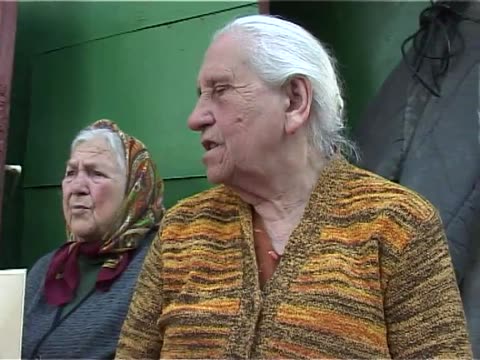
The interviewees identify people in old photographs, including grandmothers and a father, and Kerler asks how things are said in the local Yiddish. Petrunenko answers questions on terms such as street, well, buckwheat porridge, potatoes, shop and flowers, and sentence translations. They discuss Passover potato fritters, Hanukkah food and the miracle of the oil. Kerler asks about the evil eye and spoken charms; one woman declines to share most of them but explains that rolling an egg relieves fright, which is partly shown. The passage ends with thanks and farewells.
Adds the photographs and Petrunenko's word-list answers; the egg-rolling is only discussed here, not clearly performed.
Kerler and the local contact try to persuade a woman at her door to speak with him in Yiddish. The woman does not agree to come out, and the exchange is partly in Russian and Ukrainian.
Kerler is led to the home of the Zhivokritskiis and interviews them. Alexandra, born in Tomashpol' and named Sure, says she was in the ghetto at Zgivka with her uncle, a tailor, while her father was in the army. She recalls her marriage in 1950, buying the house, her two sons (one now in Israel), her parents Grisha and Libe, and Passover at Uncle Yankl's. Her husband grew up as the only Jew in a village. They describe Sabbath fish, the difference between gefilte and chopped fish, grated-potato dishes, and life today. The rest is a long word-list questionnaire: household words, adverbs, kinship, the evil eye, Hasidic terms and sentences to translate.
Adds her uncle Yankl's Passover, her brothers abroad, the husband's village, and the long questionnaire in the second half.