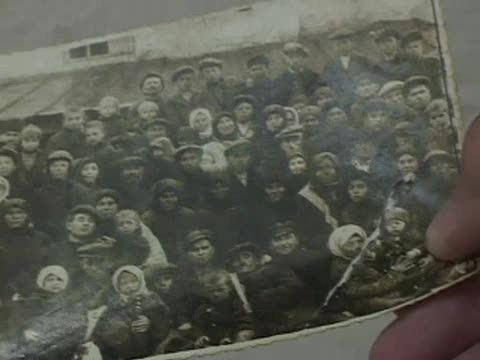
Sapozhnik shows Kerler and Lemster old photographs. They include the kolkhoz, which she says was Jewish, and her husband, son, brother Leib, her father, and a granddaughter in Moldova whose mother was non-Jewish. They ask when the kolkhoz photo was taken, and about window frames and a cellar. She also speaks about the ghetto and forced labor, a sister-in-law who emigrated, and her complaints about the repair of her house, the toilet and the local official. The team thanks her and leaves for the next interview.
Besides the photographs, it covers her complaints about housing and the local head, and talk of the ghetto and the war years.
Gingold is greeted at her door, and Kerler explains the university project. She says she is alone, her parents and brother having died, with two cousins in Israel. She gives her names, birth year, and her father's and mother's names and occupations. She also names her grandparents. She attended three years of Yiddish school before moving to a Russian one, and says she never worked and has a small pension. She recalls Sabbath, Passover, Shavuot and Purim customs, and the Tomashpol' ghetto. The interviewers then put questionnaire items: greetings, kosher salting, foods, and Russian words rendered into Yiddish such as 'spasibo', 'mouse' and 'poceluj'.
Beyond her biography, the passage covers ghetto memories, holiday and food customs, and a long section of questionnaire elicitation.