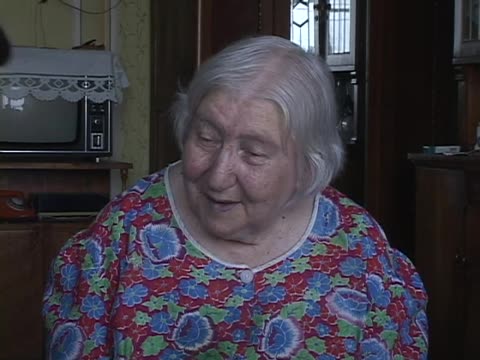
The questionnaire with the woman continues. Kerler and Lemster elicit Yiddish equivalents for Russian words: near and later, very, sick and sleepy, honest or religious, cross and Christian, peasant. They also ask for words for relatives, village and street terms, potatoes, shop, half and a liter, and sentences to translate. Along the way she talks about her father making wine, and she recalls a Jewish wedding in the 1950s with a chuppah and baked goods. She also says that no Jews remain on her street.
also covers her father's wine-making, a wedding and the absence of Jews on her street
Miaskovskij is interviewed after a move to another room. He gives his name and his father's name, and gives dates of death for both parents and for a sister. He tells an anecdote about a Soviet delegation and a KGB minder who understood no Yiddish. He says he finished ten classes in Tomashpol' in 1941 and then served at the front, with orders and medals. His father was a factory worker and his mother a seamstress; the family was once rich but lost everything after the revolution. He names childhood friends and other townspeople. He mentions that he wrote a poem and sets it to music, sings Tum balalaika and other Yiddish songs, and says his father's books are still in the attic. He studied at the Moscow institute and says he cannot read Yiddish.
adds the anecdote of the Soviet delegation, the family's loss of wealth, the Jewish community numbers, and a second singing