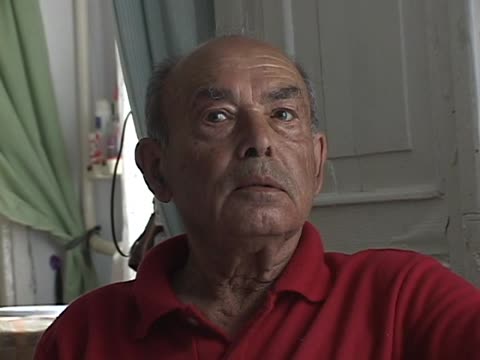
Futiran gives his Yiddish name and age, and says he was born in Tomashpol' and comes from a long line of local people. He names his father, a coachman (balegole), and his mother, an orphan from Tomashpol', and says there were six children. Two brothers were killed at the front in 1944, and other brothers are named. Futiran says he later learned the hatmaker's trade from Jewish masters, and he worked for decades as a hatmaker. He mentions two marriages, the second to a non-Jewish woman, and two sons in Moscow and Israel. He recalls a poor childhood, four years in a Yiddish school before a Ukrainian one opened, and a Jewish library. He also recalls Yiddish songs, klezmer music, Jewish weddings with a huppah, and visiting Yiddish artists. He speaks of hunger in 1933, evacuation and work during the war, and eight synagogues in the town. Kerler and Lemster ask about coachmen's stories and songs, and the father's song is mentioned. The passage ends in his workshop with a Singer sewing machine and hats the visitors try on.
Transcript also shows talk of army service and invalid status, weddings and klezmer music, and an ending in the hat workshop with fittings.