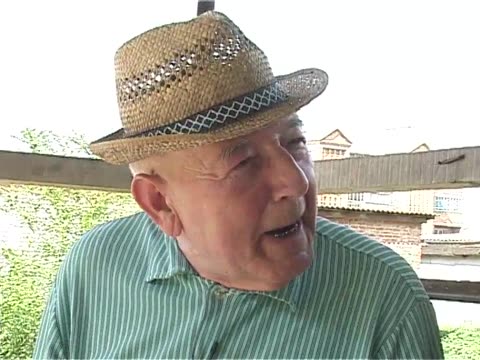
Kogan provides personal information and talks about his family. His father worked at a soap factory.
From the machine transcript
Kogan states that he was born in Bershad' and names his mother and father. His father died in the 1933 famine, and Kogan describes him as an honest, learned Jew who went to the synagogue. He worked at a soap factory and was known as Avrom from the soap factory. Kerler asks whether he was a Hasid.
Adds that the father died in the famine of 1933 and that Kerler asks whether he was Hasidic.
Kogan talks about his life in the Bershad ghetto during World War II. He recalls beatings by Romanian soldiers, while he was out to get potatoes. Kogan then speaks about the fate of regional refugees in the ghetto. He states that his mother helped them out with food.
From the machine transcript
Kogan recalls the Bershad' ghetto, including the Star of David armband he wore and being beaten by a Romanian soldier when he went out to buy potatoes. He then describes refugees from Bukovina and Bessarabia driven into the ghetto, including a family who collected bread and carried the dead. His mother cooked for refugees. He mentions beginning to compose Yiddish verse.
Adds Kogan beginning to compose Yiddish verse.
Kogan recites the words of his song "Dos lagerl" (the camp) and explains how he tailored the song to the experience in the Bershad ghetto. Kogan also mentions the fate of artisans and describes how his family shared their house with other Bershad residents. Kogan then remembers refugee families.
From the machine transcript
Kogan recites the text of his song 'Dos lagerl' about the Bershad' ghetto and the murder of the shoykhet Gedalye. He says the Romanians killed leading artisans and merchants. His home was shared with several families, and Jews from Chernivtsi stayed there; he mentions a refugee family who later went to Edinet in Moldova. Kogan recalls the lice and deaths among refugees and that he was called up at seventeen.
Adds Gedalye the shoykhet, Edinet, and the call-up at seventeen.
Kogan talks about his liberation, as well as his military draft. Kogan was trained for the front in Rzhev, Russia. He then speaks about his front service reaching Berlin in 1945.
From the machine transcript
Kogan recalls being drafted and trained before being sent to the front, which he followed as far as Berlin and the Reichstag in 1945. A short passage in Russian is rendered unclearly. Kerler then asks him to return to the song about Reb Gedalye, and Kogan begins it again.
Adds that the passage closes with Kerler asking for the song again.
Kogan sings his Yiddish song "Dos lagerl," which he wrote after he was liberated from the Bershad ghetto. He then recites his Yiddish song "Aheym, briderlekh, aheym" (homeward, brother, homeward).
From the machine transcript
Kogan performs 'Dos lagerl' about the Bershad' camp and ghetto and the cemetery, and explains that Gedalye was a shoykhet and Dvoyre his wife. Asked when he wrote it, he says he composed it while the Germans were there. He then recites his song 'Aheym, briderlekh, aheym', which expresses hope that all Jews will be freed.
Adds Kogan's explanation of Gedalye and Dvoyre and the second song.
Kogan sings his Yiddish song "Tsezeyt un tseshpreyt" (scattered and dispersed), before he sings his Yiddish song "Aheym, briderlekh, aheym" (homeward, brother, homeward). Kogan also discusses his songwriting.
From the machine transcript
Kogan performs his song of the ghetto, 'Tsezeyt un tseshpreyt', then sings 'Aheym, briderlekh, aheym' at Kerler's request. He says he wrote the songs in Yiddish while the Germans were there, and that he had attended seven classes of school before the war.
Adds his remark about seven classes of schooling.
Kogan speaks about his education before and after the war. He studied seven years at Yiddish and Ukrainian schools before the war and three years at a night school after the war.
From the machine transcript
Kogan speaks about the Yiddish school in Bershad', which still stands with three floors. He mentions a Soviet official named Kogan, a distant relative, and an episode of Jews being tried. Kerler asks the year.
Adds the Soviet official and the question of the date.
Kogan recites a poem about his war experience. He also recalls the beginning of the war, including the bombing of Bershad. Kogan then describes the living conditions in the Bershad ghetto, including the composition of the ghetto's inhabitants.
From the machine transcript
Kogan speaks about the first bombing of Bershad' near the bridge and the burning of a house. He mentions refugees from Pechora and a man from Tul'chyn, giving bedding to refugees and a photographer who escaped to Germany. Kerler asks whether a text is a song, and Kogan says he wrote it in Russian.
Adds Pechora refugees, the Tul'chyn man, and the photographer in Germany.
Kogan speaks about Yiddish ghetto writings and sings "Zog Nit Keyn Mol" (never say never), written by Hirsh Glick. He then talks about his own work.
From the machine transcript
Kogan talks about a book of ghetto writings and says it is from the Vilna ghetto, with Kerler suggesting Sutskever. Kerler asks whether he can read Yiddish. Kogan sings 'Zog nit keyn mol' and explains that Hirsh Glik was captured after the ghetto's liquidation and killed in Estonia in 1944. Kerler asks him to repeat his three songs.
Adds Glik's fate and Kerler's request to repeat the songs.
Kogan sings again his three Yiddish songs.
From the machine transcript
At Kerler's request Kogan performs his three Yiddish songs again, in order: 'Dos lagerl' (the Bershad' camp and cemetery), the song about the Jews driven over the bridge, and 'Aheym, briderlekh, aheym'. He ends by saying he thought about the songs in Bershad'.
Kogan talks about daily life in the Bershad ghetto, particularly when refugees sold food in the market. He also recalls deportation collections. Kogan sings a few lines in Romanian about this experience. After the liberation, Kogan continues, the community organized burials. Kogan lists names of victims.
From the machine transcript
Kogan describes the ghetto market where refugees from Bessarabia and Bukovina sold bread and police drove them away. He quotes a song in Ukrainian or Romanian, recalls families killed after an informer's denunciation, and says Bershad' had good craftsmen. After liberation the survivors were buried. A cinema mechanic was killed by a sniper in a church.
Adds the cinema mechanic and burials after the liberation.
Kogan speaks about his experience in the Red Army during the war, passing through Poland to Berlin. He shares an episode about soldiers, who died of poisoning in Wrocław, Poland. Kogan then describes his experiences in Berlin in May 1945.
From the machine transcript
Kogan describes marching with the Red Army through Poland. At a Wrocław-area (?) site soldiers died after drinking from a poisoned barrel. He mentions Warsaw destroyed and an attack on Germans by his unit, then Berlin and the Reichstag, where he wrote his family name. He recalls soldiers drowned in a bunker flooded with water in May 1945. Kerler asks about the Yiddish school.
Adds the Warsaw destruction and the drowning in bunkers.
Kogan addresses his education at a Yiddish school, as well as Jewish life in the Bershad ghetto. He then describes how his mother hid him to avoid deportation. Kogan recalls the circulation of rumors about mass killings in Zhabokrych. Kogan then remembers how the Romanian army took ghetto inmates to forced labor. He was taken to Pishchanka. Kogan then addresses the working conditions and escape plans with fellow prisoner Abrashe.
From the machine transcript
Kogan recalls Bershad' as a Jewish town with Yiddish songs in the Yiddish school, and that Bukovinian and Bessarabian Jews were brought in. Rumors of killings in Zhabokrych had reached them. His mother hid him in a chimney. At fourteen he was taken to forced labor by Romanian gendarmes and marched on foot to Pishchanka, hungry and with sore feet. There he worked in the camp kitchen. A Bershad' man named Abrashe planned an escape with him through the woods.
Adds the escape plan and the forced labor in Pishchanka.
Kogan describes how they escaped Pishchanka, returning to Bershad. When he arrived in Bershad, Kogan continues, he hid in a chimney at his mother's house, as well as in other places. Kogan also speaks about deportations to Mykolayiv.
From the machine transcript
Kogan describes the escape from Pishchanka through the woods, with injured feet, back to Bershad'. He hid in his mother's chimney, then in a loft at a neighbor's house in straw. His brother brought him food. He recalls the deportation of Jews to Mykolayiv, including a neighbor taken away. Kerler thanks him and the interview ends.
Adds the hiding at a neighbor's loft, the Mykolayiv deportations and the closing thanks.