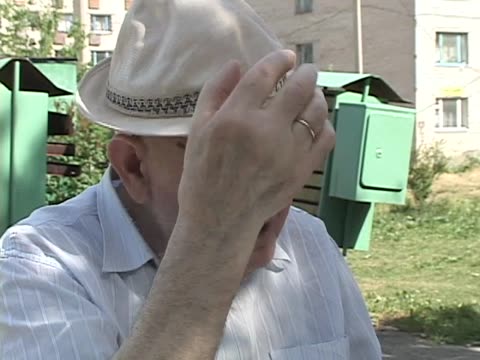
Kogan talks about his Yiddish song "Dos lagerl" and describes his experiences in the Bershad ghetto during World War II. He then sings his Yiddish song "Aheym, briderlekh, aheym." Kogan then mentions how he hid the song texts during the war, as well as talks about his writings.
Kogan answers questions about the Bershad ghetto song Dos lagerl, mentioning a poor man who collected the dead on a cart. He recalls that many people died of hunger and a policeman once threatened to throw him into the river when he was seventeen. He sings Aheym, briderlekh, aheym and explains that he wrote it down on paper but hid the texts, fearing he would be accused of being a communist. He answers Kerler's and Lemster's questions about when and in what script he wrote his songs.
Also includes a recollection of a policeman threatening him and of hunger in the ghetto.
Kogan then shares more of his writings, including his Yiddish song "Tsezeyt un tseshpreyt" (scattered and dispersed) about regional refugees in the Bershad ghetto and "Dos lagerl." Kogan also mentions a fire in his mother's home during the war, which destroyed his writings.
Kogan recites or sings the song Tsezeyt un tseshpreyt, about refugees from Bukovina, Bessarabia and Hungary driven into the Bershad ghetto, and then Aheym, briderlekh, aheym. Kerler and Lemster press him to separate texts he wrote himself from ones he copied, and he says some are his own. He recalls that a fire at his mother's house in Bershad destroyed writings and sings Dos lagerl, naming a man from the Lechetser family who collected the dead. He says he took the song "Zog nit keyn mol" from a book by a Yiddish writer, and Kerler names Sutzkever and Glik.
Adds that Kogan says he took another song from a book by a Yiddish writer (named as Sutzkever), and names a man from the Lechetser family.
Kogan offers drinks and says he does not drink, and speaks of acquaintances who wanted to see him. Kerler plays a recording of a woman from Chişinău who sang a song beginning like Tsezeyt un tseshpreyt, and Kogan notes it differs from his own songs. Kerler explains that variants of the Balanivka song were collected from some fifteen to nineteen people and that he wants to copy Kogan's texts. The talk includes good wishes that he and his wife keep Yiddish alive.
Adds that Kerler plays a video of another singer and explains the collection of variants of the Balanivka song.
Kogan speaks about another writer, who took his writings. He then talks about the market in the Bershad ghetto, as well as his family. Kogan then addresses his life after the war, after he was demobilized. He met his wife in Obodivka, introduced through Kogan's sister. Kogan worked at a liquor factory in Bershad, draining molasses.
Kogan talks about the writer Boris Zitser (?), who is now in Israel and who took his notebook of songs when he left; Kogan met him in 1944 after demobilization. He mentions the market in the ghetto, where Bessarabian Jews traded, and answers Lemster's question about a rabbi, saying the slaughterer was killed. He speaks about his late brother and his brother's son, and says he met his wife in Obodivka through his sister who lived there.
Adds Zitser, a brother and his son, and the ghetto market.
Kogan talks his wife's fate during World War II, as well as her family. He then speaks about his parents, particularly when his father passed away during the Great Hunger in 1933.
Kogan talks about his wife and her family from Zabokrych, where many were killed and she herself survived with great difficulty. He then speaks about his parents: his mother, a housewife, and his father, a prosperous merchant known as Abraham from the soap, who died in 1933 after eating with a Christian. His father had earlier been to America and his mother was his father's second wife. Kogan was about six or seven at the time.
Kogan answers questions about the Yiddish writers he read, naming Itzik Manger, Peretz Markish and Bialik, while Lemster and Kerler mention Samuel Halkin and David Hofstein. He says the songs he wrote were only about the occupation, not about love. He mentions that Kerler once presented his songs at a conference in Moscow and that he thought of writing to an editor in Kyiv, then reflects on his age.
Adds the Yiddish writers he read and Kerler's conference presentation.
Kogan talks about his life after the war, particularly his traditional wedding in Obodivka with klezmer music. He then speaks about postwar cultural life, including theater performances.
Kogan describes his wedding in Obodivka, a Jewish one with musicians hired from Bershad and Yiddish songs. He sings part of an older song that he did not write. He then says that after the war a theater from Chernivtsi came and performed Sholem Aleichem, and Kerler begins to ask about Yiddish theater before the war.
Adds a Yiddish song sung at the wedding and a touring theater from Chernivtsi.
Kogan speaks about prewar Jewish life in Bershad, shortly before Stalin's persecution campaigns. He also shares an episode when he met Solomon Mikhoels in Bershad. Kogan then speaks about Jewish writings.
Kogan talks about the end of Yiddish schools and theater in the Stalin years and about the arrests of doctors. He recalls meeting Solomon Mikhoels in Bershad before the war, who asked about his songs. He describes Bershad as a Jewish town with a park where people strolled on the Sabbath. The conversation turns to Yiddish writers and books, with Kerler and Lemster naming Hershl Ostropoler, Polyanker and Glik and Kogan getting a book from the library.
Adds Stalin's persecution, a meeting with Mikhoels, and the writers discussed.
Kogan addresses holiday celebration in the Bershad ghetto. According to him, the synagogue remained open during the Romanian occupation. He also recalls wedding celebrations among the refugees in the ghetto. Kogan then addresses tensions among the ghetto inhabitants.
Answering Lemster, Kogan talks about Rosh Hashanah and other holidays in the Bershad ghetto. He says the synagogue was open under the Romanians, a slaughterer named Gedalye Shulman was killed by the Romanians, and Jews were driven with sticks. He describes secret matzo baking and weddings among Bukovinian and Bessarabian refugees, with a rabbi of sorts officiating. Lemster mentions that his mother was from Burlivka, and the two talk about Bessarabia and Bukovina.
Kerler offers to show Kogan a recording made in 2002 of him singing, and Kogan thanks the visitors. Kogan, joined by S2 and S3, then sings Dos lagerl again, naming the slaughterer's forest and the Lechetser family, and then Aheym, briderlekh, aheym. They talk about how long the ghetto lasted.
Adds that Kerler mentions an earlier 2002 recording of Kogan singing.
The interviewers close the formal interview and Kogan and his companion exchange thanks and good wishes. Kogan mentions a teacher or writer from the Yiddish school in Bershad, who also wrote songs, and asks that those who perished not be forgotten. Kerler asks about the writer Matvei Geizer from Bershad; Kogan says he is dead, buried on the Jewish cemetery, and mentions relatives in Israel.
Adds Matvei Geizer, a writer from Bershad, and relatives in Israel.
Answering Lemster and Kerler, Kogan says the best time of his life came after he returned from the army. He then declines a drink, saying that his hands shake.