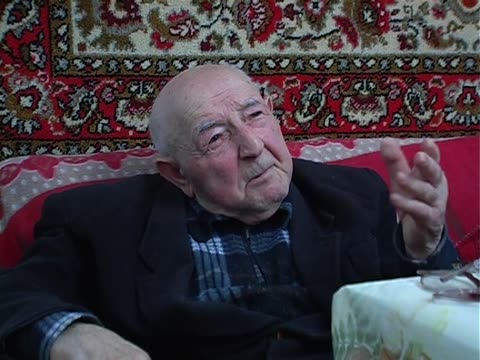
Kogan speaks about his life in the Bershad ghetto. He recalls prayer services in private homes during the war and in the synagogue after the war. Kogan then mentions wealthy refugees from the Bessarabian and Bukovina regions in the ghetto. Kogan then addresses his military service from 1944 to 1951, including fighting on the front for two months.
Kogan explains that in the Bershad' ghetto Jews prayed in private houses because the synagogue was closed and people feared reprisals, and that he went to the synagogue on the High Holidays after the war. He mentions well-off refugees from Bukovina, Bessarabia and Hungary, then says he was drafted in 1944, spent two months at the front and reached Berlin. Kerler and the second voice discuss a small booklet of his that was lent out and photographs from Berlin.
The catalogue sentence omits the discussion of a lent-out booklet with photographs.
Kogan says he wrote songs in the ghetto and hid them from others. He begins reciting the text of his song about the camp near Obodivka, but the passage is broken by a recogniser loop. Talk with the second voice about a visitor and an operation follows, and Kerler asks him to sing both songs again for the record.
The passage also contains a side conversation about a visitor and an operation, and Kerler's request to repeat the songs.
Kogan sings his ghetto song about the camp near Obodivka and Bershad', about Jews, kapores and the Bershad' cemetery. He then says he wrote only part of another song and starts a further one, with Kerler and the second voice prompting.
Kogan sings a song about Jews driven in the ghetto, including refugees from Bukovina, Bessarabia and Hungary, then "Aheym, briderlekh, aheym", a song of Jewish homecoming. He says he wrote the songs himself in the ghetto and kept them hidden. He recalls the reaction of listeners, a suit brought to him by refugees from Bukovina, and a request to send his songs to Israel. Kerler then asks how he came to be called into the army after liberation.
Kogan speaks about his military draft, after the Bershad ghetto liberation by the Red Army. He fought in the 2nd Ukrainian Front ("Steppe Front"). After the war, Kogan states, he was hired as chauffeur. Kogan then mentions his military awards.
Kogan talks about his draft after the Red Army liberated Bershad', and a train journey to Rzhev. He describes receiving British and American vehicles in 1944 and says he served on Rokossovsky's front for two months. He also mentions many medals and a driver's work after the war.
The transcript centres on Kogan's journey to Rzhev, receiving Allied vehicles and being on Rokossovsky's front; the catalogue says he was hired as a chauffeur after the war.
Kogan talks about his life after the war. He lived in Zhabokrych and Obodivka, where he worked in a procurement office. Kogan moved from Obodivka to Tulchyn in 1960. He then mentions how he met his wife.
Asked why he did not return to Bershad', Kogan talks about his life after the war, work in a trade and his move to Tul'chyn around 1960 (?). He says he met his wife in Obodivka, where she worked, and Kerler asks about speaking Yiddish after the war.
The passage also covers Kerler's question about speaking Yiddish after the war.
Kogan speaks about his military service and fellow Jewish soldiers, before talking about his positions after the war. Kogan also mentions a fire at his mother's house after the war, which destroyed his notebooks. Kogan returns to talking about how he met his wife and life after the war.
Kogan says he met four or five Jewish soldiers in the army but they spoke Russian, and recalls Marshal Rokossovsky's awards. After demobilization he spoke Yiddish at home with his mother and brother, and Russian at work. He recalls a fire at his mother's house that burned his notebooks, says he met his wife in Obodivka, where he worked on registering meat and milk, and mentions his move to Tul'chyn.
The transcript adds the question of which languages he used in the army and later at home and at work.
Kerler asks what it means to be a Jew, and Kogan answers by thanking God for surviving the war. He tells of a postwar antisemitic incident, apparently involving a Ukrainian and a shot in a cornfield, and of an encounter in Tul'chyn with a non-Jewish colleague. Much of this passage is partly in Russian. The talk then turns to Kerler's printed copy of Kogan's songs, an article Kerler plans to write, thanks, good wishes for the future, and a gift of Hanukkah money.
The passage also covers Kerler's printed copy of the songs, the planned article and the Hanukkah gift.