0:00
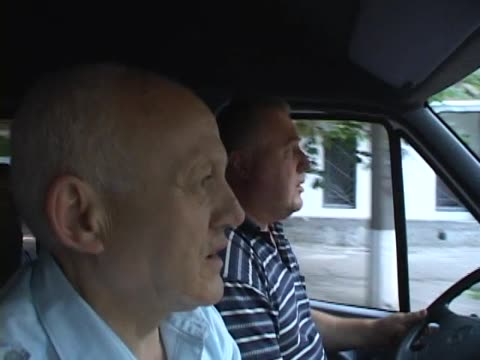
Town footage of Uman
From the machine transcript
Town footage of Uman'; the speech picked up is unintelligible and nothing can be made out.
The division was proposed from the catalogue's descriptions and the machine transcript, not stated by the catalogue (how).
Town footage of Uman
Town footage of Uman'; the speech picked up is unintelligible and nothing can be made out.
Brief chat with Alex about potential interviewees
Brief talk with the local guide and others about potential interviewees. They mention people born in Uman' and others who were in the ghetto there. Kerler says an interview takes one to two hours, and they discuss whether to walk or drive a couple of minutes.
Kerler explains how long an interview takes, and people who were in the Uman' ghetto are mentioned.
Town footage of Uman
Driving through Uman' toward the Jewish community center, with Russian talk about how to get into the courtyard. At the end a speaker tells of a visit by the German ambassador and his wife, who met former prisoners and went to the place where 25,000 Jews were shot.
Includes a story of the German ambassador's visit to the killing site.
Inside the Jewish community center
Inside the community center, the guide and Kerler discuss who still speaks good old-style Yiddish in Uman'. The best speakers have left or died, including a man of about eighty-five and another near a hundred who died half a year ago. The remaining Yiddish-speaking Jews are mostly Romanian Jews, and Kerler asks whether people came from elsewhere.
Shows that the remaining Yiddish speakers are said to be Romanian Jews, and that the best speakers have died.
Alex inside the office
Conversation in the community office about Teplitskaia and other possible interviewees. A woman called Manya Faynkold (?) is described in Russian as the one person in town who still speaks Yiddish perfectly; she went through the ghetto. They also discuss pilgrims coming to Rebbe Nachman's grave, the lack of a year-round rabbi, and Uman' before the war, when about 32,000 Jews lived there and about 25,000 were killed by the Germans.
Covers Manya Faynkold, Bratslav pilgrims and the prewar and wartime Jewish population of Uman'.
Walking to the next interview with Raisa
The team and guide set out on foot toward Teplitskaia, who is already waiting for them. On the way they talk about a woman said to be the last good Yiddish speaker in the city, about Bratslav pilgrims and the lack of a resident rabbi. In Russian they speak of the old Jewish places, and a speaker gives the prewar Jewish population of Uman' as about 32,000, of whom 25,000 were killed.
The catalogue's walk is accompanied by talk about Yiddish speakers, pilgrims and the prewar and wartime Jewish population.
Entering Teplitskaia’s apartment
Arrival at Teplitskaia's apartment and the start of the interview. Kerler asks about doing it in Yiddish, and she is asked her name and birthplace. She was born in Ternovka, a small town not far from Uman', lived there until the war, and has lived in Uman' since 1952. She was ten when the Germans came.
Gives her birthplace Ternovka, her residence in Uman' since 1952 and her age at the German arrival.
Family and life during the war
Teplitskaia names her family: her parents are buried in the Jewish cemetery, and her sisters and brother live abroad, in Dimona (?). She speaks of her children, one son in Germany, and of raising them alone after her husband left. She describes four years under the Germans, hiding in cellars and attics, hungry, naked and lice-ridden, and two pogroms she lived through.
Adds her siblings' names, her children in Germany, and her account of hiding in cellars for four years.
Liberation and life after the war
Asked about liberation, Teplitskaia says the family returned to Ternovka and got a small house there. Her parents later died and are buried in the Jewish cemetery. She mentions her children's ages when her husband abandoned her with them.
Covers the return to Ternovka after liberation and the death of her parents.
Family
Kerler asks about her work; the answer is garbled, and she speaks of her struggle raising the children alone so that they would not become drunkards or thieves. She says a son died, that one child in Germany helps her, and that she lives on a pension. Kerler asks about a Russian-influenced expression she uses.
Adds her pension, her son in Germany and a question about her phrasing.
Early childhood memories and family
Teplitskaia recalls her prewar childhood in Ternovka. Her father was a worker (the exact term is unclear) and her mother kept house; the family of seven had pigs and a cow and, she says, was not hungry before the war. Kerler asks why they kept pigs.
Adds her father's work, the household livestock and the family's prewar circumstances.
Life during the war and family
She tells how, when the Germans came and a pogrom broke out, her father's friend took the family to another village, where non-Jews hid them. She later returned to Ternovka and then, in 1952, moved to Uman' with her parents. She says her sisters are in Israel, in Haifa and Dimona, and mentions phone calls with them.
Adds the escape to another village, hiding by non-Jews and her sisters in Israel.
Ternivke before the war and life today
Kerler asks about Ternovka: it was a small town before the war, with Jewish neighbors and enough Jewish children. Now only one Jewish relative remains there among non-Jews. She says almost no true Jewish souls are left and the population is mixed, with Jews, Russians, Gypsies and others.
Adds the size and Jewish neighbors of prewar Ternovka and its mixed population today.
Family
Teplitskaia says her children have non-Jewish spouses, including the daughter-in-law of her son in Germany. She says the son has a tallit and tefillin and attended synagogue in Germany. Kerler asks whether the children know Yiddish and ends by beginning a question about a synagogue in the town.
Jewish life in Ternivke and postwar life in Uman
Teplitskaia recalls her parents' daily prayer with tallis and tefillin, and says her father kept faith in God during the German occupation. She says she wanted to leave Ukraine with her children, but could not leave her three children behind when her sisters offered to take her. She says her children treat her well.
Besides Jewish life in Ternovka, it shows her wish to emigrate and her reasons for staying.
Passover celebrations and food customs
Answers Kerler's questions about Passover before the war: baking matzah together with neighbours, and her mother's matzah dishes, latkes and kokelekh (?). She describes how her mother prepared fish with onions, and Kerler then asks about Hanukkah foods. She breaks off to ask the team not to be hurried or revealed, because she is wary of being denounced for her talk.
Personal information and family
Kerler records the date and place of the interview, then asks Teplitskaia about her Yiddish name. She gives two names, Braine/Brane (?) and a home name, and says she attended a non-Jewish school. The names of her father and mother are discussed, including her mother's second, non-Jewish name. She then asks the interviewers where they come from and begins to ask a favour on behalf of a poor, blind Jewish woman.
The catalogue says 'Personal information and family'; the transcript also shows Kerler stating the date and place of the interview and the plea for a poor woman.
Potential interviewees
Teplitskaia recommends a poor Yiddish-speaking woman in Uman' as a possible interviewee. Her name is given as Manya, but the family name and address are unclear. Kerler and others ask about her family, saying they will go to her the next day. She also reflects on honouring parents and old people.
The transcript also shows her views on respect for parents, which the label does not mention.
Holiday celebration and life today
Answers Kerler's questions about Hanukkah food in her mother's house: latkes, grated potatoes, and baked goods. Kerler describes a pastry from a woman in Bershad', and Teplitskaia recalls a teacher from Ternovka who lives there. She asks the team to be discreet about a pension matter and about aid from abroad. She then begins to speak of the pit in Ternovka where Jews were killed, a visit to it, and her relatives buried there.
Besides holiday customs, it covers the Bershad' woman, discretion about aid and pensions, and the beginning of the Ternovka mass grave account.
Memorialization and prayer during and after Soviet times
Teplitskaia describes the mass grave in the forest near Ternovka, where her father's relatives lie. She says the site is neglected and that this year she brought flowers. She says she bought a burial plot beside her mother in the Jewish cemetery and stresses honouring the dead. She says she visits the grave of Nahman of Bratslav and pleads for her children's health there, and that she went in the 1950s and 1960s, bringing her son.
Besides memorialization and prayer, it shows her burial arrangements for herself and visits to the grave in the 1950s and 60s.
Life today and emigration
Teplitskaia talks about the character of people and about Jews who came to Uman' from abroad, including from Israel. She criticizes some of them and talks of freedom and of speaking the truth. She also speaks of Jews who fled during the war. The talk drifts to the present.
The transcript is hard to follow, but shows opinions on foreign visitors and on speaking freely, and includes a Russian-language aside.
Religious customs before the war and family
Answers questions from Kerler and another person about whether Ternovka's Jews knew of Nahman's grave before the war, and she says they did not. Her father did not know of it or go there, and he worked all day. She says there were few Jews in Ternovka and that her father died after 1977 (?). She says people began going after the war.
Besides religious customs and family, it covers the small number of Jews in Ternovka and whether the Bratslav grave was known before the war.
Return home after the war and religious life
Teplitskaia says she began to go to Nahman's grave after returning from the Germans, when people began talking about him, and the neighbours showed her the hiding place of the tsadik. She says non-Jews called him a saint. She describes Bratslav Hasidim and pilgrims from America, England and France coming on holidays. She mentions that they are robbed, and that red items are given out recently, as Kerler asks what that means.
The transcript also shows Bratslav pilgrims, the robbing of visitors and what the non-Jewish neighbours said of the tsadik.