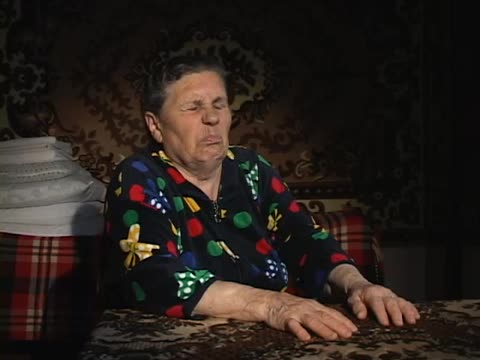
Teplitskaia and Kerler talk about television and freedom of speech, and about an interviewing crew member whom Kerler describes as trustworthy. Kerler asks what non-Jews say about the tsadik, and she answers that people no longer say anything about it. She also mentions her children and their marriages. The passage ends with Kerler's question about Yiddish-speaking non-Jews in the town. This does not read as a discussion of religious life today.
The transcript shows talk about television and speech freedom and about the crew, rather than religious life.
Teplitskaia answers Kerler's questions about non-Jews who speak Yiddish. Some learned it by working with Jews for years, and some speak it better or worse than others. She also compares Yiddish with German, having spent four years under the Germans, and says the two are close.
Asked about songs, Teplitskaia recalls Ternivka during the war, when Hungarians, Romanians, Poles and Germans passed through. As a child she had to go to peasants and fetch milk and eggs for the soldiers. A German soldier took pity on her and gave her tinned food. She recalls his remark that every people has its own customs, and that she suffered for four years.
The passage is about the German occupation and the soldier's pity, with the town name Ternivka (the transcript's spelling is approximate), rather than childhood memories.
Teplitskaia says she was ten years old during the war. Asked by Kerler and Katz about prewar songs and people, she says that as children they worked at home after school, feeding pigs and cows, and that her father was a poor worker. There was no time for singing, and she says she began to sing Yiddish songs only after the Germans. A cousin who had been in Romania sang songs from there.
The transcript shows daily work after school and poverty rather than songs, and mentions a cousin who had been in Romania.
Asked by Katz and Kerler about prayer, Teplitskaia recalls only that her father prayed. Her mother taught her the modeh ani (?) prayer. She says she remembers little because the children were always working.
Asked about Yiddish theater in Uman' after the war, Teplitskaia says she arrived in the 1940s and does not know what had happened there before. She goes on to speak of holiday customs and Jewish observance, and mentions an anecdote about a woman losing her pension. The passage is fragmentary and the topic is unclear in places.
The transcript shows an answer about Yiddish theater and a shift into holiday customs and other remarks.
Teplitskaia discusses Yiddish jokes and sayings: Jews used to say witty things and people laughed, and such things still exist. She says that when she sits alone at home she begins to remember. She tells of a neighbor of her mother who used to sing, and mentions Israel, where kibbutzim keep pigs and chickens, as a comparison.
Teplitskaia talks about relatives in Israel, including a late relative's grandson, and about Jewish-Ukrainian relations. She describes a visit to a rabbi in Kyiv and services there, and fears that Jews might be attacked. She mentions Putin and a Moscow incident, and says she watches many television programs and cannot sleep. Her neighbors urge her to leave. Kerler asks how a Ukrainian phrase would be said in Yiddish.
The transcript adds relatives in Israel and fear of antisemitic attacks, with Kerler's request for a Yiddish rendering of a Ukrainian phrase.
Teplitskaia says she has lost hope in the present, and prays to God for peace and for the good of her children and grandchildren. She describes loneliness alone at home, her depression and tears. Her daughter and son visit and bring medicines and food. Kerler urges her to be optimistic. At the end he asks whether she has a message for the Jews in America.
The transcript shows no proverb exchange here but loneliness, family visits and prayer.
Teplitskaia sends greetings and good wishes to the Jews of America. She talks about emigration, including a woman who could not take her son out, and Ternivka natives who live in America, and wishes that her own children could settle abroad. She discusses the difficulties of getting out, visas and money, and compares leaving from Israel with leaving from Ukraine. She mentions her sisters, who live in Germany, and her hopes of burial beside her parents. The passage ends with Kerler's thanks.
The transcript adds her sisters in Germany, visa difficulties and the wish to be buried beside her parents.
Teplitskaia blesses the interviewers with health and the help of God for them and their families. She invites them to visit her, and Kerler responds. This closes the interview.
Katz and Kerler talk at the grave of Nahman of Bratslav with Rabbi Kirshnboym (who gives his name as Abraham Moyshe) and other Breslov Hasidim. They discuss the word Breslover, Breslov teachings on joy and not despairing, singing and dancing, the Yiddish prayers and songs of Breslov, and Yiddish as a language of the rebbe's teaching. The kibbutz word, a singer from Kibbutz Nahal (?), the cantor Levi Yitzhak Bender in Uman' and Israeli election jokes come up. The group also tells a story of a letter to Rebbe Nahman and talks about Breslov books and scholarship, with Kerler photographing the site. The recording contains much recogniser looping.
The transcript shows a multi-voice conversation with Breslov teachings, Yiddish, jokes and songs, not only the grave.