Interviewees Raisa Kirilovna Teplitskaia Teplitskaia Interviewers Dov-Ber Kerler, Jeffrey Veidlinger, Dovid Katz
Recorded 25 June 2005, Uman'
Kind interview, performance
Related tapes MDV 736
Identifiers and copies
Tape MDV 737 · record
p8419979c · Ukraine, Cherkas'ka, Uman'
Media Collections Online (Indiana University — the archival copy)
Not yet on YouTube or archive.org.
Cite this moment
Raisa Kirilovna Teplitskaia; Teplitskaia, interviewed by Dov-Ber Kerler, Jeffrey Veidlinger, Dovid Katz, Uman', 25 June 2005. AHEYM (Archives of Historical and Ethnographic Yiddish Memories), Indiana University, tape MDV 737, at 0:00 . https://media.dlib.indiana.edu/media_objects/p8419979c/section/nk3232434?t=0
Copy
Catalogue introduction
June 25, 2005. Ukraine, Cherkas'ka Oblast', Uman'. The first part of the tape is a continuation of a formal interview with Raisa Kirilovna Teplitskaia. (Part 2 of 2. See MDV 736) They discuss religious life today, as well as life during the war under German occupation for four years. When she was ten years old, she had to go to peasants, asking them for food to bring to the Germans. She remembers how a German soldier had pity on her and gave her food. She then talks about her life before the war when she had to work after school every day. She then discusses life after the war, before sharing a few Yiddish proverbs. She discusses how she attended services in Kyiv after the Soviet period and Jewish-Ukrainian relations today. The conversation turns to life today and emigration. She compares life in America and Ukraine. The team then concludes the interview with Teplitskaia. The second part of the tape is filmed at the grave of Nahman of Bratslav. The team meets and discusses life in Uman' today with Rabbi Avrom Moyshe Kirshnboym. (Part 1 of 2. See MDV 738) They also sing a few songs together and talk to the community members. Interviewed by Dov-Ber Kerler, Jeffrey Veidlinger, Dovid Katz.
From the machine transcript
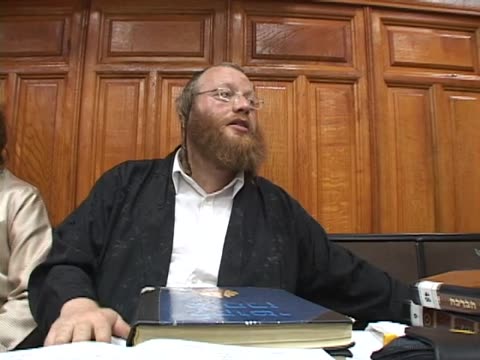
Tape MDV 737 is the second part of a June 2005 visit to Uman', whose catalogue introduction says the first part continues the interview with Raisa Teplitskaia. The one passage described here, which the catalogue places at the grave of Nahman of Bratslav, is a long informal gathering with Rabbi Avrom Moyshe Kirshnboym (the catalogue gives this name; it is not clear which voice is his) and Bratslav community members, with Kerler and Katz. It consists of talk about Rebbe Nahman, Rabbi Nosn and Bratslav teachings, several songs and melodies sung together, and Yiddish word discussions. Katz and Kerler are questioned about themselves and their work on Yiddish, and the group talks about the yeshivas and rabbis of Lithuania, Poland and Brooklyn and about arranging to pray. The transcript is heavily garbled and contains recogniser loops, so only the broad content is recoverable.
Speakers, as the transcript identifies them
INF informant INF2 informant S3 other Dov-Ber Kerler interviewer Dovid Katz interviewer Languages heard
Yiddish 57.4 min
Where catalogue and transcript differ The catalogue entry for this passage speaks of the rabbi, the team and the community, and that fits. Most of the passage is unscripted conversation among several voices, with much overlap, so speaker labels are unreliable. Hebrew phrases and songs are recognised only roughly, and there are loops (the 'ער האט נישט קיין פעה' repetition and a run of 'ני' syllables). No Teplitskaia material is heard in this part.
A paraphrase of a machine reading: the topics can be trusted; names, numbers and family relations are to be heard before they are cited. How this layer was made.