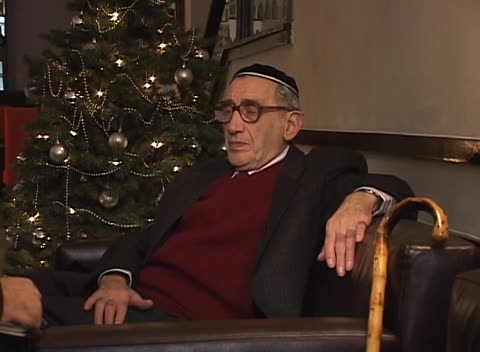
Herbst provides personal information and speaks about contemporary life in America. Herbst was born in Bornobash (Yiddish: Berlabashe), which is small village located between Trebušany and Rakhiv in the Transcarpathian region.
Opening chat with Kerler about the recording and the date; Herbst then gives his Hebrew and Hungarian names and says he was born on the eve of Passover in 1925 in Berlabash, a very small village between Rakhiv and Trebushany. He discusses the names of the village in different languages and the changing states that ruled the area (Hungarian, Czechoslovak, Soviet, Ukrainian), and says he lived there until the war. Early in the passage he also comments on American aid to Jews after the war.
opening exchange about American help to Jews after the war and the Hungarian/Slovak/Soviet/Ukrainian names of the village
Herbst discusses his childhood memories and his family. He grew up with four sisters and three brothers. According to him, approximately eleven families lived there.
Herbst describes the tiny Jewish community of Berlabash, which had a minyan and about ten to twelve families, and his own family of eight children. He tells how his sisters sewed and knitted for local women, how his father worked as a small-time local judge who travelled on foot over the mountains, and how the family ran a small shop. He names his grandfathers, and two brothers learned trades in Brno and Rakhiv.
his sisters' sewing and knitting for income, his father's work as a local judge, and his brothers' training as carpenter and tailor
Herbst speaks about his life before the war. He attended religious school (cheder) in Rakhiv and lived at his uncle's house. Herbst describes how he went to eat at several people's home ("esn teyg"). Herbst studied at the elementary school in Berlabashe for four years, before moving to Rakhiv. Herbst also attended a yeshiva high school for one year in Vişeu de Sus, Romania, (Yiddish: Oyber Visheve), where his sister lived. After graduating from this school, he began his yeshiva education in 1937.
Herbst recalls how at about age ten or eleven he went to cheder in Rakhiv, sleeping at the melamed's house and eating 'days' with different families, including a rich sawmill owner. He attended four classes of the school in Berlabash, then a year in Rakhiv and a year in Oyber-Vishev (Vișeu de Sus), where his sister lived and he was near a large yeshiva. He recounts a fight in which yeshiva students drove off hostile attackers.
the story of the attack on the yeshiva students and their defence with boards
Herbst describes the mountains and river near his childhood home, where children gathered wild blueberries, raspberries and strawberries. He tells how they picked on Tisha B'Av, when fasting, and made them into syrup and jam, and how a group made noise to scare off bears. He then says he went to work at the sawmill and that war began after his bar mitzvah.
picking berries and the bears, plus the beginning of his work at the sawmill
Herbst talks about his life during World War II. He worked as lumberjack and shares his work experiences in different places. In one episode, Herbst describes how he encountered a bear. He also mentions how he saw wolves during his childhood.
Herbst recounts his work at a sawmill and on forest paths in the mountains, as a youth too young to be registered. He tells of an encounter with a bear that jumped down while he stood pressed to a wall, and of wolves that once threatened the family's animals in winter. Kerler asks about the sawmill, sawdust and the Tisza river.
the bear and wolves stories, and the sawmill work done as an unregistered youth
Herbst speaks about his family. His mother was born in Romania. He then shows photographs of his parents. Herbst then describes his childhood home, including where his family set up a sukkah.
Herbst names his mother Perl and says she came from Romania; his paternal grandfather came from Berlabash. He shows Kerler photographs of his parents and sisters and names the four sisters and describes their looks. He describes the house where the family lived, with a cellar and a movable-roof sukkah, and mentions a neighbouring family that delivered logs from the mountains.
he shows photographs of his parents and sisters and describes the sukkah and house layout
Herbst explains how logs were sent down the mountain with warning shouts, the dangers involved, and how the sawmill owner placed orders for boards. He names his brothers' trades: one a carpenter, Shimon a tailor who also worked at the sawmill, and says he himself learned to be a shoemaker.
Herbst describes Sabbath in his parents' home before the war: his mother baking challah and bread in the early morning, cholent and kugel baked in the oven, and thin flat breads. Meat was not always affordable and there was no fish, so mock fish was made, with farfel as a side. He recalls a neighbour, a butcher, who survived the camps and now lives in Brooklyn.
a butcher neighbour who later was with him in the camps
Herbst speaks about life during World War II. He was deported to Auschwitz, together with a childhood friend. Before his deportation to Auschwitz, Herbst stayed in the 45:34 ghetto, sleeping at a cemetery for six weeks. After his arrival in Auschwitz, Herbst was sent to the Mauthausen and then Irrsee concentration camps. In Irrsee, Herbst worked as forced laborer at a quarry, building a tunnel toward Ebensee. He was liberated by the American army in Mauthausen in 1945.
Herbst recounts the deportation: in April 1944 the family was taken to the ghetto in Mateszalka (?), where for six weeks they slept in the open at the cemetery, then to Auschwitz in the first transports with a childhood friend. He declined an offer to be hidden and went with his family. He later worked on a tunnel, came to Mauthausen, and was liberated there by the Americans on 5 May 1945.
an offer of hiding that he turned down and the first meal of pork
Herbst speaks about the days of liberation in Mauthausen, when he was too weak to go to the window, and answers Kerler's question about the tunnel built under a river and into the mountain. He says the Germans paid for the work for two years under American occupation. Kerler then steers him back to Berlabash and Rakhiv before the war, and Herbst says his voice is tired, so they take a short break.
Kerler's question about the tunnel and the short break at the end
Herbst speaks about his childhood memories, particularly games. He also addresses his father's observance and charity. Herbst recalls different fruits.
Herbst recalls childhood games with a wooden top, sleds and skis on snow, and speaks about Hungarian and Yiddish words at home. He tells of his father, who did not eat before reciting Psalms, welcomed poor guests and wanderers, and kept few books. He recalls eating paprika and tomato for the first time at an uncle's home in Rakhiv, and fruit such as apples and plums.
his father's religious routine, hospitality to poor guests, and first tasting paprika and tomato
Herbst speaks about languages spoken at home. He then addresses regional differences among communities, before talking about his religious education in Rakhiv. Herbst then describes Sabbath dinners at a rebbe's home.
Herbst talks about the languages and communities of the region, comparing Ruthenian, and Maramureş Jews with those of other places, and says there was little culture in his area. Kerler brings him back to cheder at Rakhiv, followed by yeshiva, bar mitzvah and Friday evenings at a young rebbe's home in Oyber-Vishev (?). He returned home in 1938 when the Hungarians moved in, and recalls his studies of Talmud and Hebrew texts.
languages and regional differences among Jewish communities, and Sabbath at a rebbe's table
Herbst tells a joke about observant Jews on Yom Kippur. He then sings a comical song about a woman going to a rebbe. Herbst remembers both from his time in Rakhiv.
Herbst tells a joke about guests in a small town on Yom Kippur eve who needed a cantor, and recites a chant. He then tells a joke about a childless woman who went to a rebbe for a blessing, and sings a comic song about it, both remembered from his time in Rakhiv.