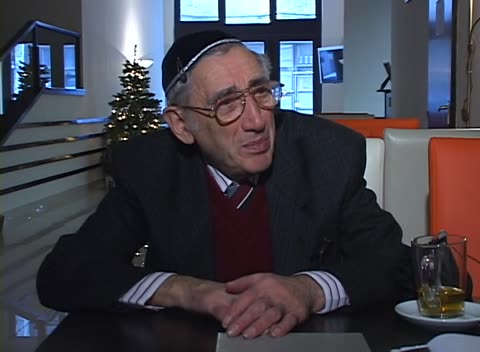
Herbst recites a humorous rhyme about the Hasidic rebbes of Sighet and Spinka: one goes to Sighet for a cow, to Spinka for a bride. Kerler asks him about it, and they discuss going to rebbes, who were also called 'good Jews'. Herbst mentions the Kalov rebbe, whose descendant lives in Israel, and Kerler asks whether the song was known at his home; it was not, and he heard it only in Budapest. Kerler ends by asking about the word 'baal-shem'.
The rhyme is about the Sighet and Spinka rebbes; the segment also includes talk about the Kalov rebbe and Hasidic followers.
Kerler asks Herbst about cultural terms such as 'baal-shem' and 'dibbuk' (placed in Prague, with a question about the golem). Herbst then sings a song about a destitute man who sleeps on boulevard benches and is woken by a policeman's stick. Kerler has him repeat it line by line to write down the words. Herbst says it was brought by a cousin from Sighet; Kerler then starts a question on 'barkhes' and challah.
Kerler has the song repeated line by line for transcription, and the words 'baal-shem' and 'dibbuk' are asked about.
Herbst answers a question on whether his family said challah or 'barkhes'. Kerler asks where in Hungary Jews spoke Yiddish; Herbst names small towns in the north of the country, among them Tokaj and Kalov, where there were many Yiddish-speaking Jews, and the talk turns to Slovakia. He says he would rather talk about the hard postwar years another time. Kerler thanks him and asks for a religious saying he remembers.
Herbst recites a rabbinic saying about honouring the place, and Kerler asks about the sense of 'makom' as God. Herbst describes a Yiddish club in Budapest and how he speaks Yiddish words to Jews he meets in the street. He recalls the prewar poverty in which his father still invited passing guests to eat while going without himself, and says he now offers food to anyone who comes. Kerler also talks about making a copy of the recording for him, and finally asks about Purim.
Besides the sayings, the segment covers the Budapest Yiddish club and the father's hospitality during prewar poverty.
Herbst says people went to see the Purim play and recites a Purim rhyme, with Kerler asking about a word in it. Kerler mentions his own trip to a Carpathian place, and Herbst mentions a man who came from the Carpathians. Kerler asks whether Jews in southern and western Hungary spoke Yiddish. Herbst replies that Hungarian Jews were called 'Hungarian donkeys' and Carpathian Jews 'Polish', and he explains Hungary as 'mameland'. Kerler ends by turning to Passover and the four questions.
Herbst recites a Purim rhyme and explains how Hungarian and Carpathian Jews referred to each other.
Herbst describes the prewar Passover custom of neighbours visiting each other to hear how each conducted the seder, with a remark about the eggs. He gives a sayings-style wish for the coming year and the Messiah, recited at the seder, and speaks of very pious Jews. Kerler then begins a question about a dialect word for coming together.
Kerler asks Herbst for the Yiddish expression for 'to meet' or 'come together'. Herbst gives forms of 'tsunemen' and 'trefn zikh', and Kerler notes that his own speech says 'tsam-'.
Herbst speaks about the contemporary community. He then addresses his life after the war. Herbst worked as nuclear technician at an institute of physics for forty years. He then talks about contemporary friends and shows newspaper articles.
Herbst and Kerler discuss people in the community today, especially a man nicknamed Tsures-bachi who prays in a synagogue on Csekonics(?) street, and others whom Kerler names. Herbst recalls a few postwar months in Debrecen working in a hospital, and says he then worked for forty years as a technician at an institute of physics and received a recognition from the academy. He talks about a friend near Donetsk who wrote him a warm tribute, and about Professor Scheiber, whose books Kerler knows. He also tells of a woman visiting from Israel who criticised Carpathian Jews, and recalls his son's bar mitzvah.
Gives details of his forty years as a physics-institute technician, the friend and Professor Scheiber, and the Debrecen hospital months.
The team concludes the interview with Herbst. The camera then collects outside shots from the synagogue, before the team conducts a brief interview with Dof.
Kerler and Herbst close the interview with thanks and good wishes. The camera then records outside views of the synagogue while Kerler calls out to someone nearby, and a second male voice is heard briefly. The Dof interview follows.
Dof speaks about his life during and after World War II. He was born in Uzhhorod and lived in Khust during his childhood. He then speaks about his education, during which he attended a religious school (cheder) and a Hebrew primary school for six years in Khust.
Dof says he was born in Uzhhorod but grew up in Khust, where the great rabbi Dushinsky was and whose synagogue still stands. During the war he was in the ghetto with his mother, her sister and the children. He attended cheder and a Hebrew school in Khust, with a Hebrew gymnasium also mentioned.
Adds the ghetto with his mother and her sister's family.
Dof speaks about contemporary religious life. He is a cantor. He then addresses prewar religious life in Khust, specifically his cheder education. He then recalls a Yiddish-language synagogue service in Buda in 1944. He then talks about contemporary religious life.
Dof says he is now a cantor in a Budapest community in Buda. He describes the big Khust synagogue with its cantor and a strict beit midrash, and his cheder with a fine rabbi. He recalls hearing a Yiddish sermon on Yom Kippur in a 'Polish' synagogue on the street where the family lived before the war; Kerler asks for the year. He lives in Buda now and says the synagogue there has Friday-night services. Few Yiddish speakers are left, since many died in the Holocaust; Hungarian Jews spoke Hungarian, some German.
Contains the Yom Kippur sermon memory and the question of how many Yiddish speakers remain among Hungarian Jews.
Dof says he studied four or five years at the Hebrew school, after which the war came. He says the family was lucky to get away before deportation. Kerler asks about Hebrew songs, and Dof sings or recites a Hebrew song from school. He then speaks about relatives in Jerusalem and about being afraid to fly there.
Adds the escape before deportation and his relatives in Jerusalem.
Dof says he worked here after the war and stayed beside his ill mother for years; he is called a devoted son. He and Kerler exchange names, and Kerler gives his card and says he lives in America. Dof explains that his name is Yitshak Dof, not Imre (the Hungarian form), and mentions his mother's brother Bernstein in America, a confectioner. He then recalls the Purim play only dimly and says his wife also speaks some Yiddish.
Covers the name exchange (Dof vs Imre), his uncle in America and care for his mother.
The team meets Shloyme Levkovich. He was born in a village, fifty kilometers from Debrecen. Levkovich then speaks about life today, before touching upon his life before the war and holiday celebration.
Kerler meets Shloyme Levkovich, who comes from a village near Debrecen. They talk about whether he speaks Yiddish and about Hungarian being a hard language. Kerler explains that Levkovich is nicknamed Tsures-bachi because he is always complaining, and that he is the best Debrecen speaker he has met. Levkovich says Purim was celebrated with baking and recalls a bit of the Purim play. Kerler then talks with a colleague, partly in English, about the meeting and his age, and they leave to see the synagogue, where they see Yiddish-speaking children with sidelocks from Vienna.
Includes the nickname Tsures-bachi and the aside with a colleague and the Yiddish-speaking children from Vienna.
The camera records town footage of Budapest while Kerler and a second man talk off-camera, mostly in English, about the dialect boundary and having found two Yiddish speakers from the Carpathian–Debrecen area. The Yiddish is largely garbled.
The team walks through the streets looking for Gotlieb's address, with talk among Kerler and others, partly in unclear language. They ask about her whereabouts and finally greet her at the door. Much of the speech is garbled.
The team greets Gotlieb at her apartment and then sets up the interview with her. She then provides personal information and speaks about her family, while showing photographs. Friedman was born in Sátoraljaújhely (Yiddish: Ihel).
The team greets Gotlieb in her apartment and introduces themselves by first names. Kerler explains the Yiddish interview, and she says she has no one to speak Yiddish with. They speak of the Yismach Moshe Teitelbaum, buried in her home town, and she refers to her husband and son, now dead, and relatives in Brazil. She says the town was called Ihel in Yiddish, and Kerler states the date and begins the interview.
Adds Teitelbaum's grave in her home town and her references to her husband, son and relatives in Brazil.
The formal interview with Gotlieb begins. She provides personal information and speaks about her family. Gotlieb's mother was born in 59:47 and her father in Sátoraljaújhely. Her father was a leather supplier.
The formal interview with Gotlieb begins. She gives her married name Gotlieb and her maiden name Friedman, and says she was born in Ihel (Sátoraljaújhely) in 1925. Her mother, Khaye Sore, came from another place that is unclear in the transcript; her father, Shloyme, was born and lived in Ihel. Kerler and she work out his trade, and it was dealing in raw, unworked leather rather than making shoes or leather goods.
Gives her parents' names, her father's leather trade, and the mother's origin as unclear.