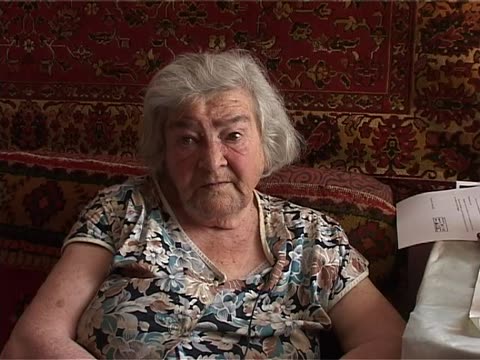
Vainer-Shpak speaks about her life during World War II. She was imprisoned in the Vinnytsya ghetto. Vainer-Shpak describes how she was taken to forced labor by the Germans to build roads.
Vainer-Shpak recalls the Vinnytsya ghetto and a labor camp. Men were taken from the camp for road work, and she joined a work group paving a road. She then fled with a man she met there, and they became husband and wife. They returned to Vinnytsya and found a neighbor occupying their house.
The flight with her future husband to Zhmerynka and the return to Vinnytsya are not mentioned in the catalogue.
Vainer-Shpak explains how she tried to reclaim her house after the war. According to her, the Ukrainian neighbors vacated soon after. She then addresses her life during and after World War II.
She says she confronted the neighbor who had taken over her house, and the neighbors soon moved out. She describes her happy childhood and her isolation during the war, with no parents or siblings left. A man named Itsik helped save her from death. She mentions her hearing loss.
Itsik, who saved her, and her childhood and loss of family are not in the catalogue.
Vainer-Shpak speaks about her life during the war and shares an episode when she spent time in hiding. She states that the bombing damaged her hearing.
Vainer-Shpak recalls the war, when she went into the fields as the militia fled. Aircraft bombed the area, and she says the bombing damaged her hearing. Kerler then asks about non-Jews who spoke Yiddish.
She remembers a non-Jewish family in Vinnytsya that spoke Yiddish because the mother rented out her houses to Jews. She comments that Jews once wanted to become gentiles and now gentiles want to become Jews. She talks about help from the Joint and a food parcel. Kerler then begins asking about Yiddish books and newspapers.
The Joint's help today and the question of Jews and gentiles are not in the catalogue.
Vainer-Shpak talks about Jewish life before the war, particularly Yiddish books and press. She also speaks about her family, as well as prewar religious life. In particular, Vainer-Shpak remembers the local cantor and her father chanting at the synagogue.
Vainer-Shpak answers questions about Yiddish newspapers read before the war, including the Moscow Emes. Kerler asks about her father, who is identified as a Bratslav Hasid. She says he was not a cantor but sang at the synagogue. A cantor in Vinnytsya used to call him over when he led the prayers.
The father's Bratslav Hasidism, which comes from Kerler's questions, is not in the catalogue.
She describes her father singing at the Sabbath table and the children joining in. He sang with words, in Hebrew and in Yiddish, and sang on Purim, Hanukkah and Passover. Kerler asks about the songs, and she recalls only a couple of words of a Purim song. Kerler then asks about a rabbi in Vinnytsya.
Vainer-Shpak remembers prewar religious life, specifically a local rabbi. She then answers questions about cultural terminology, before she addresses prewar Jewish life in Bratslav.
Vainer-Shpak remembers the rabbi of Vinnytsya as an important man with a fine head and beard. She answers Kerler's questions about the terms 'a good Jew' and 'tsadik'. She recalls no Hasidim beyond her father's Bratslav and calls Bratslav a very Jewish town. Kerler then begins asking about Sabbath bread.
Kerler's questions on Yiddish terms for a good Jew and a tsadik are not in the catalogue.
Vainer-Shpak speaks about her mother's cooking and baking for the Sabbath. In particular, she shares her mother's recipe for gefilte fish. Vainer-Shpak then addresses food and drinking customs in general before the war.
She describes her mother's Sabbath baking and her gefilte fish recipe: the fish was chopped by hand and mixed with pepper, salt and egg, with no sugar added. Kerler then asks whether tatsh (a potato dish) or vodka were known and what Jews called vodka. She explains that Jews drank brandy but not to get drunk. Kerler closes the passage by asking about a spell against the evil eye.
The questions on terms for potato dishes and vodka are not in the catalogue.
Kerler asks about spells against the evil eye, the dybbuk, the golem and terms for a cemetery. Vainer-Shpak answers, though the transcript is garbled in places. She says Jewish fields no longer exist, and a name for a large field is discussed. Kerler asks about how her father invoked a dead person, and she says she once prayed for her ill relatives at the cemetery.
The dybbuk, the golem and cemetery terms, as well as the prayer for her ill relatives, are not in the catalogue.
Vainer-Shpak tells of praying at the cemetery for her husband, father and mother and says God helped her. Kerler then asks the AHEYM dialectological questionnaire in Russian and Yiddish. The items include greetings and times of day, house, book, window and glass, colors, building, adjectives and adverbs of space and time, health words, the bed, midwife and thousand, the street, potato and flowers, shop, kinship words and family, and 'a different story'. Many of her answers show uncertainty or ask Kerler to repeat. The two also talk briefly about the project's other interviews.
The long questionnaire stretch and the exchange about the project's other interviews are not in the catalogue.
The formal interview closes with a few exchanges between Kerler and Vainer-Shpak about the questionnaire work having tired her. The transcript shows no speech about the apartment or yard footage.
The transcript shows only brief closing talk, not the apartment and yard footage.