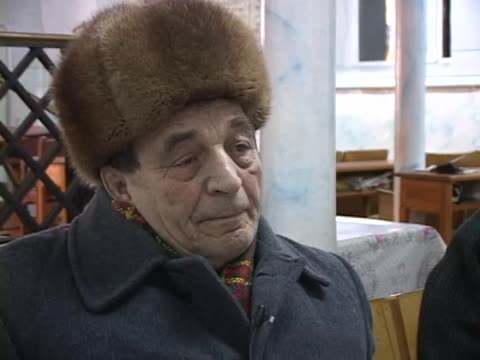
After a few lines of chatter among the interviewers, Vaisman says he was born in Berdychiv and that his father, Yosl, died in 1928, so his mother raised him. Lemster and Kerler discuss the Yiddish word for 'raising' a child. Vaisman says his mother worked at a factory and that there were two children. He studied in a Yiddish school until 1938, then in a Russian school, and fled in 1941 with his mother and sister to Central Asia.
Includes a short exchange about the Yiddish word for raising children and the 1941 flight to Central Asia.
Vaisman recalls being drafted into the army in 1943 and serving until 1946, then returning to Berdychiv. Asked about life before the war, he says it was very hard, with hardly any bread. His mother worked at a factory washing, and Lemster presses him on her job. He names his sister Sonya (Yiddish Sara), who is still alive.
Adds the factory work of his mother and his sister Sonya.
Vaisman says his sister never married. He has two children: a daughter in America and a son nearby, and grandchildren in America and Israel, one of whom visited. Life is still hard, and he and his wife live on pensions. His wife, born in 1925 like him, lost her parents, who were killed. The passage ends with Lemster's first question about Yiddish theater.
Adds his children and grandchildren in America and Israel and his wife's parents who were killed.
Lemster asks whether Yiddish theater came to Berdychiv before or after the war. Vaisman says there was no thought of theater before the war because the family had no bread. Asked about Yiddish reading, he says he studied in the Yiddish school until it closed in 1938 and could read Yiddish after four classes. He read no Yiddish books because hunger was the only concern.
Adds that he read no Yiddish books and that the school closed in 1938.
Asked about the 1932–33 famine, Vaisman says only that they were always hungry and ate cornmeal porridge (?). He did not know his grandfather, who died in 1927. His mother spoke Yiddish at home but could not pay a melamed, so he had no cheder. He recalls evacuation with his mother until 1943, after which she stayed with his sister in Central Asia while he was taken into the army and was in Romania. The passage ends with Katz asking about songs.
Adds grandparents, his lack of cheder education, and the wartime separation from his mother and sister.
Vaisman says there was no singing at home, since the mother could not sing and the family lacked bread. He says his unmarried sister lives with him and his wife. Katz and Kerler ask about the pension, and he and Kerler discuss how much money a person or a family needs, in hryvnias, as prices rise. Kerler thanks him at the end.
Adds songs at home, the sister living with him, and detail on pension amounts.
Near the synagogue the interviewers talk among themselves and with Vaisman, seemingly about buying or borrowing a prayer book or other books, and thank him. A local voice then explains that a man's wife has died and he lives alone with his daughter. The transcript is largely garbled.
The transcript shows talk about books and a thank-you rather than a walk round the synagogue.
Kerler and the woman guide, Barshteyn, decide whether to go on foot or by car to see Jewish Sharhorod. She notes the places are not far, they take a bag from the car, and she points to the central street. She says she does not live there now and does not know whether people pray at the building on the right.
Shows only the decision about walking or driving and the first remarks about the central street.
Barshteyn leads the team through the former Jewish quarter of Sharhorod and points out former Jewish houses now lived in by non-Jews. She says there were ten synagogues, of which only the big one remains. She describes a church and a monastery, visiting theater troupes, wealthy men and cantors from other towns, and Jews working as tailors and shoemakers. She says she left Sharhorod for Vinnytsya in 1983, recalls her mother's holiday cooking and Hanukkah latkes (?), and says she studied in a Yiddish school and can read Yiddish (Sholem Aleichem, Peretz, Mendele). Her family house was pulled down and is now a garden; the former synagogue is now a library, and she points out traces of a mezuzah, the house of a woman called Klara, and a place linked to hiding. Several Russian exchanges with locals occur.
Adds the guided walk past specific houses, former synagogues and the library, plus her move to Vinnytsya and her Yiddish reading.
At Abrashe's closed house the team greets him. Kerler and Katz remind him of an earlier visit, mention photographs and visitors from America, and ask about his family, saying his grandmother has died. A short Russian exchange follows.
Barshteyn points out a former militia building and shop, and the walk continues. Lemster asks whether Jews under Romanian occupation used coded words in Yiddish so that others would not understand. She replies that Jews spoke Yiddish at home, and that in the ghetto they were allowed to walk on one street only until six o'clock.
Adds the wartime question about coded Yiddish speech and the curfew in the ghetto.
Barshteyn describes the war years in Sharhorod. The Germans were there for two weeks and took what they wanted. Romanian authorities followed, and Jews deported from Romania came into the shtetl. She says Jews could not speak Yiddish freely in public but did at home. She was twelve (?), her sister eight and there was a baby, and her mother was left alone without work. Lemster asks whether her mother sang; she says she sang only at home, in the ghetto.
Barshteyn says non-Jews took over the Jewish houses. Lemster asks about stories, and she says her father told Yiddish stories, including an anecdote about a joker and a stern rebbe. She recalls the town cantor and describes weddings with klezmorim brought from Moldova and Bessarabia, the chuppah held at the synagogue, and the women's gallery upstairs. Better cantors were hired from Zhytomyr and Moldova.
Adds the rebbe anecdote, the hired cantors and the klezmorim at weddings.
Russian talk among the group and locals, with Katz commenting. A local man speaks English, saying he has led the Jewish community since 1994 and that very old Jews are gone, buried in the cemetery or emigrated to Israel, Germany and Australia. Kerler then asks whether Jews kept dogs. Barshteyn says she had a dog and a cat, in a house lower down near the river.
The transcript shows the community leader's English remarks and a question about dogs rather than a simple introduction.
Barshteyn describes Jewish weddings in Sharhorod: the in-laws arrived, the chuppah was held at the synagogue, and then the party continued at home, accompanied by Jewish music. She mentions a bulgar-type dance and a dance with a kerchief whose name she cannot recall. Kerler and Lemster ask about the dance of the two mothers-in-law seated on benches. Katz offers to sing a song about a rebbe, but she does not know it.
Adds dances and the question about the dance of the two mothers-in-law.
Lemster and Kerler ask what 'Litvak' meant in Sharhorod. Barshteyn says it was not pejorative, only a person from Lithuania or Latvia. She does not recall special Jewish games, and says Romanian Jews who came during the war sang many Yiddish songs, while older local Jews no longer understood Yiddish. Interviewers and locals then discuss a Christian who still speaks Yiddish, the Bible museum and the keys, and a robbery at the synagogue. Items mentioned as stolen include a gramophone, Jewish books, candlesticks and samovars; furniture and books remained. Much of this is in Russian.
Adds the meaning of 'Litvak', the Yiddish-speaking Christian, the museum and the theft from the synagogue.
Barshteyn describes kosher meat: the shoykhet slaughtered, the blood was drained and the meat was salted for an hour. She describes Passover preparations, with the dishes brought down from the attic, a special oven for baking bread, and the house cleaned and whitewashed. Her father baked matzo using a perforating wheel. Lemster asks about the fillings of Purim pastries (poppy, jam and similar), and Kerler asks about the evil eye and a remedy using a glass, which she half recalls.
Adds Passover preparation, the baking oven, matzo, Purim pastry fillings and the evil-eye remedy.
Barshteyn says she spoke Yiddish with her parents, that elderly Jewish women in Vinnytsya often do not understand Yiddish, and that her son (about 52) finished school locally and went to Vinnytsya. She says Hebrew was known only to those who went to a yeshiva, and that Hebrew is now taught. She names her father's seven siblings and their trades, including trading, tailoring and shoemaking, and her mother's early orphaned family. Lemster asks whether the cousins met.
Adds her extended family and their trades and the discussion of Yiddish in Vinnytsya today.
Barshteyn says she studied in a Yiddish school with Yiddish teachers, a director and teachers of Ukrainian and Russian. Pupils were told to speak the language of each teacher. She says there was no singing in Yiddish at school. Lemster begins to ask how pupils addressed their teachers, and the tape ends.
Adds the teachers' languages and the school's director.