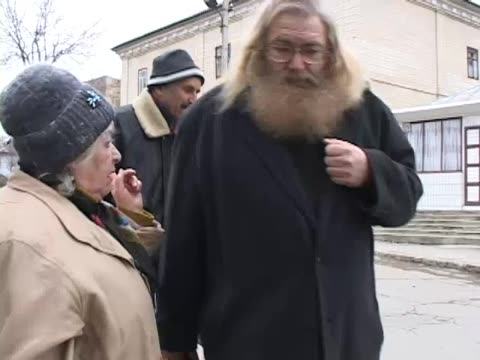
Barshteyn answers Lemster's questions about Sabbath in her parents' home. She describes her mother lighting candles on Friday evening and praying for the health of her children and grandchildren. She lists Sabbath foods such as soup with noodles, meat and kugel, and discusses whether cholent was made, recalling that her grandmother in Sharhorod made it in the oven. Lemster ends by asking about Yom Kippur kapores.
Barshteyn speaks about the Yom Kippur kapores custom, in which women used a rooster or money, and about the old shoykhet. Her mother performed it. Katz and Kerler pursue the details, and the talk is interrupted by traffic and logistics in Russian. She also mentions a roundup in which people were seized on the street and taken to a monastery. Katz closes by asking when the synagogue was built.
Beyond holiday celebrations, a mention of a roundup of people taken to a monastery, and talk about local places in Yiddish and Russian.
Barshteyn tells how the synagogue was built from an ancient wall found in the ground, many years or even thousands of years ago, according to her telling. She describes the large building, visiting cantors, and its size (some hundreds of worshippers). She says that during the occupation only Bukovinian Jews prayed there. She recalls the beautiful beis medresh, which was crowded with Romanian Jewish refugees, and says many died of disease. Kerler and Katz press her on dates; the passage ends with Russian talk about going to a café.
Adds the wartime refugee use of the beis medresh (Bukovinian and Romanian Jews) and the founding legend of the wall.
The team meets a Ukrainian man, Matsey (also called Volodya, surname Pidpaliuk (?)), who is about seventy and speaks Yiddish. He says he lived all his life on a Jewish street and worked with Jews. Asked by Kerler and Lemster, he points out the old shoykhet's house, recalls Jews hiding in a cellar during the war, and mentions playing with Jewish children. He talks about his five children, Soviet life and politicians, the Jews he worked with, and whether life was better with Jews.
Names the man and his background, and adds the wartime hiding in a cellar, his children, and Soviet-era talk.
At the interviewers' request, the man recites Yiddish rhymes and a song about a mother arranging a marriage, set in the attic, with the refrain that there is no money and no good looks. Kerler and Lemster explain that they are recording for a university and studying Yiddish, and they ask him to repeat it several times. They also ask in Russian about payment and about other songs.
The passage is mainly a song, and the interviewers explain the purpose of the recording.
Lemster asks the man about his father's name and what he worked at. He answers in Russian that he was formerly called a speculator and is now called a businessman. He recalls a Jewish militiaman named Berman (?) who helped someone wrongly accused. Kerler then asks whether he attended Jewish weddings.
The man describes Jewish weddings as lively and cheerful and says that Moldovan musicians played. He danced with Jews and had a Jewish friend (a name close to Yasha Moldovan (?)). Answering Lemster and Katz, he also recalls in Russian a Jewish schoolmate, Klara Minakur (?), and a friend who left.
Adds the musicians' origin, his Jewish friends, and a schoolmate.
The man says in Russian that friends call him though he has no phone. He tells how he slaughtered chickens, lambs and calves for Jews and says he kept five hens and a rooster. He describes Jews bringing him matzo and recalls Yiddish names of meats, and he repeats a Yiddish saying about a Jew with a Jewish soul. Lemster and Kerler keep asking for a song and for Yiddish words; a recogniser loop mars part of the passage.
Adds his own slaughtering for Jews, his poultry, matzo brought by Jews, and the request for a farewell song.
Mostly in Russian, the man tells how in Kazakhstan around 1955 he worked on a construction site, and a Jewish foreman asked in Yiddish whether he was a Jew. He answered that he was a Ukrainian who had grown up among Jews, and the Yiddish helped him. He tells a joke about Khaim at customs. Lemster and Kerler praise his Yiddish and ask for a proverb, a curse or an anecdote; he offers curses such as going into the ground and a black year.
Lemster asks the man whether he cooks Jewish dishes. He says he can make roast and fish, describing how gefilte fish is stuffed and what goes into the filling. He also names potato pancakes, with Lemster and Kerler supplying the Yiddish terms. The interviewers thank him and say farewell with good wishes.
Adds the food discussion and the closing farewell.
Brief exchange in which Lemster and Kerler ask about a place with music and a temple, apparently the synagogue and its past, with some years mentioned. The passage is largely unclear, and a Russian remark about an old cemetery follows.
At the old cemetery, Barshteyn explains that part of it was cleared for a road in Soviet times. Her mother helped gather the bones, and the gravestones of two tsadikim were left standing. She tells of the tsadikim's legendary powers and of Jews who emigrated to Israel having the graves repaired. Katz and Kerler try to read the Hebrew inscription (Naftali Hertz) and work out dates. She then takes them to her mother Brayne's grave and says a few words there.
Adds the Soviet-era road clearing, the legends of the two tsadikim, the reading of inscriptions, and the visit to her mother's grave.