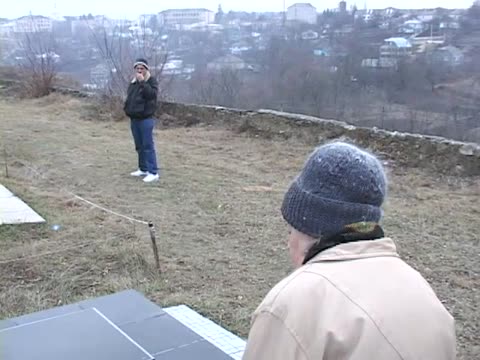
Barshteyn explains how the community takes care of the Sharhorod cemetery. She then points out her graves of her relatives. The camera then records footage of the old Jewish cemetery.
At the Sharhorod Jewish cemetery, Barshteyn explains that a man is paid to look after the graves. She points out her father's grave and says he was a kolkhoz bookkeeper. She wants the team to photograph a notable sculpted monument and talks about other tombstones.
Gives her father's occupation and the name on the family grave.
Barshteyn explains graves of various locals, as well as distant relatives. She then points out the place to wash the dead prior to burial ("toytshtibl").
Barshteyn reads inscriptions on graves of local people and of a cousin of hers, and comments on the rich families buried there. She and Kerler then identify the building where the dead were prepared for burial and discuss how it was used.
Names the graves she reads out, and discusses the purification house and the custom for the dead.
Barshteyn recalls a Romanian Jewish refugee doctor named Taykh (?) who came during the war. After he died, his body was placed in a metal box and taken to Romania. She also complains that her family paid money and got nothing for it.
In the van, Barshteyn sings 'Lomir zikh iberbetn' and then a song about a mother-in-law and daughter-in-law, and ends with a short Hebrew-flavored song about Jerusalem and Eretz Yisrael. Kerler and Lemster applaud and comment, and Kerler asks her to sing 'Rebbe reb Shneyer'.
Includes a third song about Jerusalem and Eretz Yisrael.
Barshteyn sings the Yiddish comic song 'Rebbe reb Shneyer', about a woman who asks the rabbi whether a dairy knife made meat can be made kosher. The rabbi answers with the remedy of burying it in the earth.
Barshteyn discusses Yiddish songs, particularly Yiddish songs from Bessarabia. She then remembers poor Romanian refugees, who died in the cold winter of 1941. Barshteyn witnessed the transport of the corpses to a mass grave.
Barshteyn says she forgot many songs and that Bessarabian songs were very sad. She then tells how Jewish refugees from Bessarabia and Moldova came to Sharhorod, carrying little. Many froze in the severe frost, and she saw with her own eyes how the frozen bodies were carted away to a common pit. She begins to speak of the Germans' arrival.
Mentions that the refugees came from Bessarabia and Moldova, and her remarks on Bessarabian songs.
Barshteyn speaks about her life during World War II when she was imprisoned in the Sharhorod ghetto. She describes the first two weeks under German occpation. According to Barshteyn, Germans kidnapped Jews off the street and she then describes how her German friend Julius successfully negotiated with the occupiers to free them.
Barshteyn tells of the German troops' first two weeks in Sharhorod, when they seized Jews off the streets, including children and old people, and held them in a large building. An ethnic German named Julius, who had worked at the mill and lived on good terms with the Jews, talked to the Germans, and the Jews were released without being shot.
Barshteyn addresses her life during the war when the Sharhorod ghetto was under Romanian command, as well as Julius's fate after the war. She then shares episodes of killing in the ghetto, as well as how Romanian Jews shared housing with local Jews.
Barshteyn continues about Julius, who stayed after the Germans left and later disappeared. She tells of a girl threatened by the Germans and her mother killed, and of the looting of shops and the mill when the war began. She describes how the Romanian Jews in the ghetto lived with local families and told them about life in the Romanian cities.
Mentions the killings in the town and the Romanian Jews living with local families.
Barshteyn says the Romanian Jews went home after the war and names several towns they came from. She returns to describing how many of them froze to death and were taken to a mass grave. Kerler asks whether 'Romanian Jews' meant Bessarabian Jews.
Kerler asks whether 'Romanian Jews' meant Bessarabian Jews, and she gives the refugees' places of origin.
Barshteyn characterizes Romanian Jewish communities from Bessarabia, Moldova and Romania. She then briefly returns to the German invasion of Sharhorod. Barshsteyn also talks about contemporary life.
Lemster and Kerler ask whether there were sayings about Jews from different places, such as Odesa or Bessarabian Jews. Barshteyn says only Jews from Moldova and Romania came to Sharhorod, and S3 adds a remark about survival. She also briefly returns to the German entry into the town and the locals' fear. The last part is a Russian and Yiddish exchange about the route of the van.
Includes questions about sayings on Jews from different places and the discussion of the route.
The team plays recorded music in the van. Kerler comments that one piece is Hasidic-style and unlike the older Yiddish songs, and that such songs are now made in New York and Jerusalem. The rest is garbled, with Russian remarks about the recording.